Joint base upgrades housing for military families
When the massive housing project got under way five years ago at McGuire Air Force Base and Fort Dix, the developer didn't have much to work with.More than 1,900 of the 2,300 military houses — taken over by United Communities L.L.C. — had to be demolished. The cramped rooms, small closets, steam radiators, and antiquated wiring and plumbing turned off many families. "We'd been thinking about moving here from Northeast Philadelphia [in 2007] and saw the previous housing," said Angel Hartman, a mother of two whose husband, Peter, serves in the Army. "It just wasn't taken care of."
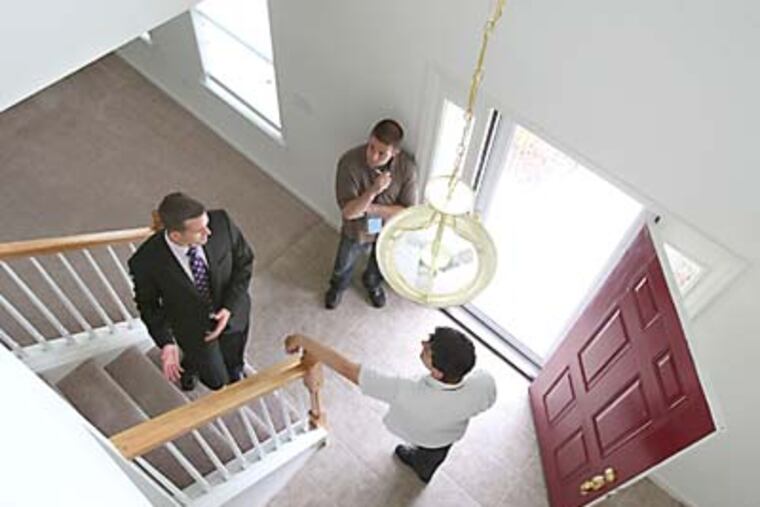
When the massive housing project got under way five years ago at McGuire Air Force Base and Fort Dix, the developer didn't have much to work with.
More than 1,900 of the 2,300 military houses — taken over by United Communities L.L.C. — had to be demolished. The cramped rooms, small closets, steam radiators, and antiquated wiring and plumbing turned off many families.
"We'd been thinking about moving here from Northeast Philadelphia [in 2007] and saw the previous housing," said Angel Hartman, a mother of two whose husband, Peter, serves in the Army. "It just wasn't taken care of."
That changed over the next few years, and on Tuesday, past and present politicians and military leaders celebrated the construction of hundreds of well-appointed homes rivaling those in suburbia.
They held ceremonies at the Saxton Community Center in the Falcon Courts North Housing Area and were joined by Hartman and her family, now among thousands of military families who call Joint Base McGuire-Dix-Lakehurst home.
"The housing is wonderful," said Hartman, 44, who has a three-bedroom house with a garage. "We've been here two years, and it feels like a community."
The houses come with central heat and air-conditioning, fiber-optic broadband cable, fully equipped kitchens, 2½ bathrooms, walk-in closets, and garages.
More than 1,635 single-family homes, duplexes and fourplexes were constructed at the base, and 435 homes were rehabilitated. All have three to four bedrooms and one- to three-car garages.
Improved housing has been cropping up at dozens of bases across the country as part of a national Military Housing Privatization Initiative that Congress and the Pentagon brass hope will encourage soldiers, airmen, and sailors to remain on active duty.
"We like the space," said Marine Gunnery Sgt. Jorge Ulloa, 30, an Iraq War veteran who has lived with his wife and two children at the base for the last year. "It's very accommodating."
The project will generate rental income for United Communities, situated at the joint base, as it manages and reinvests in the housing over the coming decades. The cost of the rent for the houses is dependent upon rank and is covered by the service member's housing allowance. The average is $2,335 per unit a month.
"Over the past five years, our desire was to one day see happy families making new homes for themselves within the walls we helped build and rehab," said Richard Haydinger, director of United Communities. "That day has finally come."
About 95 percent of the housing is occupied, he said. The development covers 817 acres of the base and is near 50 playgrounds, two swimming pools, and two community centers.
"We want the base to be so strong and so vital, it will never be closed," Haydinger said. "We built, own, and will manage the housing for the next 50 years."
Haydinger is a member of the Defense Enhancement Coalition, a local group that works with members of Congress to promote and find new missions for the base. Other members include former U.S. Rep. Jim Saxton and retired Army Col. Michael Warner, who once commanded Fort Dix.
"We've provided a great place for our families," Warner said during Tuesday's ceremony, attended by dozens of members of the community.
The privatized housing at the base is an achievement but "we all agree the job is not done," U.S. Rep. Jon Runyan told the crowd. "What we have in this community, this joint base, is a model."
"We already have a jewel," he said. "We just have to polish it a bit more."
Maj. Gen. William Bender, commander of the Air Force Expeditionary Center at the base, said the project "is an example of how privatized housing should work."
"It's an astounding feat, over the last couple years, to get where we are today," he said.
The construction program, established by Congress in 1996, touches all the services and involves at least 80 bases across the country.
The new and rehabbed homes at the joint base are one of the largest Air Force housing projects in history and the first Army-Air Force project of its kind at the sprawling military site.
It was financed by $274 million in Goldman Sachs-issued bonds, a $46.7 million government loan, and $17.3 million of owner equity and project revenues, officials said.
The construction provided work for 1,450 people, and the landscaping, garbage collection and snow removal services mean jobs for 30 others.
On Tuesday, the yards across the community were manicured and the new housing received rave reviews.
"It's best described by a lady I met this morning," Saxton recalled after the ceremony. "She said it was 'wonderful, outstanding, unbelievable.' "