Thousands of N.J. residents are still displaced after storm
MANAHAWKIN, N.J. - In what seems another life now, Mark Rahn was on the phone with his ex-wife, getting a lecture about the need to get off the barrier island town of Seaside Heights before Sandy hit the coast.
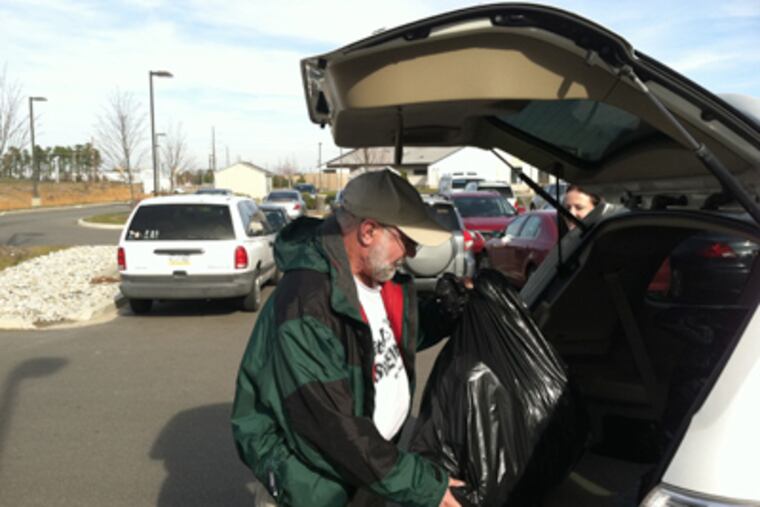
MANAHAWKIN, N.J. - In what seems another life now, Mark Rahn was on the phone with his ex-wife, getting a lecture about the need to get off the barrier island town of Seaside Heights before Sandy hit the coast.
"I was going to throw a hurricane party," Rahn, 54, recalled Tuesday.
So began a three-week odyssey that took Rahn through three storm shelters and a seemingly endless series of conversations with federal disaster officials as he tried to verify that he, and not a woman he briefly allowed to stay in his apartment, was entitled to the federal assistance she subsequently claimed.
"I called FEMA two days after the storm, but it was like I was never in the right place in the right time," he said. "Every time, I had to repeat the same thing over and over."
Thousands along the Shore remain in post-storm limbo, living out of hotel rooms, in shelters, and on relatives' couches as they wait for their houses to be repaired, FEMA trailers to arrive, or authorities to give the OK that their neighborhoods are inhabitable again.
Some barrier island towns, such as Seaside Heights and the southern section of Long Beach Island, have given no specific return date, and residents wonder whether they will be able to go home before summer.
While most have found somewhere to live in the meantime, as of Tuesday night almost 200 New Jersey residents were still staying in emergency shelters in Ocean, Middlesex, and Monmouth Counties.
Federal and state officials are working with families, but finding temporary housing for thousands of people is challenging, said Mary Gefford, spokeswoman for the New Jersey Office of Emergency Management.
"Some people want to stay as close to their area as possible, and that can be a challenge," she said. "There's a variety of reasons."
At St. Mary of the Pines Catholic Church, behind a shopping mall in Manahawkin, a handful of families walked the hallways Tuesday, shuffling between the gymnasium where beds were set out and the television room.
The shelter was closing down, with the last of the residents to relocate before the end of the week.
A shortage of apartment space and difficulties getting FEMA assistance had held up many residents, but with those roadblocks largely out of the way, residents had started to flow out quickly over the last week, said American Red Cross volunteers running the shelter.
"All the easy cases are gone now," said Sid Farcey, a Red Cross volunteer who flew in from Missouri.
Once out of the shelters and into a hotel, another kind of waiting begins.
Robert Snyder, an optometrist on Long Beach Island, fled the storm and spent two weeks at the Holiday Inn in Manahawkin.
"It was the not-ever-knowing that was the worst. We booked two days to start. We figured it would be fun, stay in a hotel for a couple days. And then the lights went out," he said. "You would just listen to all the stories. Each one worse than the last."
Snyder and his wife, Lauren, were allowed to return to their home last week, but some of his staff were still sleeping at relatives' homes.
"We just try and keep smiling," Snyder said.
For those who still do not know when they will be able to return home, the goal is to find what FEMA officials refer to as "semipermanent housing."
That could be a FEMA trailer or a rental apartment or possibly a house at Fort Monmouth, the shuttered Army base that the state is working to open soon to storm victims.
Rahn, who said he suffers from an anxiety disorder, said he had yet to start looking and was happy just to be getting out of the shelter. Arrangements had been made for him at a motel in Point Pleasant.
"Finally," he said.