Rescued sea turtle finds home in aquarium's new exhibit
He should have died. Twice. First, when he was born too weak to scramble from his sandy birthplace and scuttle to the sea. Rescued once, the tiny loggerhead sea turtle came down with pneumonia, which damaged his lungs. His hind fins didn't develop properly, making a swim to the ocean deep impossible.
He should have died. Twice.
First, when he was born too weak to scramble from his sandy birthplace and scuttle to the sea. Rescued once, the tiny loggerhead sea turtle came down with pneumonia, which damaged his lungs. His hind fins didn't develop properly, making a swim to the ocean deep impossible.
But with careful veterinary care, Ozzy survived. Now, the year-old loggerhead will be a star at Camden's Adventure Aquarium turtle exhibit, which opens Monday.
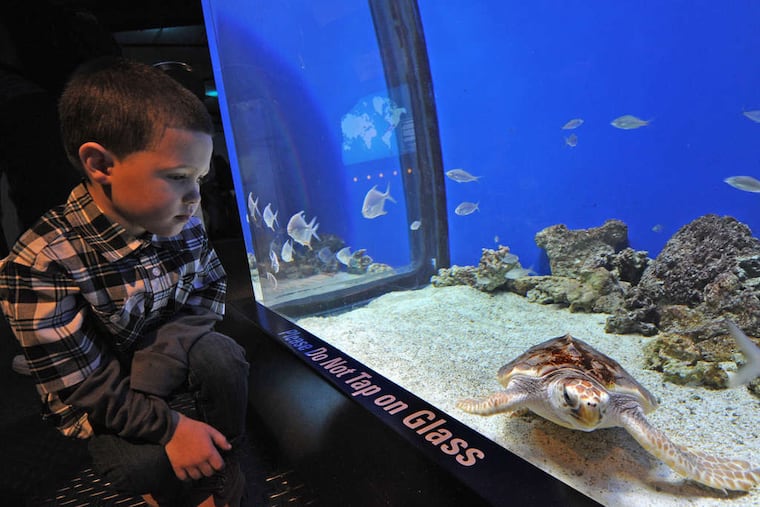
The exhibit, called Turtles: Journey of Survival, features 19 turtle species that live in water, mud, and even sand. The three-month exhibit hasn't fully opened, but children at the aquarium Thursday noticed Ozzy right away.
"Cool! A turtle!" a blond boy shouted as he and his father walked past Ozzy's blue tank.
"I think it's all about the face," said Nikki Grandinetti, exhibit curator.
Across from Ozzy, Bob, a 21-year-old, 450-pound loggerhead, swam by a window into the aquarium's main tank, where sharks, fish, and stingrays live. Bob is the largest of the three adult sea turtles in the tank.
"Turtles look like they're flying in the water; they look magical," Grandinetti said.
Starring in a Disney film doesn't hurt either. Loggerheads named Crush and Squirt were featured in the 2003 animated film Finding Nemo. The movie wasn't "biologically accurate," Grandinetti notes, but it did help children develop an attachment with creatures they can't pet.
Endangered
Loggerheads are an endangered species found along the East Coast and in coastal waters in temperate and tropical climates in the Pacific and Indian Oceans, according to the National Oceanic and Atmospheric Administration.
Typically, loggerheads flap their fins and swim about, occasionally coming to the surface for air. Ozzy, who weighs 5.72 pounds and is about the size of a dinner plate, rests on the bottom of his 1,700-gallon tank. His lungs don't fully inflate, so he tends to sink. He can swim and surface for air but is less active than other turtles because his hind flippers suffered muscle or nerve damage, aquarium officials said.
As he grows, he'll be moved to increasingly larger tanks, eventually to the main 760,000-gallon tank.
On Thursday, Ozzy sat placidly at the sandy bottom of his tank. As iridescent white fish swooped around him, Ozzy tucked his front fins underneath him like a cat. Left in nature, "he'd probably be somebody's food," Grandinetti said.
Like all turtles, Ozzy has a tendency to bite, although it is usually rocks, plants - or perhaps a helping hand - that end up in his mouth. He doesn't bother the fish.
Turtles "explore the world with their mouths," Grandinetti said.
Adventure Aquarium partnered this year with the North Carolina Aquarium at Pine Knoll Shores to help more loggerheads survive. Many females nest on North Carolina beaches, each turtle burying as much as 35 pounds of eggs in the sand, according to NOAA. When the turtles hatch, they must claw their way out and run to the ocean.
The babies make their journey at night, when they're less likely to be seen by predators. They instinctually use the light of the moon to find the sea, so lights from homes and businesses along the shore confuse them. Some run the wrong way. Others, like Ozzy, are too weak to reach the water or emerge from the sand.
Volunteers from the North Carolina Wildlife Resources Commission watch the nests, retrieving any turtles that do not complete the journey. They are kept by aquariums across the country for one year and then released.
Volunteers dug up Ozzy in July 2011 and took him to the North Carolina aquarium. That's when veterinarians noticed that he wasn't growing as quickly as the others and that his hind fins had slight deformities.
The North Carolina aquarium called Adventure Aquarium to offer them a 3-month-old loggerhead to monitor for one year. They also asked whether there was space for Ozzy in Camden.
Adventure Aquarium eagerly accepted, knowing that it had the room and staff to care for both and that visitors could watch Ozzy grow up.
Name that turtle
Along with Ozzy, Camden now has a grapefruit-sized 3-month-old loggerhead on exhibit. The tiny turtle doesn't yet have a name: The aquarium will hold a Facebook contest to pick one. Next year, the turtle will be tagged with a locator device and released into the ocean. Adventure Aquarium plans to monitor his life at sea, updating patrons on his whereabouts.
The aquarium hopes to foster baby loggerheads every year, caring for and tracking turtles for years ahead, said Kim Walker, an aquarium spokeswoman.
at 856-779-3237, jfarrell@phillynews.com, or @joellefarrell on Twitter.