Remembering a giant advocate for many causes
His funeral drew judges, lawyers, officials, civil rights activists, and marijuana-legalization advocates from around the country. William H. Buckman, a Moorestown lawyer known for his pivotal role in exposing racial profiling in New Jersey, was remembered by those and others after his death two weeks ago at age 61. He committed suicide in a Mount Laurel motel room, prompting disbelief and grief in the legal community, where he was revered for his many accomplishments.
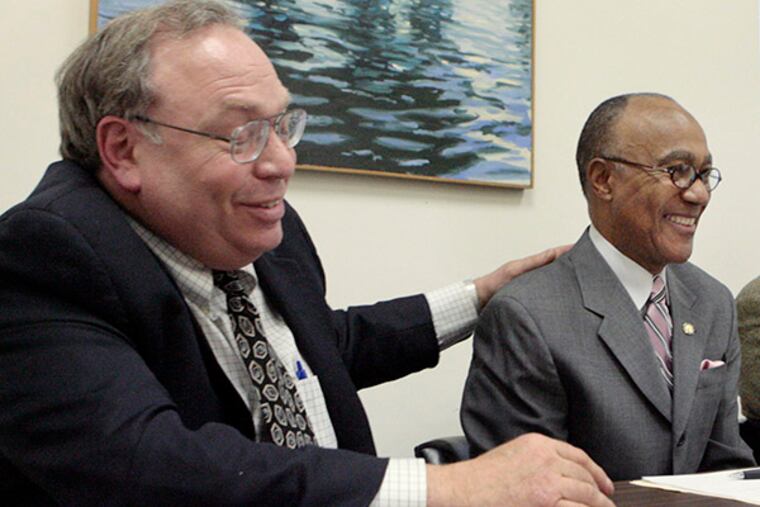
His funeral drew judges, lawyers, officials, civil rights activists, and marijuana-legalization advocates from around the country.
William H. Buckman, a Moorestown lawyer known for his pivotal role in exposing racial profiling in New Jersey, was remembered by those and others after his death two weeks ago at age 61. He committed suicide in a Mount Laurel motel room, prompting disbelief and grief in the legal community, where he was revered for his many accomplishments.
The solo practitioner died the day before the U.S. Court of Appeals for the Third Circuit handed him a victory in a case in which he represented the estate of a suspected North Jersey mob figure. Buckman had advanced a novel argument, saying Frank Lagano's civil rights were violated when law enforcement leaked his role as a confidential informant. Buckman contended that the leak led to Lagano's being killed in an alleged organized-crime hit.
Buckman had not received advance notice of the ruling, according to his wife, Shellie.
Earlier in his career, Buckman headed a legal team that proved that the state police were illegally targeting minorities in their stops and searches on the New Jersey Turnpike. A 1996 court ruling in State v. Soto was the first in the nation to affirm that racial profiling existed, and led to oversight by the U.S. Department of Justice and reforms in police practices.
"Bill fought for justice and equality. He didn't do this for fame or money, but because he believed it was right," his wife of 25 years, Shellie, said.
While achieving professional success, he had long battled depression, said Shellie Buckman, a social worker aiding geriatrics. He had sought counseling.
"Like cancer, ALS, MS, or Parkinson disease, depression is a medical issue. Bill took care of it through treatment; he did not drink or self-medicate," she said. "In spite of some dark times, he always made me laugh, he was loving, giving, and kind, and I miss him so much."
In May, her husband had open-heart surgery and a bypass operation that left him fatigued, she added. Some medical studies have found depression to be a complication of this surgery and she wonders if that may have contributed to his suicide.
"In the beginning [after the surgery] he seemed better - then things overcame him. He couldn't go back to work and things were piling up," she said.
The couple lived modestly in a small ranch house in Cherry Hill. He frequently did pro bono work or charged nominal fees to defend people who were struggling to pay bills. Even when approached on the street by homeless people, her husband would always give them some money, she said.
The two had been childhood friends, and after they married, they had two children, Ethan, a brewmaster in Philadelphia, and Emilee, who attends culinary school.
At the funeral at Platt Memorial Chapels in Cherry Hill, attended by a few hundred people, the two children spoke of their father's deep devotion to the family. Ethan recalled his father's love of gadgets, particularly remote-controlled helicopters. On one sleepless night, his father sat on the floor of the parlor and flew the choppers around the room for fun and to release stress, Ethan said.
Dan McMahon, a semiretired college professor, said he began his close friendship with Buckman when they were editors of the student newspaper at Richard Stockton College in the early '70s. To make extra money they would go clamming at the Jersey Shore and earn a penny a clam, he said.
McMahon said they remained close and their families spent the last 15 years having Thanksgiving dinners in Rutland, Vt., where the Buckmans owned a 14-acre property. There, Buckman rebuilt an antique tractor and tinkered with carpentry projects, he said.
Buckman's activism began after he founded the student union at Stockton and organized protests on campus, McMahon said. Later, in Washington, he was arrested during an antiwar demonstration.
After he graduated from Rutgers-Camden Law School in 1978, he became an assistant public defender in Gloucester County, where he began looking at civil rights issues.
Justin T. Loughry, a lawyer who worked on Soto with Buckman, said earlier that Buckman received only $20 an hour because he volunteered much of his time and refused to give up. "We knew in our collective bones that the police were stopping minorities . . . and knew nothing was being done," Loughry said.
Buckman was also part of a legal team with nationally known lawyers Barry Scheck, who founded the Innocence Project, and Johnnie Cochran that won settlements in a high-profile case in which state police pulled over four unarmed black students on the turnpike in 1998 and shot at their van, injuring three of the students.
Later, Buckman was named president of the Association of Criminal Defense Lawyers of New Jersey and was on the board of trustees of the National Association of Criminal Defense Lawyers and the ACLU of New Jersey.
He also defended police in discrimination cases and when they claimed they were improperly charged with misconduct. More recently, he won a $5 million settlement in a case last year against Lindenwold Borough after a police officer released a German shepherd that bit a cabdriver following a traffic stop.
Another of Buckman's interests was working to change marijuana laws and representing clients who were prosecuted for possessing small amounts of the drug.
Diane Fornbacher, a marijuana activist who lived in Collingswood before moving to Colorado last spring, said she asked Buckman to represent her a couple of years ago. The state's child protection agency had threatened to search her house and charge her with neglect after her 10-year-old son mentioned "hemp" in a discussion at his school.
Fornbacher said that she became a close friend of the attorney, and that he told her he believed people had "a right to consume cannabis so long as you do no harm, a civil right to be left alone and have privacy," and also "to choose death with dignity." She said his devotion to protecting people from government overreaching was "full immersion."
She said his absence will be deeply felt.
Chris Goldstein, another marijuana activist, said Buckman had freely offered the use of his conference room and legal advice to promote the cause. "He was a rock of our movement," Goldstein said. When Goldstein was arrested for lighting up during a protest in Philadelphia, Buckman stepped in to represent him pro bono.
Charles Tyson, South Harrison's first black mayor, asked Buckman for help after he received phone calls laced with racial slurs in 2007 and felt he was being harassed by police. "Bill said it was outrageous that all of this happened to a mayor who had been elected," Tyson said. "He was good - it wasn't about how much money he could make, but he was out to get justice."
Tyson said he worries who will take Buckman's place now that his office has been closed.
"That man is going to be missed," Tyson said. "There's going to be a whole lot of people out there now hanging by a thread looking for that civil rights lawyer who is going to work for them and not be charged a lot of money."