She uses sand to help others find peace
A distraught-looking woman in a green dress gazes up at the crucified Jesus as Buddha weeps nearby. Four boys lock arms in a circle dance, and a lion, a turtle, a bear, and a rabbit - representing the spirits of the dancers - look on.
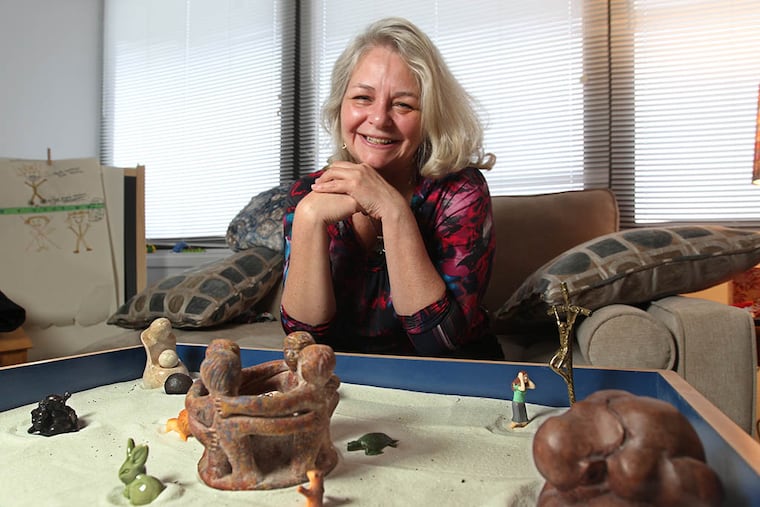
A distraught-looking woman in a green dress gazes up at the crucified Jesus as Buddha weeps nearby.
Four boys lock arms in a circle dance, and a lion, a turtle, a bear, and a rabbit - representing the spirits of the dancers - look on.
Clusters of American Indian "singing stones" and scattered seashells complete the evocative tableau that Carolyn Piro has arranged in a tabletop box of soft, sugary sand.
"Sand-tray therapy helps people work out situations in their lives," says the Cherry Hill therapist, who suggests to clients that they "build me a world."
The world in this particular tray represents Piro's own, which has been marked by struggles over family and faith.
She's the divorced mother of four sons, three of whom have special needs. The experience inspired her to leave IT consulting behind and become a therapist.
"The end of my marriage, and my sons being diagnosed, were a test of my religion," says Piro, 50, who was raised Catholic.
"I thought that following the dogma would bring me answers and comfort. It only made me ask more questions," she says.
"Now, I consider myself a human being who doesn't know the answers. . . . My guiding rule is love."
Piro, an engaging woman with a heartfelt laugh, goes on to further explain the tray she created for our interview at her Kings Highway North office.
"The subconscious always comes out in the tray, whether the person is trying to say something or not," she says. "The tray gives voice to that which we don't have a voice for."
The Moorestown native earned a master's degree in social work from Rutgers-Camden and began seeing clients in 2013. She launched a solo practice in October called Pax Lumen (Live in Peace, Walk in Light) Behavioral Health Services.
She primarily treats adults and children affected by trauma, and those on the autism spectrum.
"Carolyn is one of the strongest women I've ever met," says a Cherry Hill retiree who began seeing Piro last year because of anxiety. Concerned about her privacy, she asked that I not use her name.
"I'm dealing with a lot of feelings, things I never even thought were stored in my memories," the client says. "We're taking it slow, and she's been wonderful."
Piro is trained and certified to use sand-tray therapy and other therapeutic tools; she also employs eye-movement desensitization and reprocessing, or EMDR, which uses patterns of flashing lights.
But the sand-tray technique, which is rooted in the work of the pioneering Swiss psychiatrist Carl Gustav Jung, strikes me as an elegantly expressive way for clients to connect with themselves and with their therapist.
It seems plausible that the selection as well as the arrangement and proximity of objects - Piro has hundreds of items from which clients can choose - could suggest unrecognized correlations among events. Or undetected patterns in a person's life.
"Jung believed that everything we need to heal is inside of us, but that the intellect blocks access," says Mary Pat McGeehin, a partner at the Lighthouse Counseling & Sand Play Training Center in Monmouth County. That's where Piro completed 40 hours of training last year.
"Sand is primal and soothing. Creative juices can start to happen," McGeehin says. "The person can access a very childlike openness [that] gets around the defenses of the intellect."
Piro's four sons range in age from 13 to 22. One has Down syndrome, another has a condition called Fragile X syndrome, and a third has Autistic Spectrum Disorder. They have attended or continue to attend Cherry Hill schools; Piro shares custody with their father.
"If it hadn't been for the boys, I never would have been able to be in touch with people who've been exposed to suffering," Piro says.
"The universal story of living life the best we can with what we get," she says, "that's what I've had to learn."