Mt. Laurel monastery will close
It was with a heavy heart that a Cistercian monk who headed a monastery in a heavily populated South Jersey town prepared last July for a trip to the Casamari Abbey. Up for debate in a cloistered hall just south of Rome was the future of his spiritual community, established 54 years ago on about 120 acres of farmland off a bumpy dirt road in Mount Laurel.
It was with a heavy heart that a Cistercian monk who headed a monastery in a heavily populated South Jersey town prepared last July for a trip to the Casamari Abbey. Up for debate in a cloistered hall just south of Rome was the future of his spiritual community, established 54 years ago on about 120 acres of farmland off a bumpy dirt road in Mount Laurel.
The Rev. Lino S. Parente was concerned because he and another monk at Our Lady of Fatima monastery had retired from their longtime jobs of managing and preaching at the adjacent St. John Neumann Roman Catholic Church, leaving only two other monks fully employed at the monastery, recalled James Cattanea, a longtime church deacon and close friend of Parente's. The monastery had been unsuccessful in attracting postulates.
Upon his return a few months later, Parente said in a brief interview that a decision had been made during the meeting at the abbey. "Officially, the monastery is closed," the prior said in a thick Italian accent, and shook his head sadly. But he was not willing to publicly disclose any details.
Still unknown is what will happen to the land, prime real estate valued at more than $1 million and zoned for housing and agricultural use in a Burlington County town with a highly regarded school system. In recent months, Parente had not responded to calls asking for comment.
On June 23, Parente, 76, died in his sleep at the monastery. His death, from a heart condition, may hasten the shuttering of the monastery. It was the only one the Casamari Abbey opened in the United States; others are in Brazil as well as Spain, Italy, and other parts of Europe.
"I cannot keep [the monastery] open without work," Parente had said after his return, standing in the foyer of the brick, dormitory-style building, where he and another Italian-born monk had lived with two monks from Eritrea. He said he needed time to find a solution and was trying to keep everyone "calm" in the meantime. The pungent smell of simmering tomato gravy wafted through the quiet corridors.
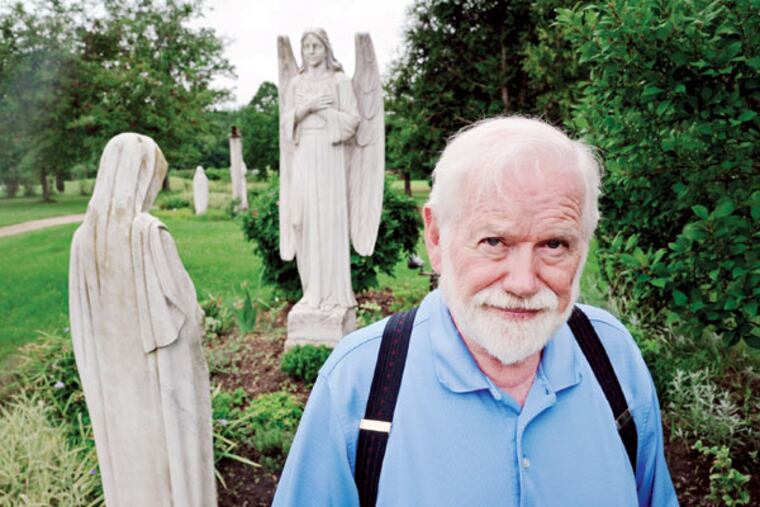
Last week, two auditors from Casamari Abbey were in Mount Laurel examining the assets of the monastery. They are preparing a report with details about the buildings, the property, the monks' three cars, the imported life-size marble statues in the rosary garden, and the bank accounts, Cattanea said.
Rayanne Bennett, a spokeswoman for the Diocese of Trenton, said she was not aware of any potential sale of the land adjacent to the diocese's property. "We have not been informed of the Cistercians' intent to withdraw from the monastery and sell the property. It is part of the diocese's long-standing agreement with the Cistercians that we have the right to first refusal, but no discussions on this matter have taken place at this time," she said.
The diocese acquired the property in 1957 from a farmer who had donated his 1890 farmhouse and land off Walton Avenue to be used for a religious purpose. In 1961, the diocese gave about 100 acres of the property to the abbey so that the monastery could be established, Bennett said.
When Bishop George Ahr created the St. John Neumann parish in 1978, he asked the monks to administer it and provide church services. The property was subdivided, with the monastery getting a deed for 100 acres and the diocese getting 20 acres for the new church, which now has 3,000 families.
The monks, who take a vow of poverty, would receive stipends for their service, while some of the collection money would go to the maintenance of the monastery, church, and grounds, according to a parish bulletin that described the arrangement made between the Cistercians and the bishop.
A dozen years ago, the monastery deeded about 20 of its acres to the township in a land swap so that a larger buffer could be created between its grounds and a new development.
According to 2015 property tax records, the 80 acres of land the monastery now owns is assessed at $1.3 million. The property has a "farmland assessment" that lowers the taxes. The land is zoned for residential, agricultural, and horticultural use, effectively allowing it to be developed if sold.
Several housing and condominium developments have sprung up in the vicinity, along with industrial parks, recreational fields, and preserved open space.
In his July 3 eulogy for Parente, Cistercian monk Maurizio Nicoletti poetically described the monastery's "mission in America." To applause from nearly 900 people who attended the funeral, Nicoletti said, "Before, there was nothing . . . a garden. . . . Now the sun shines on a great parish - this is the work of God."
Nicoletti said that he and Parente took their religious vows together nearly 50 years ago, when both were living in Italy. Later, when Parente was named the monastery's prior, he sent out a call for other monks to join him in New Jersey, and Nicoletti volunteered to go. Nicoletti said he "became one of the family."
"For years, we were side by side, working, praying, really as brothers," Nicoletti, 77, said. In recent years, when the two monks reached the diocese's mandatory retirement age of 75, they were replaced by a diocesan administrator and stopped celebrating Sunday Mass each week. Parente also was asked by Bishop David O'Connell to retire from his role as the pastor in charge of the church, a position he had held since 1989.
A few parishioners said after the funeral that many families had been upset with the bishop's decision to replace Parente and that they had left the parish in protest. The bishop had discretion to reject the resignation but said it was a policy decision.
Monks Awte Weldu, 62, and Musie Tesfayohannes, 61, who are from Eritrea, continue to preach at the church. Nicoletti occasionally assists with services.
"This monastery was not closed, but it was being closed," Cattanea said. Parente's influence, he said, had kept it open a little longer. Cattanea said it was unclear when the operation will be shut, but it could be a year or two from now, based on the pace of conducting business in Italy. The three monks likely would be reassigned to another monastery, he said.
At its peak, the monastery had as many as 10 monks, Cattanea said. But it started with two monks, who lived in the original farmhouse and created a rosary garden around a lake for prayer and contemplation. They raised chickens and pigs, and tended a garden behind the building. Later, Nicoletti planted grapes and made wine for the monks and their guests.
"You had a holy presence here," Cattanea said. "The monks have great wisdom, and are very special. That's why people from all over came to church here."
856-779-3224@JanHefler