Three new laws aim to protect beekeeping in New Jersey
Three bipartisan, unanimously passed bills offering new support and protection to thousands of registered beekeepers and tens of thousands of bee colonies in New Jersey were signed into law Friday by acting Gov. Kim Guadagno. The laws take effect immediately.
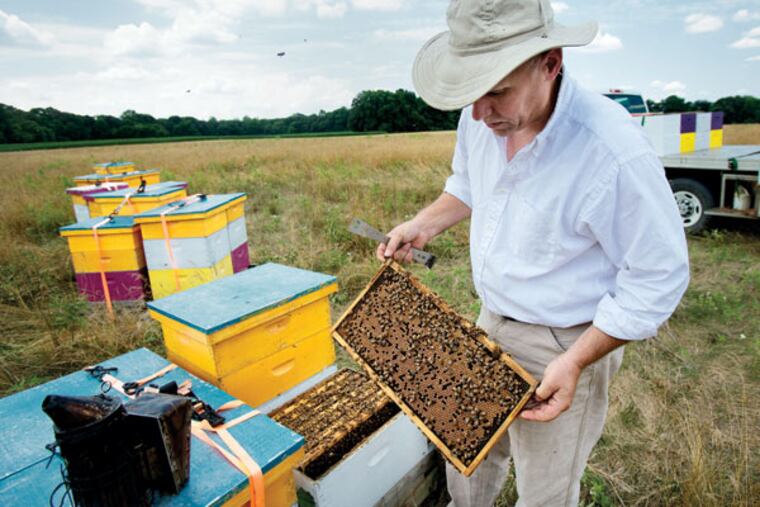
Three bipartisan, unanimously passed bills offering new support and protection to thousands of registered beekeepers and tens of thousands of bee colonies in New Jersey were signed into law Friday by acting Gov. Kim Guadagno. The laws take effect immediately.
"Bees are central to New Jersey's rich agricultural history, and, more important, to New Jersey's agricultural future," Guadagno said in a statement. "These bills collectively provide appropriate protection to New Jersey's growing beekeeping industry, support the Garden State's commercial and recreational bee industry, and heighten public awareness of the importance of bees to our food chain."
New Jersey's 20,000 bee colonies represent a $7 million honeybee industry for the state and contribute to the production of nearly $200 million worth of fruit and vegetables annually, according to the New Jersey Department of Agriculture.
The honeybee is the state's official insect and is among the best-known, popular, and economically beneficial insects, officials said.
More than 3,000 registered beekeepers across New Jersey tend to honeybees as well as other bee species that are critical to crop pollination, including mason and bumblebees.
"These bills are important to the health and vitality of the beekeeping industry in New Jersey," state Agriculture Secretary Douglas H. Fisher said in a statement. "Bees are some of the most interesting creatures in nature and are essential to the pollination of our crops."
Honeybees live in large colonies of up to 80,000 bees, officials said. More than 80 percent of U.S. food crops are pollinated by honeybees, the state Agriculture Department said.
Pollination is crucial for the state's blueberry, cranberry, pumpkin, squash, strawberry, peach, and apple crops as well as a wide variety of annual and perennial flowers and tree species. Some farms pay beekeepers to place bee colonies in their fields to enhance pollination.
"These bills will aid commercial beekeepers in continuing to provide vital pollination services and give clear, enforceable guidance to municipalities," said Janet A. Katz, president of the New Jersey Beekeepers Association.
The first measure signed into law Friday extends the Right to Farm Act protections to commercial beekeepers who are producing honey or other agricultural or horticultural apiary-related products, or providing crop pollination services, worth $10,000 or more annually.
The Right to Farm Act, enacted in 1983, protects responsible commercial farmers from public and private nuisance actions and unduly restrictive municipal regulations.
The second law requires that regulation of beekeepers, and the breeding or keeping of honeybees and any related activities, be done exclusively at the state level by the Agriculture Department. Activities could include use of honeybees for pollination and reproduction, the sale of honey bees, or the production of honey and other apiary products from honeybees.
Because honeybees have been plagued by a variety of introduced insect and bacterial parasites, they are rarely found in natural colonies, officials said.
The law also allows the department to delegate to a municipality the responsibility for monitoring and enforcing the standards within the municipality's borders.
The third law provides a civil penalty of up to $500 for each offense when a person intentionally destroys a man-made native bee hive. A man-made native bee hive is defined as a tube or other apparatus in which native bees may nest, and which is installed to attract native bees.
Under the law, a native bee is a species native to New Jersey that does not produce honey, but does provide for the pollination of crops or plants, or other agricultural, environmental or horticultural benefits.
"Bees can be mistaken by humans as predators, but the truth is that they are unlikely to sting unless disturbed," said State Sen. Jeff Van Drew, (D., Cape May), who sponsored all three bills. "We have to continue to educate people about honeybees and their invaluable contribution to our agricultural community.
"The fact is that millions of dollars of crops are grown in New Jersey each year, and with much of them dependent upon pollination from bees, protecting them is critical," Van Drew said. "These laws go a long way to improve protections and to ease restrictions on beekeepers who are working to support and maintain this important industry."
State officials "know of the problems faced by the industry with a decline in the honeybee population," said Assemblyman Bob Andrzejczak (D., Cape May), who sponsored two of the three measures. "The new laws will help to protect this industry and our farming communities."