Audubon Park's slice of bliss
If you live in Audubon Park, your neighbors are probably "the people you grew up with," says Mary Stokes, who moved there with her parents in 1941.
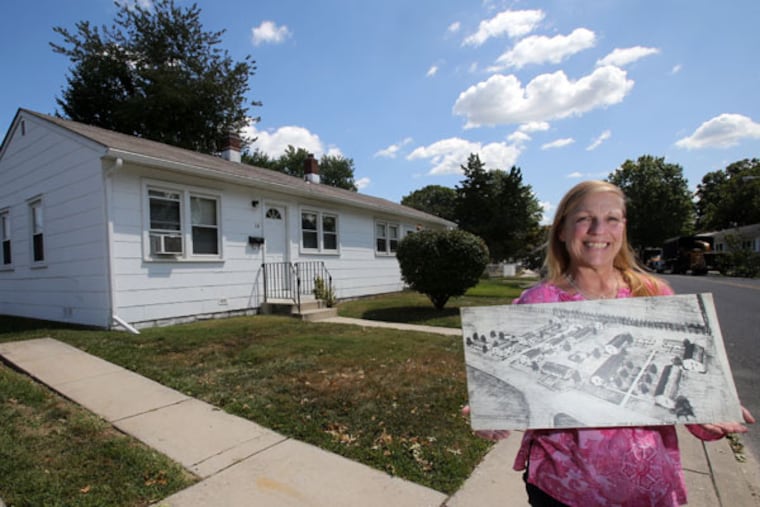
If you live in Audubon Park, your neighbors are probably "the people you grew up with," says Mary Stokes, who moved there with her parents in 1941.
Stokes is 74 now, and she and other residents love the villagelike coziness of this unusual Camden County municipality.
Audubon Park is a single square mile between Nicholson Road, the Black Horse Pike, and Peter's Creek. It has no stores, schools, or churches, and the real estate is collective property.
"There were supposed to be Audubon Parks all over America," says Kristin M. Szylvian, whose book The Mutual Housing Experiment - New Deal Communities for the Urban Middle Class was published in July by Temple University Press.
Produced through an ambitious collaboration between labor unions and Roosevelt administration progressives eager to build low-cost, high-quality housing for defense workers as World War II loomed, Audubon Park was constructed for $1.4 million in 1941.
It is among 32 mutual housing communities that have endured nationally, a radical experiment that time has rendered almost quaint.
"It's an old-fashioned town," says Lisa Galiano, 48. She runs the kitchen at the Thursday night bingo games that benefit the volunteer fire company in the borough of just over 1,000 people.
Prospective residents - there's a waiting list - who meet income and credit requirements can purchase a share in the corporation that owns and manages all 499 units of multifamily housing.
The one- and two-story attached dwellings must be painted white, which gives Audubon Park the look of a military base in a park. But many people have dressed up their homes with porches, patios, and landscaping. American flags fly everywhere.
"I love this town. It's like a big family," says Mayor Larry Pennock, who succeeded his father, Donald, in office ("he handed me the gavel").
Shareholders can live in their units for as long as they pay a monthly service fee that covers such things as utility costs and property taxes; many families pass their shares/units to children and grandchildren.
Other mutual housing communities in the region include Bellmawr Park in Camden County and Pennypack Woods in Northeast Philadelphia. All were intended as "models for postwar development," says Szylvian, an associate professor of history at St. John's University in New York.
Plans to promote mutual housing as an option for workers ineligible for public housing but without the means to own conventional homes were doomed after the war by political squabbles and the rise of single-family suburbia.
But for generations of working-class South Jerseyans, Audubon Park has continued to provide a modest piece of the American dream: a home and a yard of one's own, in a real community with high levels of participation in civic life.
"Where else can you live in the state of New Jersey and have what we have here, at an average monthly cost of around $900? Nowhere," says Denise Balderama, president of the board of trustees of the nonprofit Audubon Mutual Housing Corp.
Adds Balderama, 53, who grew up in the borough: "This is an ideal utopia, basically."
Spend time in Audubon Park and you'll hear grumbles that utopia isn't what it ought to, or used to, be. I was told of unhappiness with corporation and borough leaders and concerns about rising "rents," as residents of "the Park" call them.
But at the impressively organized Thursday night bingo, where about 100 people sat at long tables in the municipal gymnasium, I heard stories like one from Charlene Lefebvre.
"My husband, Kelly, and I - he's 92, retired from the Navy - we have a beautiful backyard and a patio with umbrellas," says Lefebvre, 80, who worked for many years as a waitress in Atlantic City.
"Everybody walks by, and they talk to us. They bring treats for my dog," she says, adding, "I know every place changes, but there's just something about Audubon Park."
Szylvian, who will speak about her book on Friday at Rutgers-Camden, says Audubon Park and other mutual-housing communities are an overlooked success story.
"We don't have enough low-moderate income housing distributed evenly through our region," says Natasha O. Fletcher, associate director of the Center for Urban Research and Education (CURE), which is hosting the Rutgers-Camden event.
"So I think now is the time to look at new, or revisit old, ideas of creating innovative housing opportunities and building communities."
Why not? An old idea has been working quite well in Audubon Park for nearly 75 years.