Saddlertown holds tight to its African American history
When Ray Fussell was growing up, Saddlertown's two streets were made of dirt. But for Fussell and others with roots in Haddon Township's historically black hamlet - started by former slave Joshua Saddler in 1842 - Beechwood and Rhoads Avenues were paved with gold.
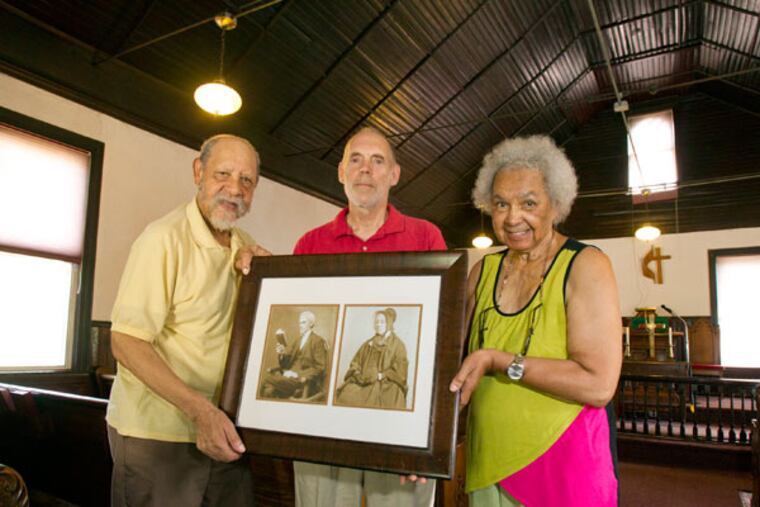
When Ray Fussell was growing up, Saddlertown's two streets were made of dirt.
But for Fussell and others with roots in Haddon Township's historically black hamlet - started by former slave Joshua Saddler in 1842 - Beechwood and Rhoads Avenues were paved with gold.
"All of the people up and down the block left their doors unlocked," recalls Fussell, 85, describing Saddlertown's close-knit, extended-family ambience.
The gentlemanly retired technician is one of three Saddler descendants living in the tucked-away neighborhood off MacArthur Boulevard.
"Joshua Saddler's daughter, Lucinda, was married to my great-great-grandfather," he says. "And my father rang the bell in this church on Sunday."
"This church" is Rhoads Temple United Methodist, built by a Quaker couple in 1893. Charles and Beulah Rhoads wanted to ensure that Saddlertown residents wouldn't have to walk all the way to Haddonfield for worship.
Fussell's grandmother Margaret was one of the founders of the church at 504 Rhoads Ave., where the fourth annual "Saddlertown Day" celebration is set to begin at 11 a.m. Saturday, Sept. 19. Everyone is welcome.
"Saddlertown has been considered a stop on the Underground Railroad, but I don't consider it a stop," says Fussell, who's an artist and a photographer as well as a history buff.
"I consider it a destination."
Fussell and a friend, Oaklyn Councilman Chuck Lehman - the borough's unofficial historian - are among the volunteers behind Saddlertown Day.
I meet up with them on Rhoads Temple's first floor, in space that once housed a school. The facility saved Saddlertown youngsters from having to walk to Lawnside to get an education.
Although Saddlertown at its mid-20th-century peak had fewer than 50 residents, "people come to Saddlertown Day from near and far," says Lehman, 71. "It's as if there was a Saddlertown diaspora."
A retired Philadelphia public school history teacher, Lehman met Fussell while researching Oaklyn's long-gone Fusselltown neighborhood 15 years ago.
Saddlertown and Fusselltown were among dozens of unincorporated communities where African Americans settled within larger South Jersey municipalities in the 19th and 20th centuries.
Some, like Cherry Hill's Batesville, still exist as distinct neighborhoods, while others have all but disappeared. Saddlertown consists of the church and just 20 houses of various vintages, many of them now home to white families.
"The history of South Jersey is a tapestry of all different kinds of folks," says Lehman, who is white. "It's too easy to forget how communities like Saddlertown sprang up, and how they thrived."
"It's important for people to know what this area was, once upon a time," says Andrea McDonald, a Saddler descendant and Fussell cousin who lives in Lindenwold.
A retired grants administrator, McDonald collaborated with historian and author Sandra White-Grear on a deeply researched history of Saddlertown, completed in 2009 and available on the township historical society's website (haddontwphistoricalsociety.org).
Saddlertown "provides proof of black folks' survival, and more," McDonald says. "I am proud that in 1842 a free black man was able to purchase land and maintain it."
Saddler did more than maintain his five acres. He called in his will for the adjacent forest to be preserved.
And 120 years after Sadler's death, his will helped galvanize public support for protecting what's now known as Saddler's Woods from development.
"The Saddler's Woods Conservation Association and the Haddon Township Historical Society are instrumental in our annual [Saddlertown Day] celebration," notes Alice Cook, who was appointed pastor of the Rhoads Temple congregation in 2009.
A Pennsauken resident who had been unfamiliar with the community, Cook says Saddlertown Day's history forum - at which people share their memories - "is an honoring and appreciation of what was, is, and will be."
Although Cook describes the church as "alive and well," Fussell says he worries about Saddlertown's future.
"My two cousins and I are the only ones left of old Saddlertown," he says. "Most of the people I grew up with are dead. But I'm still hanging on."
Just like the little settlement Joshua Saddler established 173 years ago.