Surveying Shore damage after the storm
AVALON, N.J. - Despite the sunny sky on Tuesday - a contrast to the dismal weather brought by a weekend nor'easter that chewed up beaches and pulled tons of sand offshore - the surf along the Ninth Street beach here remained kicked up as a crew of coastal geologists began assessing the damage from the storm.
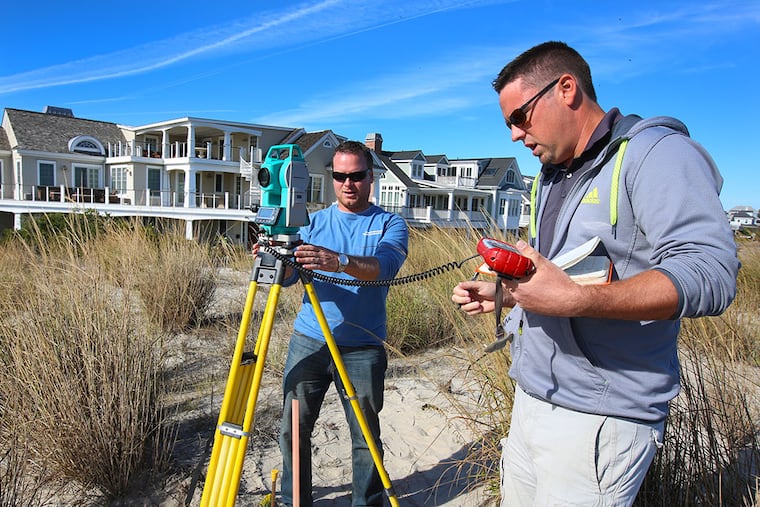
AVALON, N.J. - Despite the sunny sky on Tuesday - a contrast to the dismal weather brought by a weekend nor'easter that chewed up beaches and pulled tons of sand offshore - the surf along the Ninth Street beach here remained kicked up as a crew of coastal geologists began assessing the damage from the storm.
"This is really the best time to be out here," said Crist Robine, chief sedimentologist and geoscience specialist at the Stockton University Coastal Research Center in Galloway Township. "Right after the storm, before things have had time to shift and change, can give us a good read on what a storm may have done in terms of sand-volume losses."
Ultimately, the data collected in coastal New Jersey towns such as Avalon can help communities make claims for federal disaster reimbursements and other money when recovering from storms such as Sandy or a season of nor'easters.
"It really allows us to see the before and after of a storm," said Brad R. Smith, environmental field specialist and data analyst for the center. "But we also look at times of the year, as well as other factors in making comparisons and determinations."
And so on Tuesday the Stockton crew - two geologists and two divers - trudged up a dune to find a specific rebar marker that is always used as a starting point for the measurement it takes of this beach for the Borough of Avalon four times a year.
The coastal geologists use a piece of equipment called a Sokkia Set-520-R Electronic Total Station, which transfers to the data collector, called an SDR-33 Electronic Field Book. The unit is initialized with position coordinates, the elevation for two known locations, transit height, and target height - much the way surveys of land are done.
The geologists use an orange flag to communicate with the divers who are equipped with an optical prism mounted to a range pole as they traverse the dunes, the back beach area, and into the water at depths of up to 15 feet.
The survey information is edited, checked against field notes, and sent to a database for use and storage.
The measurements provide exact profiles of the beach that allow scientists and engineers to compare the losses and gains of sand upon a particular spot throughout the year - and ultimately over the decades.
Avalon has 10 such marker locations along its beachfront and is among several municipalities - and the state Department of Environmental Protection - that have contracted with the Coastal Research Center to survey the beaches for recurring storm damage and shoreline retreat issues.
The center, founded in 1981 by coastal geologist Stewart Farrell, who still leads it, has also collected the data and provided a geotechnical resource for the numerous federal, state, and municipal beach replenishment projects that have occurred in New Jersey over the decades. The state spent more than $400 million on beach protection between 1996 and 2013, according to experts.
Smith called communities that use the data "proactive," allowing the towns to use the information that is collected to enhance storm protection efforts, preserve aesthetics, and improve tourism.
The "high density" data provides coastal zone managers (the Shore towns) with more information to better manage their beaches and dunes, Smith said.
The center has also been awarded two congressional earmarks over the last two years to perform a statewide dune assessment of New Jersey's beaches.
Farrell said he did some preliminary assessments of the results of the weekend storm on Monday in Avalon, Stone Harbor, Ocean City, Beach Haven, and elsewhere to determine the overall effect of the nor'easter.
"It's one that we'll certainly put on the calendar as one to keep in mind when we talk about damaging storms," Farrell said. "And one where we can certainly see that beach replenishment and dune replacement certainly did its job in protecting the coastline."
But such activity isn't without its critics - and beach towns that don't necessarily want the attention that Farrell and the state of New Jersey give to counting the sand along the beachfront or the expensive dunes and replenishment that goes with it.
In Margate, a battle of words and philosophies continued to brew between local officials and Gov. Christie as the three-day nor'easter approached and Hurricane Joaquin still threatened to be on the Jersey Shore's doorstep at the beginning of the week before veering away from the coast.
Since Sandy struck, Christie has wanted to build a dune system that would stretch nearly the entire length of the state's 127-mile Atlantic coastline. The state has obtained easements from all but 366 of the state's 4,200 beachfront property owners to create lengthy dunes.
But Margate and several other towns have said no to the idea. And Margate - which itself owns all the land that the state needs to build the dune there - remains locked in litigation after it won a federal lawsuit to stop the state from seizing the municipal-owned property.
On Thursday, the governor called Margate "among the most selfish people in the state of New Jersey."
And on Tuesday, as other towns fretted about losing much of the sand placed by recent beach replenishment projects in places such as Ocean City and North Wildwood, Margate officials continued to sing the praises of its unique bulkhead system that it said makes any dune unnecessary.
"Respectfully, to the governor, yes we all need flood protection," said Margate Mayor Scott Becker. "But our beaches look great after we rode out the storm with whatever high tides God gave us. We had very little flooding in only two areas."
Voters voted twice in referendums to oppose the dunes, Becker said. "And, ultimately, our bulkhead system has proved successful again."
Contact Jacqueline L. Urgo at 609-652-8382 or jurgo@phillynews.com @JacquelineUrgo