South Jersey's becoming a tough neighborhood for trees
Extreme weather, compacted soil, and wayward vehicles make it tough to be a tree on the streets of South Jersey.
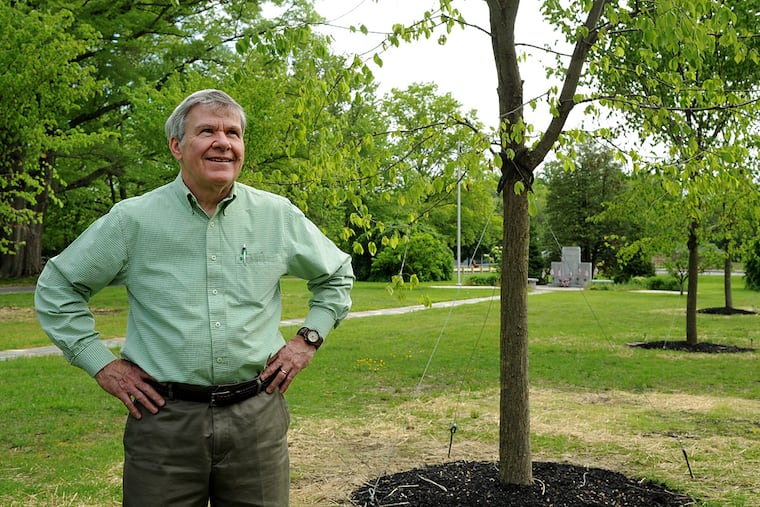
Extreme weather, compacted soil, and wayward vehicles make it tough to be a tree on the streets of South Jersey.
Age takes its toll as well, particularly in the signature canopies of older communities such as Haddonfield, Moorestown, and Woodbury, where even mighty oaks can't live forever.
Diseases such as "ash yellows" and "bacterial leaf scorch" are decimating certain tree populations in some places. And as if all those woes aren't bad enough, there's the emerald ash borer.
This pernicious insect, whose larvae are sucking the life from tens of millions of ash trees in the eastern United States, showed up about two years ago in Somerset County.
"Last November, one of our tree crew gave me a call and said, 'Guess what I found,' " John Gibson, chairman of Moorestown's tree planting and preservation committee, recalls. The township has about 8,400 street trees.
"Fortunately, we did a tree inventory several years ago, so we know we have about 300 ash trees on [municipal] property," he adds. "And we have a forestry management plan."
Moorestown, Haddonfield, Woodbury, and more than a third of New Jersey's other municipalities, along with five of its 21 counties, have such voluntary, state-approved plans in place, says Carrie Sargeant, urban and community forestry coordinator for the New Jersey Department of Environmental Protection.
With incentives for tree inventories, strategic placement, and replacement of trees, and training for employees and volunteers, "these plans are a proactive way for communities to get ahead of problems," Sargeant adds.
Amid the vivid greenery of even a so-so spring like the one we've been having, dead, dying, damaged, or possibly diseased trees stand out starkly.
I've noticed a number of them during recent walks in and around Camden County's beautiful park in Haddon Heights. The leafy borough has a forestry management plan, but the county, generally a strong steward of its vast and complex park system, does not.
I also was surprised to learn that verdant Burlington County, as well Cherry Hill Township - where curbside trees are private, not municipal, property - don't have state-approved forestry management plans either.
But Gloucester and Atlantic Counties do, and so does Camden City.
"Good forest management is essential," says Jessica Franzini, program director for the New Jersey Tree Foundation, which has planted 6,000 trees in the city since 2002.
The nonprofit organization works closely with City Hall; as Camden's current plan is updated, Franzini says, "we hope to have a professional tree risk assessment that will include looking at the ash trees in the city."
In Haddonfield, the majestic canopy of 9,500 trees is being diminished primarily by disease; 800 trees have been taken down in recent years, with 1,200 to go.
"Bacterial leaf scorch is hitting red oaks and pin oaks and essentially killing them all," Borough Commissioner John Moscatelli says.
"Our ash trees are dying at an alarming rate, and when an ash tree dies, it starts falling apart and becomes hazardous."
On a happier note, Moscatelli says the borough expects to plant 80 trees this year.
And the emerald borer "doesn't seem to have found" Haddonfield's 400 to 600 ash trees, says Bill Ober, a state-certified tree expert with Haddonfield's public works department.
Woodbury, designated a "Tree City USA" by the national Arbor Day Foundation in April, also is free of the beetles. The city has a canopy of 5,000 trees and more than a dozen parks, and "a very active green team," administrator Michael Theokas says.
"We are reluctant to take down any trees unless they are diseased, dead, or a hazard, and we try to do a two-to-one replacement," he adds. "Trees are part of the fabric of the community, the character of the streets."
Officials in Burlington County and Cherry Hill Township tell me their existing programs for tree monitoring, maintenance, and replacement are working well.
In Camden County, the forestry management plan "is in its draft form," says Maggie McCann, an aide to parks department director Frank Moran. "We are awaiting the completed tree canopy analysis from the U.S. Forest Service."
That's good news, given the way Sargeant and Richard Buckley, director of the Rutgers Plant Diagnostic Laboratory, describe the threats to tree populations statewide.
Leaf scorch could doom "40 percent of the oaks in the older towns," Buckley says.
And those dreadful emerald beetles could "kill the ash tree in the state," he warns. "Communities are going to have to decide whether they want to save their trees. Or not."
For more information, visit www.state.nj.us/dep/and type "emerald ash borer" in the searchbox.
kriordan@phillynews.com 856-779-3845 @inqkriordan www.philly.com/blinq