Iraq War surgeon who saved Marines' lives now leads NJ doctors
After the humvee struck an IED during a dangerous convoy in Iraq and flipped over, the airman driving it was knocked unconscious and bleeding profusely. His face was unrecognizable, his right arm crushed.
After the humvee struck an IED during a dangerous convoy in Iraq and flipped over, the airman driving it was knocked unconscious and bleeding profusely. His face was unrecognizable, his right arm crushed.
He was rushed by a Black Hawk helicopter to a U.S. military hospital in Kuwait where Capt. Joseph P. Costabile, head of the surgery department, was waiting. Costabile recalled hearing someone say that the patient was "already dead" while he was being carried in.
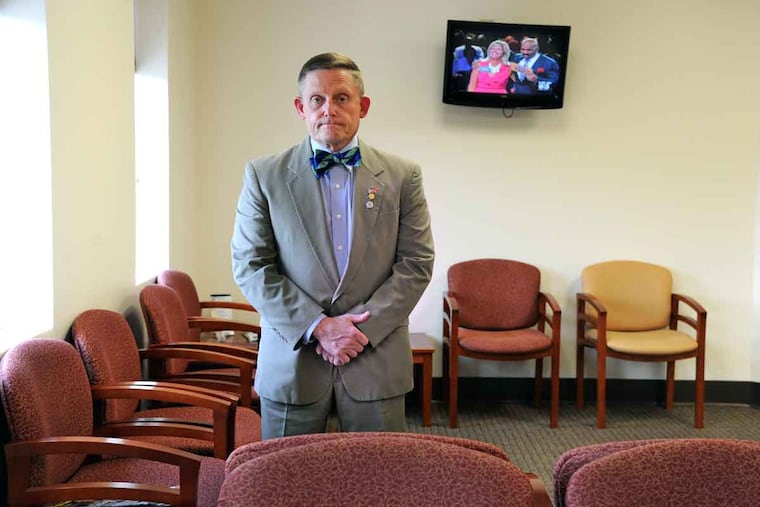
Costabile had a busy vascular surgery practice in Cherry Hill and was a reservist in the Navy when he was called to duty in 2005. He served nearly 12 months in Kuwait and eight in Iraq three years later with the First Medical Battalion serving the First Marine Division.
The tours of duty, he said, vividly demonstrated the value of teamwork, loyalty, and perseverance, traits that will be useful as he takes the helm of the Medical Society of New Jersey this month.
Founded in 1766, the organization calls itself the oldest professional society in the nation. But with only 7,000 members, less than half of the state's total physicians, the organization is struggling to command respect and remain relevant. Insurance companies and the government continue to propose new rules that affect the medical profession and dictate to doctors how they should help their patients, he said.
Costabile relishes the challenge and said he would call upon his military experience to get results.
"I can look at things with a different perspective," he said during an interview last week at the Marlton home he shares with his wife, Yolanda, a paralegal who helps defend doctors against malpractice lawsuits, and their two dogs. He said he wants to unite doctors across the state to work together for the good of their profession and for patients they are dedicated to serve.
Costabile said that in Kuwait and Iraq, he had been impressed with the Marines and other combat troops he had operated on and remembered how they were "fiercely loyal to each other. . . . As soon as they came out of anesthesia they would ask, 'When can I get back to my unit?' " He witnessed firsthand how their camaraderie had helped them endure tough times.
It was teamwork, Costabile said, that helped the airman who was rescued from the humvee defy the odds and recover. The airman survived with only the loss of his right hand, after being repeatedly resuscitated and treated by medics over 36 hours in the hospital. Costabile did his part, pouring blood into him, flushing his wounds, and performing a tracheotomy. After all that, Costabile said he had still believed the patient had only a 50/50 chance at staying alive.
Later, a shipmate told him that the airman had appeared on CNN and talked about how he had witnessed his wife deliver their first child a few months after returning to his home in Texas.
"We had done everything we could to put him back together," Costabile said.
Back in New Jersey, Costabile, 62, is a board-certified surgeon and a partner with the Virtua Surgical Group, a Voorhees-based practice with 22 surgeons. Later this month he will be inaugurated as the president of the state's Medical Society. "It's not a job I sought. I'm OK with being in the trenches and doing the grunt work," he said.
But Charles Field, one of his medical partners and a longtime friend, said Costabile is the leader the doctors need as membership in the medical society declines and physicians go separate ways. "He's a very strong personality, very vocal, and very opinionated, in a good way," Field said. "He has some good ideas about how to bring physicians together and work as teams."
Field and Costabile met at Rutgers Medical School in Camden, now called the Robert Wood Medical School. Costabile's military service and dedication to his patients will inspire physicians to follow his lead and work for their common interests, Field said. "Layers of insurance and hospital bureaucracy" impedes doctors and hurts patients, he said.
Costabile said that he recently testified in Trenton against legislation that would impose new limits on what doctors can prescribe. He also has fought bills that would force patients to use only doctors in an insurance network.
Another priority, he said, will be to improve the care offered to military personnel and veterans. He will lobby for all physicians to accept TRICARE, the medical benefit plan for the military, even if it pays less than other plans. He also wants to reinvigorate the Heroes and Healers program, which matches veterans with doctors who are independent from the Veterans Administration. It was created because some veterans may hesitate to contact the VA doctors with concerns because they fear that might affect their career, he said.
Costabile said he will "probably stay neutral" on a medical-marijuana bill in New Jersey that some veterans are supporting. The bill would add post-traumatic stress to the list of conditions that would qualify a patient to use medical marijuana in the state. "I'm not 100 percent opposed to it, but I'm not sure it will help patients . . . There are no scientific studies or proof it makes a difference," he said.
While he was overseas, he said none of his patients had confided that marijuana had helped them get by after a trauma.
Costabile said another focus will be to improve conditions so that doctors' offices can succeed as small businesses. Too many regulations, he said, and frivolous malpractice lawsuits have forced many doctors to leave private practice. "Every time a doctor closes an office," he said, "we've lost another small business."
856-779-3224 @JanHefler