Woodworking hobby has roots in family history
The new hobby Edgar Stern had been searching for was there all along. "My grandfather made this in the 1930s, in Germany," the 89-year-old Cinnaminson resident says, holding up a hand-carved wooden plaque, known as a mizrach, of the type often found in Jewish homes.
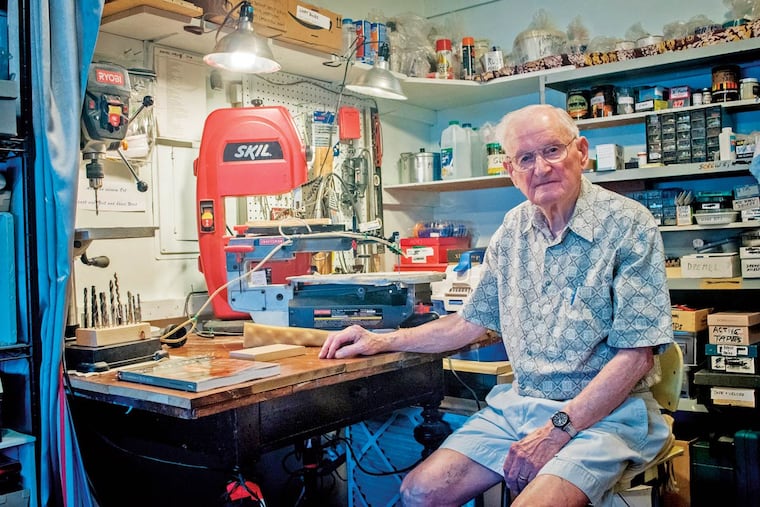
The new hobby Edgar Stern had been searching for was there all along.
"My grandfather made this in the 1930s, in Germany," the 89-year-old Cinnaminson resident says, holding up a hand-carved wooden plaque, known as a mizrach, of the type often found in Jewish homes.
"I was looking for something new to do, and it gave me an idea," adds Stern, who was barely 9 when he and his family fled Hitler's Germany. "Why don't I try woodworking?"
Since that inspiration about four years ago, the retired therapist has crafted dozens of decorative objects in his meticulously organized workshop and given most away.
"I'm the kind of person who likes to get things done yesterday. But when I'm working in here, I'm patient," he says, demonstrating the formidable powers of the bandsaw on a chunk of plywood and the dexterity of his scroll saw with a piece of pine.
"The relaxation is important to me. I listen to classical guitar and folk music, and I'm off to myself. The world disappears in my shop."
Stern's creations include toys, lawn ornaments, menorahs, and charming tabletop "dioramas" of rural scenes. He posts photos of his work on edswoodcraft.wordpress.com.
"I never sell any of my stuff," he says. "I keep it as a hobby. I don't want it as a business."
Examples of what Stern calls his "woodcrafting" also grace the home he shares with Milly, his wife of 59 years. The couple have three grown children, 11 grandchildren, and four great-grandchildren.
"He always has been a guy who had to be involved in a project," says Milly, 83, a retired school social worker. "Four years ago he was at loose ends, and he wanted to do something different. He had never done anything of significance with tools, and I was amazed at how he really took off with this."
Says their son and oldest child Walter, 56, a Plainsboro resident and English teacher at Cherry Hill High School West: "He's become sort of an artist with this. We used to visit farms on our family vacations, and with his farm diorama, he transformed into three dimensions an emotional memory I have of that part of my life."
After arriving in America in 1936, Stern and his family settled among other German Jewish refugees in Upper Manhattan's Washington Heights ("people called it 'Frankfurt on the Hudson,' " he recalls). He learned English quickly and later, after earning a master's degree in social work from Adelphi University, began working in the Philadelphia area, settling first in West Chester and moving to Cinnaminson in 1969.
"I was always into a lot of hobbies," he recalls. "I collected stamps as a kid. Later I was interested in tropical fish and performing traditional folk music."
Stern also wrote a memoir, The Peppermint Train, about coming to grips with his childhood in Nazi Germany, where members of his extended family perished at Auschwitz. The book, published by the University Press of Florida in 1992, also recounts visits the author made to his homeland during the 1980s.
Stern was fighting depression around the time he was moved to start working with wood.
He taught himself by watching tutorials online and taking books out of the Cinnaminson Public Library, where he served as president of the Friends of the Library for 23 years. He began collecting tools - his kids got him the scroll saw.
His debut creation - a birthday gift for his wife - is on a wall near the kitchen table; the elegant plaque his grandfather Ludwig Walther made with a hand coping saw is in an upstairs bedroom.
Stern brings it downstairs to show me: It's a simple but elegant piece of work.
"He and my grandmother helped raise me," says Stern, who was an only child. "He was my favorite person for a long time."
Stern's "Opa" also escaped Nazi Germany and settled in Washington Heights with the rest of the family. He died in 1945; a solid oak table that belonged to him has become his grandson's woodcrafting workbench.
"I'm 99.9 percent certain this is the table where he made the mizrach," Stern says.
"It's very inspiring to have my grandfathers's table, and to be working off this table.
"He's still in my heart."
And his hands.
856-779-3845 @inqkriordan