A new role for lighthouse, but still a beacon
SEA GIRT, N.J. - Rising 44 feet over the land and 60 feet above sea level, the redbrick building isn't the most imposing structure - at least not as lighthouses go.
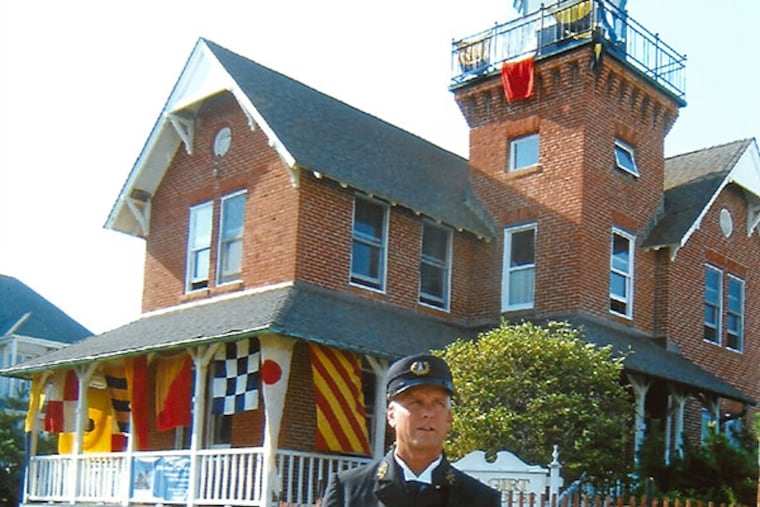
SEA GIRT, N.J. - Rising 44 feet over the land and 60 feet above sea level, the redbrick building isn't the most imposing structure - at least not as lighthouses go.
When it was built in 1896, it performed the much-needed job of illuminating a dark spot for mariners, midway in the 44-mile stretch between Navesink Twin Lights and Barnegat Lighthouse.
Its bright beacon was sighted by the crew and passengers fleeing the burning liner Morro Castle in 1934, and Coast Guard members in the lighthouse's watchtower saw the explosion of the Standard Oil tanker R.P. Resor after it was hit by a torpedo from a German U-boat in 1942.
Now, after being decommissioned in 1945 and later serving as a library and recreation and community center, the Sea Girt Lighthouse is taking on a new role, much more than a historic site with a few artifacts.
It's becoming a first-rate museum, where its colorful past is on full display in exhibits and special programs such as "Moonlight Climbs" to the tower during full moons that illuminate the ocean. On a single night, hundreds make the climb.
In addition to an authentically furnished keeper's office and quarters and beehive-shaped lens like the one the lighthouse had more than 100 years ago, the museum has added many artifacts over the last year, including a keeper's uniform, rare signal flags, an unusual fire-extinguishing grenade made of thin blue glass, and an 1898 map showing the lighthouse and Jersey coast.
"We want to turn the lighthouse more into a museum that's also a living history site," said Bill Mountford, president of the Sea Girt Lighthouse Citizens Committee, the nonprofit volunteer organization that operates the site.
'More refined'
"We want to have a reenactment of life in the lighthouse," said Mountford, who is also the great-grandson of the site's longest-serving keeper, William "Pappy" Lake, who served from 1917 to 1931, and the grandson of Elvin "Toots" Lake, one of the Sea Girt lifeguards involved in the 1934 rescue of Morro Castle passengers.
The museum is becoming "more refined, absolutely," added Jude Meehan, vice president and head docent who helped unveil the formal 1912-style keeper's uniform on Aug. 1 by putting it on.
"We do want to do more living history, where I'll wear a uniform and someone else will wear the fatigue uniform" - the overalls used by keepers, also known as "wickies," when performing the dirty work of cleaning the windows in the tower and maintaining the oil-fueled light, Meehan said.
For wickies, duty at Sea Girt was light, since the climb to the tower - on an elevation overlooking the beach - was only 42 steps.
Today, the lighthouse is free and open for tours from 2 to 4 p.m. on Sundays, except holiday weekends, through mid-November and resumes tours in mid-April.
It's available for group tours anytime by prior arrangement and is a favorite meeting place for community groups. The land-based lighthouse is one of 11 visited by thousands of people during the annual Lighthouse Challenge of New Jersey, to be held this year Oct. 17 and 18.
"We've had one Kansas family drive 24 hours straight to take the challenge," said Bill Dunn, a docent and former president of the Sea Girt Lighthouse Citizens Committee. "The mother used to live in the area."
The Sea Girt Lighthouse preserves the story of colorful keepers - from a Union soldier during the Civil War to a pioneering woman who kept the light burning while raising her children at the lighthouse.
It also tells a tale of the site's service in World War II, when Coast Guard members were stationed there and patrolled the beach with carbines and side arms.
One of the most memorable events, though, was the Morro Castle disaster, said Mountford. "My grandfather [Elvin 'Toots' Lake] lived here as a little boy and was later a lifeguard and fire chief," he said.
On the morning of the Morro Castle fire, "he was awakened and told, 'Toots, get up, we have to get down to the beach,' " Mountford said. ". . . He told me they brought in 12 survivors - but more bodies than people."
Overnight camps
The first keeper of the lighthouse was Abraham Wolf, Dunn said. He was a guard in charge of the barracks where Confederate prisoners were held at Fort Delaware on Pea Patch Island in the Delaware River.
Wolf was followed by Abram Yates, whose wife, Harriet, briefly took over after his death. Lighthouses did not usually have women as keepers. The next keeper was John Hawkey, who had spent most of his career aboard the Five Fathom Lightship, anchored in the Delaware Bay off Cape May.
Hawkey has been portrayed by Meehan in a keeper's uniform authentically created by Jim "JJ" Newberry, a Roebling, N.J., man who made some of the costumes used in the movie Last of the Mohicans.
The next keeper was William Lake, Mountford's great-grandfather. Lake oversaw the installation in 1921 of the first land-based radio-beacon navigation system.
The last keeper was George Thomas, who served until 1941, when the Coast Guard took over the lighthouse, which was sold in 1956 to the Borough of Sea Girt for $11,000.
"We get requests by people to stay and work in the lighthouse," Mountford said. "We've had overnight camps for Girl Scouts who stay with their leaders.
"We may do more of that," he said. "We're eager to share the story of this treasured landmark."