Sandy survivor to Harvey victims: Prepare for a long road ahead
Brenda Nasce cautions Texas survivors: Nothing will ever be the same.
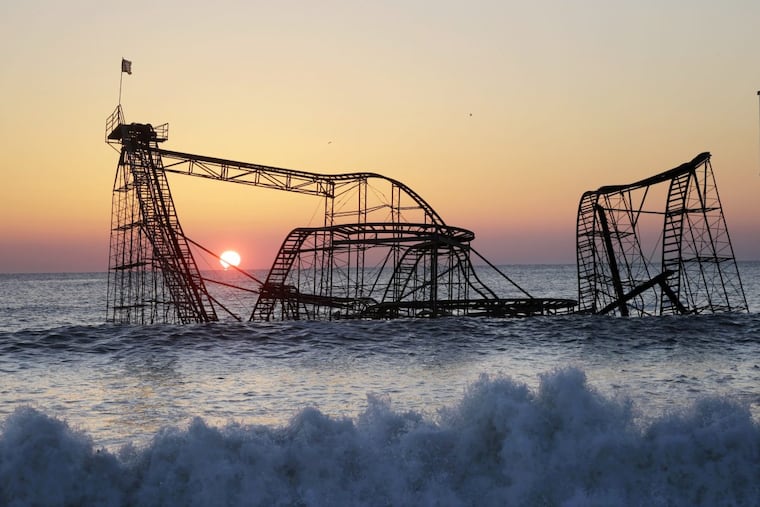
The advice that Brenda Nasce of Point Pleasant Beach, N.J. — who lost her home and her printing business in Hurricane Sandy nearly five years ago — can give to Harvey's victims in Texas would run the gamut from prosaic to poetic.
Like the idea that when they first get to return to their homes, they should ignore the mud and mildew, and instead put their effort into finding another place to stay for a while.
In her case, Nasce found that four feet of water had swamped the first floor of her two-story Cape Cod, which sits about 1,000 feet from the Manasquan Inlet. She was left with a six-foot pile of decomposing sea matter — sand, driftwood, seaweed, dead fish — in her basement.
"You can't worry about mopping up the floor," said Nasce, 50. "It's your first instinct to want to clean it all up. But you have to realize that it's going to take a lot more than a bucket and a mop to deal with it."
Point Pleasant Beach and the surrounding coastal areas in Ocean and Monmouth Counties were among the hardest hit by Sandy because they were at the northern thrust of the roaring storm, which made landfall to the south on Oct. 29, 2012. The monster storm left more than $30 billion in damage.
As many as 346,000 houses at the Jersey Shore were destroyed or damaged. Hundreds of businesses up and down the coast were affected, including Nasce's C&D Printing, which she had operated for more than a decade. Her print shop never reopened because her insurance ultimately didn't cover the equipment damaged by floodwaters. Nasce now works as a restaurant manager.
Instead of dwelling on what happened, storm victims need to stay focused in the moment and try not to think about the "enormity of the idea that you've pretty much lost everything you ever owned," Nasce said.
"You have to look ahead to your immediate needs of shelter away from what had been your home … because your home's not really there anymore," said Nasce, who with her son, Jonathan, who was 7 at the time, stayed at a friend's home nearby, which wasn't as damaged as her own. "In the immediate aftermath, I had to secure a home for us to go to, because you can't live in a shelter."
Eventually, she and her son moved to an apartment to wait out her home's reconstruction, which was delayed by more than two years after her homeowner's insurance company had actually given her the money to rebuild but FEMA regulations and funding for the region continued to hold things up. So much of the last five years has been waiting — for insurance funds to be made available, for help to arrive, for things to get back to normal.
"At first I went along with the program, with what the government told me in terms of a timetable, and then I realized that I had to become my own advocate and get things moving myself," Nasce said. "You can't wait for assistance to come to you. You have to go out and find it."
So Harvey victims should prepare for a long road ahead, Nasce said.
"It took 3½ years to get my home rebuilt," said Nasce. "So what I would say to the people in Texas is that they have a long road to walk. And probably nothing will ever be the same for them, because an experience like this really changes you in ways you can't imagine until you live through something like this."
Some of her days during the process were especially difficult. Like the morning when she and her son had to watch their possessions, including all of his toys, which had become contaminated by the rotting filth from the flooding, be scooped up by a giant mechanical claw and placed in a dumpster to be carted away.
"Losing all your toys is hard to explain to a child," Nasce said. "And I miss certain things, too. Like the big, beautiful refrigerator I used to have in my kitchen that I had to replace with a crappy small one because I couldn't afford to get the model I used to have. But ultimately I'm grateful, because at least I have a refrigerator to call my own again."
Still, Nasce said, the experience has taught her to focus on what's ahead instead of what was left behind.
"All you really have is this moment," she said. "It's your job to make the best of it no matter what."
