Time's up for trees along the Schuylkill
About 30 will be taken down this spring. Age and disease left them dangerously weak, Fairmount Park experts say.
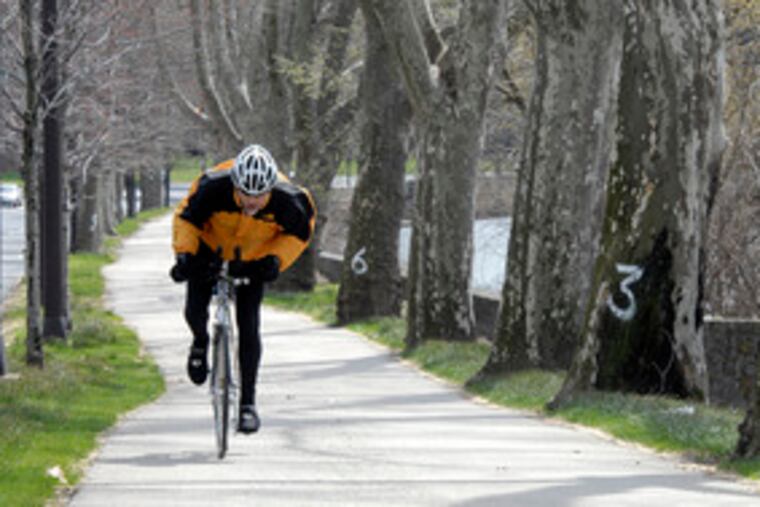
About those numbered sycamore trees on Kelly Drive along the Schuylkill: No, it's not the work of a cult.
Nor, contrary to the suggestion of one blogger, are the painted white numbers there because the squirrels had trouble getting mail delivered.
Rather, say Fairmount Park officials, the 30 or so trees are those whose number has come up - as in headed to the Big Chipper.
"They're at the end of their lives - 80-plus years old - and they are diseased, and a number of them have been hit by cars," said Christopher Palmer, director of operations and landscape management for the Fairmount Park Commission.
So this spring is the last for these sycamores. During the next few months, contractors will take down the trees, which will be chipped and chopped, and offered free to city residents as mulch and firewood, said Mark A. Focht, the park commission's executive director.
The felling of the 30 to 35 sycamores - the colloquial name for the London plane tree - is just one of several dramatic changes along the Schuylkill this spring.
Closer to the Art Museum, across Kelly Drive from the historic Tudor-style Crescent Boat Club, some drivers brake and swerve when they spot the fresh crop of tree stumps leading up the escarpment to Lemon Hill, the 207-year-old mansion overlooking the Schuylkill.
The park commission's Lemon Hill Viewshed Restoration project will recreate the view of the mansion from the drive below and, officials hope, draw the curious into other areas of the park.
The project, to be completed in June, costs $115,000: $70,000 from philanthropist H.F. "Gerry" Lenfest, $30,000 in state funds through the Schuylkill River Heritage Area, and the rest from the park commission.
And, at the Philadelphia Museum of Art, work has begun on a new underground parking garage on the building's north side.
For longtime Philadelphians, the Kelly Drive sycamores, with their gnarled bark and distinctive cream-and-tan mottling, are as iconic as Boathouse Row and the green steel braces of the Falls Bridge.
Nor is Focht unaware of the emotional ties some people have with these trees.
"We are the last people to do that," Focht said. "There is a lot we do . . . before deciding that they have to be chopped."
In East Falls, where any suggestion of change can trigger a community meeting, the numbering of the trees has been greeted with questions, not outrage.
"It's never been my experience that they [Fairmount Park officials] have ever taken down a tree if they feel a tree is healthy. I have the utmost confidence in their judgment," said Cynthia Kishinchand, a member of the East Falls Tree Tenders since 1995.
Although the trees have been around longer than most Philadelphians alive today, they are not native, Palmer said. The even spacing and similar heights indicated that the Kelly Drive trees were part of a city beautification project in the early 20th century.
Palmer said the trees were probably selected because of their reputation for thriving in polluted urban environments - one reason they were so popular in London.
Or perhaps, Palmer added, they were a fad - what nurseries were pushing in the early 1900s: "That's often why we buy trees today, although we would never plant this many of them," he said.
To laypeople, the trees look healthy, and some might question the park commission's decision to chop them down.
But Focht and Palmer said those decisions are part of the role of an urban arborist.
Focht said the commission spends more than $2 million a year treating, pruning, and correcting structural problems in some of the millions of trees in the park's 9,200 acres.
Eventually, Focht said, some have to come down.
"With trees, maintenance is an ongoing process, and it doesn't matter if it's London planes, sycamores or Bradford pears," said Steve Maurer, a spokesman for the Pennsylvania Horticultural Society.
Maurer said that, in an urban environment, an 80-year-old London plane tree has had a "very mature life span."
"In a woodland setting, sooner or later everything comes down," Maurer said. "In nature, wood and trees again become part of the woodland."
But in an urban neighborhood, when an 80-year-old tree that is almost 100 feet tall and has a trunk two feet in diameter comes down, the natural process likely includes power lines, parked cars, buildings, and maybe a few people.
Focht said he did not know much it would cost to remove the 30 to 35 Kelly Drive trees. He said the commission would contact contractors who do tree removal and ask them to inspect the trees and propose a price.
Focht said wood and wood chips from the removal will go to the city's Fairmount Recycling Center, where they are available free to city residents. The center, near the intersection of Ford Road and Chamounix Drive in West Fairmount Park, is open 7:30 a.m. to 3 p.m. weekdays.
Palmer said the removed trees would be replaced. Although no decision has been made about the type of replacement tree, Palmer said they are unlikely to be London planes.
"We don't want to create a monoculture," he said.
Maurer said horticultural research has shown that planting all of one type of tree makes an entire landscape vulnerable to destruction by a single pest.
"You know, we have learned things," Maurer said. "We know a lot more about botany and horticulture than we did in the 1920s. I really have to laud Fairmount Park for addressing this issue."