For many girls, 'Wicked' is a metaphor for their lives.
Because, like, life is unfair
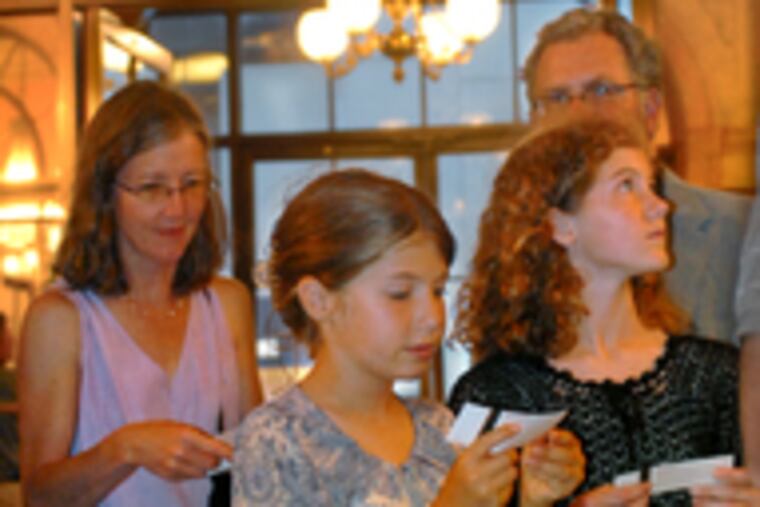
Fact: The preteen and adolescent female population of the United States with the means to buy $100 tickets to a play is insufficient to make a Broadway musical a record-breaking success.
But, oh, sister, can they make a major contribution.
Abigail Kastenberg of Center City, for example, has seen Wicked three times.
She's 10 years old.
"My mom said I was on the edge of my seat the whole show," Abigail says. So was her 8-year-old sister, Emily, who has seen the play twice.
Lauren Waksman, a 13-year-old from Richboro, Bucks County, has seen it twice. Her sister Lindsay, 9, has seen it once. They will go again in September to catch the national-tour production, which opened last week at the Academy of Music.
Girls love Wicked.
Not just love it. LOVE it.
Since Wicked premiered in October 2003, the musical about what happened before Dorothy whacked the dyspeptic owner of the ruby slippers in Oz has grown into one of the biggest hits in Broadway history. A few million mothers and fathers and aunts and uncles and brothers and cousins and grandparents have helped make that happen. For them, it was great entertainment.
For a select, but substantial, cohort of girls, however, the play has become a metaphor for life.
They paint their rooms with the play's green-and-black logo, listen to the CD until the lyrics are more familiar than anything Maroon 5 ever wrote, and get their parents to buy them the expensive Wicked crap, er, memorabilia: T-shirts, Emerald City sunglasses, sweatshirts, baseball caps, the hardbound Grimmerie, which looks like a sorcerer's book of spells and contains the script, lyrics, character descriptions and the personality test to see whether you are more like Glinda or Elphaba.
"I'm more like Elphaba," Abigail said. Neither blond nor chirpy, she has a passionate nature that emphatically aligns her with the green witch.
Lauren, too, is more Elphaba ("You want to change the world!") than Glinda ("Your flirtation skills are second to none!").
She wrote an essay about her obsession with the play and started a Web site devoted to Shoshana Bean, one of the actors who has played Elphaba.
"My favorite part," she says, "is when Elphaba casts a spell on Nessarose so she can walk. And then she turns Bok into the Tin Man, and everyone starts to misunderstand her."
Nessarose is the green witch's paraplegic younger sister. Bok is a munchkin who . . . never mind. Get thee to a Grimmerie.
It took some serious magic to burst the good witch's bubble and transform the sadistic wicked one into a role model for idealistic young women.
"When I hear 'Defying Gravity,' it makes me jump higher," says Samantha Wright, a 7-year-old figure skater who was to see the musical for the second time last night. Dancing around her yard in Ridley Park, wearing a decidedly Glinda-ish pink sundress, Samantha said the song pumps her up before every competition.
In a three-week run in Philadelphia in the spring of 2006, Wicked made $4.7 million. It is back for seven weeks, through Sept. 9, with tickets still available for most performances.
On Broadway, the show is sold out months in advance. Tickets are very expensive. So seeing the play once is no small accomplishment.
For a child to see it two, three or more times requires patience, pleading, and a mega-dent in the family bank account.
Samantha's grandmother Jan McBreen estimates that her family has spent $900 on Wicked tickets in the last three years. Avid theatergoers, they've seen other plays multiple times. But never, McBreen says, has one touched them like Wicked.
"It's inspirational."
Critics have analyzed the play's subtext, its relevance to the nation's cultural drift. Some see it as a commentary on the deceptions that led to the war in Iraq.
As Glinda might say, no disrespectation intended, but for more than 10 percent of the audience, the point is that it goes straight to the broken, betrayed and palpitating heart of many young women's lives.
Like Elphaba, they know how it feels to dream big and feel small. To be ostracized for being different. To stand by, hopeless, as the unworthy are worshiped. To yearn to be popular. To trust the wrong people. They also know the gravity-defying relief when they find a friend who really understands.
Which is not to say they can put all that into words.
Samantha, Emily, Abigail, Lauren - definish Wicked junkies - seem to feel the play.
"I think it's possible that you can relate to it, but you can't say why," Abigail posits.
"There's a mystery to it," says Winnie Holzman, who adapted Gregory Maguire's novel into the play, and dedicated it to her then-18-year-old daughter. "Quite frankly, you can't take the phenomenon of love and say, 'Why? Why do you love?' "
Abigail's mother, Judith Kastenberg, a psychiatrist, says that the last time she bought tickets, they were hard to find, and that when she finally got them two months before the performance, "they were expensive, and they were the worst seats in the theater, with a partially blocked view."
But seeing her daughter's joy watching the play was priceless, Kastenberg says.
"Her face was beaming. She was crying . . . "
"Why weren't your eyes on the stage?" Abigail asks.
"Because part of your job as a parent is watching your children enjoy things," her mother says, adding, "I felt the emotions too."
Watching Elphaba suffer, Kastenberg says, "it was just like I was back in fourth grade. There was a Glinda in my life. I won't tell you her name. Supposedly, she's a nice person now."
Abigail asks whether they're going to see the show this summer in Philadelphia.
"Enough, already," her mother says.
"How can you say that?"
"My pocketbook says so."
But if there is a way to get the tickets at a discount?
"Definitely," her mother says.
Abigail nods hard.
"Definitely!"