Asian-Americans hope to see one of their own on Council
POSTERS IN CHINATOWN windows declare their support for at-large City Council candidates Andy Toy and David Oh. Groups like the Philadelphia Chinatown Development Corp. have been urging people to vote in Tuesday's primary election.
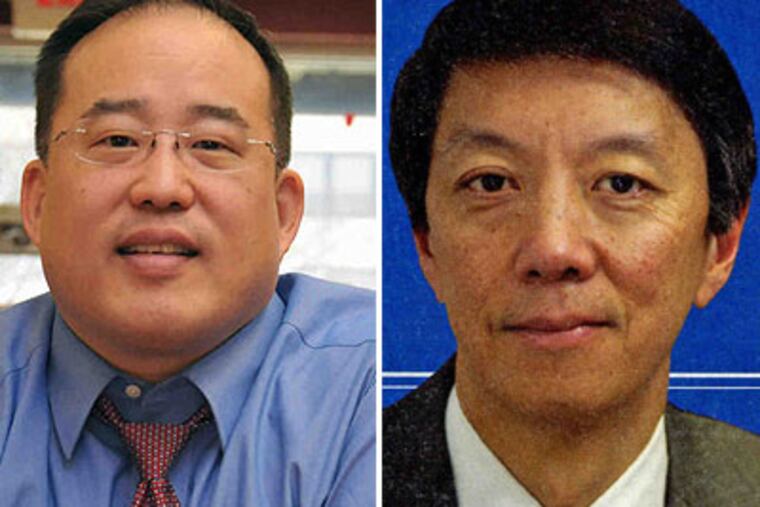
POSTERS IN CHINATOWN windows declare their support for at-large City Council candidates Andy Toy and David Oh. Groups like the Philadelphia Chinatown Development Corp. have been urging people to vote in Tuesday's primary election.
With Asians now making up 6 percent of the city's population, some argue that City Council should have an Asian-American member.
In Chinese and Korean communities in the city, there is a bubbling sense of excitement that this could be the year.
"I think it's beyond the time," said Glenn F. Hing, a Chinese-American lawyer and Democratic committeeman in the 5th Ward division that includes Chinatown.
Hing said that he "absolutely" has seen more of a push in Asian communities to try to get people to vote. But, with typically low voter turnout in a primary election, can the Asian-American community have much of an impact?
Political analysts aren't so sure but say that Asian-Americans can bridge the gap in a close race.
Neither the Asian nor the Latino community "has ever voted in the numbers that they represent in the population," said political consultant Larry Ceisler. "They've never been politically motivated groups. And you really have to wonder, why is that?"
For some immigrants, he said, "I don't know if voting is not part of the culture, or they're skeptical of the government."
If the Asian-American population "votes for these two candidates, it's not what's going to get them elected because it's not enough," Ceisler said. "But in a close election, that population could make a difference."
Toy and Oh are appealing to Asian voters, but each sees himself as a citywide candidate with broad appeal, not as an "Asian-American candidate."
And both have emphasized that they are very different politically.
Toy is a Democrat, Oh a Republican.
Both were born in the United States. Toy, 53, who most recently worked in economic development at the Enterprise Center, in West Philly, is of Chinese descent. He and his wife, who is Italian-American, have two children.
Oh, 51, is a lawyer of Korean heritage and served in the U.S. Army. He met his wife in South Korea in 1999, when then-Gov. Tom Ridge sent him there on a trade mission. (She will be taking her citizenship test this year, Oh said.) They have two children and live in Southwest Philly on the block where he grew up.
Bob Lee, the city's voter-registration administrator, said that there isn't a reliable way to figure out how many Asian-Americans are registered to vote. There is a write-in line on the registration form for someone to put in his or her race, but it's optional.
Asian-Americans here tend to be more Democratic than Republican, both Toy and Oh said.
Randall Miller, a political historian at Saint Joseph's University, said that Oh has a good chance of winning in November - not because there is a strong Asian voting bloc, but because members of a minority party in the city, typically the Republican Party, are guaranteed two of the seven at-large Council seats.
Signs of support
Wan Woo, president of the Korean American Grocers Association of Philadelphia, said that members of the community had been hoping that a Korean-American would get elected to Council, but "it never happened. This is really an exciting moment for the community."
Woo, who owns Wan's Seafood, in the Reading Terminal Market, lives in Horsham, but his daughter attends Temple's dental school and lives in the city. "I told her to vote for him," he said, referring to Oh.
John Chin, executive director of the Philadelphia Chinatown Development Corp., on which Toy serves on the board of directors, said that his staff has promoted voter registration to immigrants seeking help with social-service and financial-literacy needs.
PCDC, which, as a nonprofit, is barred by the IRS from supporting a specific candidate, serves immigrants from across the city - including Northeast and South Philly, where Asian residents are concentrated - in addition to Chinatown.
Chin said that some immigrants in Chinatown work long hours and are hesitant to ask their bosses for time off to vote. "And there's the sentiment of 'I'm only one vote, and is my vote really important?' We try to say your vote is stronger when you and your neighbors vote together."
The Chinese American Women's Sisterhood Society of Philadelphia has also been educating people about voting, with outreach at Asian supermarkets and other gathering spots in South and Northeast Philly. Its president, Grace Kong, said that her group doesn't push for a specific candidate, but that she has heard enthusiasm on the street for Toy.
People are "very excited," she said. "They think to have at least a Chinese-American in the City Council would be a great opportunity for us."
Some other major cities, like New York, San Francisco and Seattle, have Asian-Americans on their councils, she said.
"Philadelphia is a growing city," she said, "and I think it's time for us to have an Asian representative, too."