GOP's Horton takes on a big challenge in Camden County by running against U.S. Rep. Andrews
When the Camden County GOP asked Gregory Horton if he'd run for Congress, Horton asked how many Republicans had already turned down the offer.
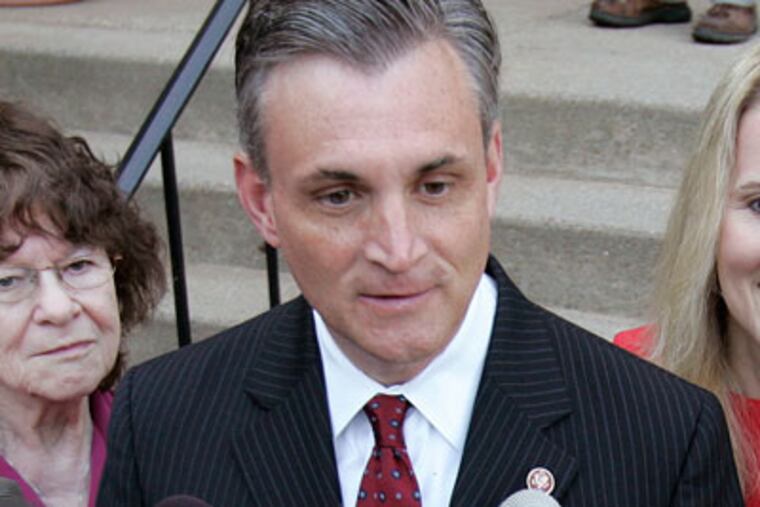
When the Camden County GOP asked Gregory Horton if he'd run for Congress, Horton asked how many Republicans had already turned down the offer.
Horton understood the challenge. His Democratic opponent, Rob Andrews, is a well-funded 22-year incumbent in a majority Democratic district.
"I know it's a major longshot," Horton said.
But Horton, 46, vice principal at Clearview Regional Middle School, said he's running to show people that you don't need money or connections to run for office. He wants people to put aside their cynicism about politics and take responsibility to help fix the country.
Horton, a committeeman with the Camden County GOP, ran for office for the first time last fall, when he and another Republican challenged Assembly Majority Leader Lou Greenwald (D., Camden) and Assemblywoman Pamela Lampitt (D., Camden) in the Sixth Legislative District. Both Democratic incumbents retained their seats.
"People don't run for office because of how nasty it's gotten," Horton, a Haddonfield resident, said. "I'm looking for leadership, and I don't see it. I see partisanship."
Andrews, 55, of Haddon Heights, has had no trouble winning reelection, but he drew criticism this year from government watchdog groups for using campaign money to fund trips with his family. One questionable campaign expense: a $30,000 trip to Scotland to attend a former consultant's wedding. Andrews repaid the money, then donated the same amount to an organization that helps homeless veterans.
The House Ethics Committee is reviewing Andrews' campaign spending after the Office of Congressional Ethics - an independent, nonpartisan entity created by the House to investigate ethics complaints - said there was "substantial reason to believe" that Andrews misused the campaign funds. It is unlawful for lawmakers to put campaign funds to personal use.
Andrews says his spending was not out of bounds.
"I have followed the rules, I have met the standards," he said at a recent editorial board meeting at The Inquirer. "I'm going to participate in the process with the ethics committee and tell my side of the story, and I believe I will be exonerated."
Looking back, Andrews said he probably would have done things differently.
"I'm going to evaluate what I've done right and wrong and improve what needs to be improved," he said.
Andrews helped to write President Obama's health care reform law. If reelected, he'd like to help work out some of the kinks in rolling out the reforms.
Horton said he agrees with some of the law's provisions, such as the one prohibiting insurance companies from discriminating against those who have "preexisting conditions," or illnesses they've been diagnosed with prior to seeking health insurance. But he wants to repeal the Affordable Care Act and replace it with a law that does not penalize those who don't buy insurance.
Andrews said that repealing President Obama's health-care reform would be "catastrophically bad for the country."
And Horton's plan - the same outline supported by Republican presidential candidate Mitt Romney - will lead to a spike in health insurance costs, he said.
"If you don't have an individual mandate and you force insurance companies to insure people who have an illness at regular rates, premiums for everyone else are going to skyrocket," he said. "[Republicans] know better."
Horton said the current health-care reform law doesn't address tort reform, which has added to the rising prices of health care.
To address the country's debt, Andrews wants to let the Bush-era tax cuts for those making $250,000 or more expire by the end of the year, which would increase their marginal income tax rates to between 36 percent and 40 percent. He wants to cut spending to bring the budget into balance, but hasn't specified which programs he would cut.
Horton wants to institute a flat income tax structure that would lower tax rates at every income level.
Andrews and other Democrats, including Obama, say there's no way to cut taxes and not increase the debt without drastic cuts to federal programs.
Horton wants to limit the number of terms senators and congressmen can serve: two six-year terms for a U.S. Senator and he proposed two five-year terms for members of Congress. If elected, Horton said he would serve a maximum of 10 years in Congress.
He knows it would be a tough sell to lawmakers on Capitol Hill, but he believes voters would side with him.
"It's just a matter of convincing the people," he said.
Andrews and Horton have found some common ground - on the abortion issue: Both support abortion rights.
Horton describes himself as "pro-life," but he worries that banning abortion would drive the practice underground, possibly threatening the health of women and children. He supports using education and counseling to fight the "battle for a pro-life world."
The First Congressional District includes nearly all of Camden County, about half of Gloucester County and a patch of Burlington County.
Andrews beat his closest opponent by a 2 to 1 ratio in his last election in 2010, and he could improve upon that this year: He picked up the Democratic bastion of Cherry Hill when a panel remapped the congressional districts last year, a once-a-decade task that coincides with the latest U.S. Census numbers.
Pollsters don't consider any of New Jersey's congressional races to be competitive, and the new boundaries made it easier for incumbents to hold their positions. The Cook Political Report, which tracks likely election outcomes, lists Andrews' district as solidly Democratic and expects that Andrews will pull out a double-digit victory margin.
Andrews has an edge in voter registration and in fund-raising.
The only congressional candidate who raised less cash than Horton was one who reported receiving zero contributions. As of Sept. 30, Horton had raised a total of $8,665 in contributions and had $3,526 cash on hand, according to federal campaign financial reports.
Andrews, meanwhile, had raised more than $1.2 million as of Sept. 30, the latest financial disclosure on file with the Federal Election Commission. He reported more than half a million dollars on hand at the end of that period.
Andrews faces two other challengers: Margaret Chapman, 56, of Pine Hill, a legal secretary and Reform Party candidate who ran against him in 2010; and Bill Reitter, 71, a retired tour guide from Glassboro and a Green Party candidate.