After the Republicans lost the 2012 presidential election with a hard-line policy on immigration and a multimillionaire investment banker as their nominee, party leaders concluded in an "autopsy" that survival required, among other things, winning over Latino voters and erasing the perception they are the party of the rich.
They did not reckon on Donald Trump.
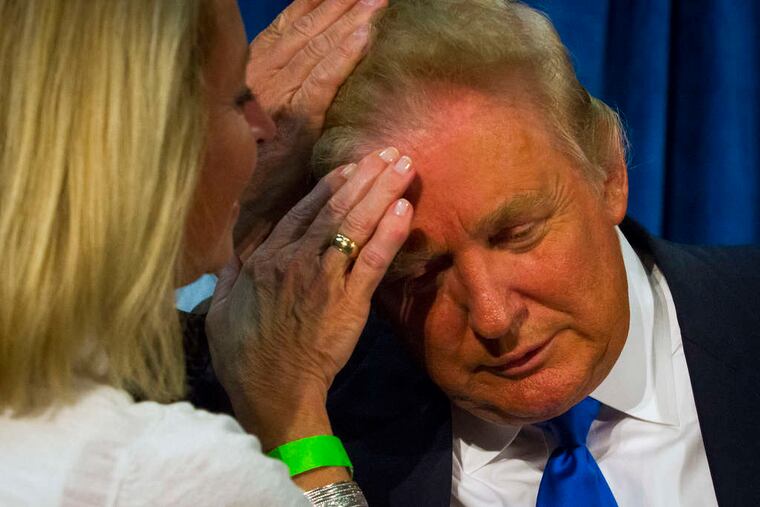
The reality TV star and real estate developer boasted about his wealth and insulted Mexican migrants as he announced last week he was entering the 2016 GOP race for president. And that was just for starters.
History shows the man is liable to say anything. As a result, some Republicans are worrying that Trump will eclipse serious candidates and damage the party's image.
"I'm really rich," Trump said after descending to the stage on a gilded escalator in the New York tower bearing his name. He waved a piece of paper he said proved his net worth is $8.7 billion, much larger than most independent estimates.
He promised to "build a great, great wall" on the nation's southern border and make Mexico pay for it, to stem illegal immigration. "They're sending people that have lots of problems," Trump said. "They're bringing drugs. They're bringing crime. They're rapists. And some, I assume, are good people."
A dozen and counting
Trump's garish entry into the race illustrates how wide open the Republican contest is, with a historically huge number of candidates - 12 have declared so far, and four more are considered likely to run.
It's an unwieldy mess - or a beautiful testament to the choices democracy produces.
There's a female candidate, former Hewlett-Packard chief executive Carly Fiorina; an African American candidate, retired neurosurgeon Ben Carson; and two Hispanics, Sens. Marco Rubio of Florida and Ted Cruz of Texas.
There are hard-right candidates (Cruz, for example), a libertarian-leaning one (Kentucky Sen. Rand Paul), and those considered to be of more moderate bent (former New York Gov. George Pataki and, to some, Gov. Christie, who has not announced but is expected to do so soon). There's even GOP royalty (former Florida Gov. Jeb Bush, the son and brother of presidents).
"I used to quip that everybody should run for president - it's an amazing experience. Little did I know they'd take me up on it," former Pennsylvania Sen. Rick Santorum said. He is running for the second time, having carried 11 states in the GOP primaries and caucuses of 2012.
Wisconsin Gov. Scott Walker, Ohio Gov. John Kasich, and Louisiana Gov. Bobby Jindal are considering campaigns.
Several factors are driving up the number of aspirants, according to Republican strategists and political analysts.
For one thing, Democrats have held the White House for two terms, and that favors the opposition party as it is historically difficult for the party in power to win what is in effect a "third term," said Jack Pitney a political scientist at Claremont McKenna College in California.
"They know that if they win, there's a very good chance of becoming president of the United States," Pitney said. "Some of these candidates have to feel it's their last shot," he said. "For Mike Huckabee and Rick Perry, it's now or never." Younger candidates such as Rubio or Christie have not much to lose by trying.
The Citizens United Supreme Court decision and the rise of super PACs that can raise and spend unlimited amounts of money to back candidates also have made it easier for hopefuls to continue later into the primary season. In 2012, wealthy backers enabled former Speaker Newt Gingrich and Santorum to keep going in their challenges to Romney, Pitney said.
In addition, several Republicans noted, there was no favorite heading into 2016, no obvious "next in line" candidate. Santorum finished second four years ago, which can often give a candidate a leg up, but he has few ties to the Republican establishment and was benefiting from conservative protest votes against Romney.
Reince Priebus, chairman of the Republican National Committee, argued that Hillary Rodham Clinton, the Democratic front-runner, also has helped increase the party's field; she has 100 percent name recognition but early polls suggest she has a ceiling to her potential level of support - people either love Clinton or loathe her, he said.
'Up to them'
"It's not up to me nor should it be up to anybody in Washington to tell the people in our party who they can support and who they can't," Preibus said in an interview Friday. "It's going to be up to them."
Though there has been a lot of consternation on how to manage the stages for televised debates, "everybody deserves an opportunity to run," he said.
Asked if Trump's comments about Mexicans, and some of his other blunt statements, hurt the party, Preibus was diplomatic.
"I think that every candidate has to express themselves in ways that offer an element of dignity to everybody," he said, "but that goes to every candidate. . . . They've got to watch how they communicate."
Trump was a big topic of conversation at the Northeast Republican Leadership Conference in Philadelphia over the weekend and in political circles around the country, with people trying to guess what effect he might have on the campaign.
For one thing, late-night comics were rejoicing. Jon Stewart, in the last six weeks of his run on The Daily Show, was gleeful: "He is putting me in some kind of comedy hospice where all I'm getting is just straight morphine."
John Feehery, a GOP strategist in Washington, was not laughing.
"I don't think it's funny, and anybody who wants to beat Hillary Clinton should worry," he said. "We have to expand as a party, cast a bigger net, and having a blowhard like Trump sucking up attention and insulting people makes that harder."
Few if any experts believe Trump can get the nomination. A whopping 57 percent of Republicans have an unfavorable view of the mogul, according to an average of the three most recent national polls. The website FiveThirtyEight, devoted to statistical analysis of politics and sports, found that Trump's net favorability rating (favorable minus unfavorable) of -32 percentage points is the worst of 106 candidates who have run for president since 1980.
Yet Trump attracts some voters who like his bluntness, and he may well qualify for the first of the debates sanctioned by the Republican National Committee. Fox News has limited the debate to candidates who place in the top 10 in national polls. (Fox has promised to hold a separate debate for the rest of the field.)
Missing the cut
Trump has drawn between 4 percent and 5 percent in recent surveys, enough to qualify for the first debate, Aug. 6, if invitations were sent today. Former Texas Gov. Perry, South Carolina Sen. Lindsey Graham, and Fiorina would be in danger of not making the cut.
Fiorina said she's not concerned about Trump's stealing her thunder. "I think Donald Trump spends most of his time focusing on his own thunder," she told reporters at the Philadelphia conference Friday. At "current course and speed, I'll be in the debate," Fiorina said.
Pennsylvania GOP Chairman Rob Gleason looked on the bright side of Trump's entry. "He'll get us ratings for the debate," Gleason said. "He is not going to hurt us, I think. Most people see Donald Trump for who he is - an entertainer."
215-854-2718@tomfitzgerald