Estey admits role in pay-to-play corruption case
HARRISBURG - John H. Estey, a former top aide to Democratic Gov. Ed Rendell, pleaded guilty Tuesday to funneling illegal campaign contributions to Pennsylvania legislators to help a phony company set up by the FBI in an elaborate pay-to-play sting.
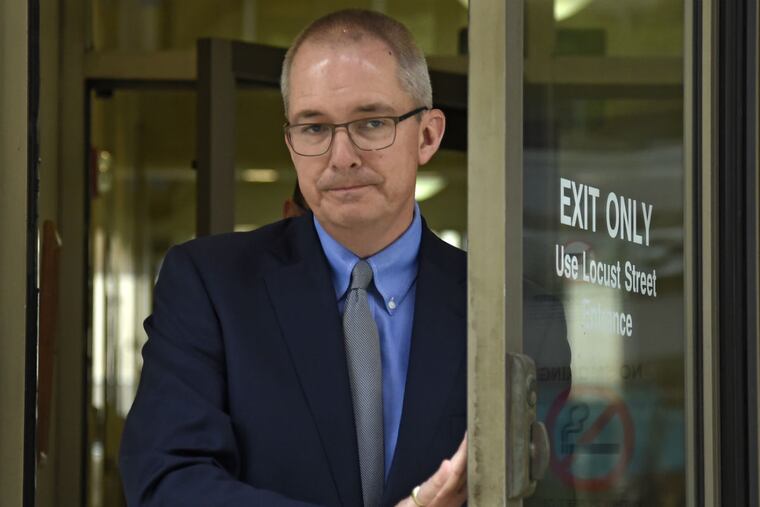
HARRISBURG - John H. Estey, a former top aide to Democratic Gov. Ed Rendell, pleaded guilty Tuesday to funneling illegal campaign contributions to Pennsylvania legislators to help a phony company set up by the FBI in an elaborate pay-to-play sting.
Estey, a lawyer from Ardmore, pleaded guilty to a count of wire fraud committed in 2011, when he was snared in an investigation in which FBI agents posed as businessmen seeking influence with state legislators, according to court documents.
The Inquirer has reported that Estey, 53, has been secretly cooperating with federal authorities, possibly for years, and wore a digital recording device to surreptitiously record his conversations for the agents as he traveled in the state's political, legal, and business circles.
Sources familiar with the matter have suggested that the investigation, which federal authorities have said involves "lobbying in the Pennsylvania General Assembly," has the potential to lead to more arrests.
During the 30-minute hearing, Estey, appearing weary, said little, mainly affirming that he understood his rights and the terms of his agreement to plead guilty. Asked if he was satisfied with his lawyer's work, he replied, "Very much so, your honor."
He declined to comment as he left the courtroom Tuesday, as did his lawyer, Ronald Levine.
Assistant U.S. Attorneys Michael Consiglio, Christy Fawcett, and William S. Houser of Pennsylvania's Middle District are prosecuting the case.
Consiglio said in court that the former chief of staff to Rendell had acknowledged acting as a pass-through for the fake company to distribute campaign donations to state lawmakers, but kept two-thirds of the money for himself.
Though Estey could receive a maximum term of 20 years in prison under the law, sentencing guidelines call for Estey to receive a sentence of probation to six months, reflecting his cooperation and the relatively small amount of money involved in his fraud.
U.S. District Judge John E. Jones III reminded Estey in court that he would impose any sentence he deemed appropriate. Jones did not schedule the sentencing.
According to the court filings, the FBI set up its phony business in 2009 to "investigate allegations of public corruption in Pennsylvania." The documents repeatedly call it "the undercover company" or "the UCC" but do not identify the company's name or purpose, except to say it was an "out-of-state business."
The Inquirer has reported that the undercover business was a Florida-based textbook recycling company called Textbook Bio-Solutions that purported to want to buy textbooks from public schools to give to "impoverished nations," or to recycle into pellet fuel as an alternative heating source.
The fake firm hired Estey, as well as a top Harrisburg lobbying firm, to help it get legislation to benefit its business, and made campaign contributions to further its goals.
Through his plea agreement, Estey acknowledged that he concocted a plan to ensure legislation was introduced to help the firm, a process to be aided by campaign contributions that would "not be prohibitively expensive."
In 2010, a bill was introduced that would have required schools to send unwanted textbooks to licensed recycling centers. It passed the Senate unanimously but never got a vote in the House, and was reintroduced the next year.
Around that time, court documents say, the undercover agents gave Estey $20,000 that he promised he would pass along as campaign contributions in his name, circumventing state laws that ban corporate gifts and the use of lobbyists as "pass-throughs."
Estey kept $13,000 of that money for himself, according to court records. Which lawmakers received shares of the $7,000 is unclear. Prosecutors did not disclose that in the plea documents.
In the late 1990s, Estey served as deputy chief of staff to then-Philadelphia Mayor Rendell and later became gubernatorial chief of staff.
Estey also has served as chairman of the Delaware River Port Authority, the Philadelphia Regional Port Authority, and the Independence Visitor Center. Until recently, Estey was a top official at the Hershey Trust Co., which fired him after federal authorities announced the charges.
717-787-5934 @AngelasInk