Bridgegate witness: A loyal Christie soldier? Or self-serving braggart?
NEWARK, N.J. - As mysterious lane closures at the George Washington Bridge came under heightened scrutiny by the news media and state lawmakers in late 2013, David Wildstein told a close friend he wanted to fall on the sword to try to kill the story.
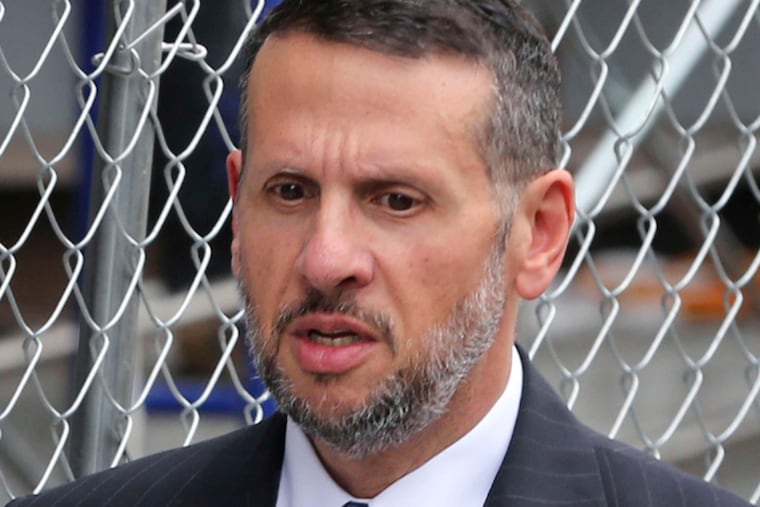
NEWARK, N.J. - As mysterious lane closures at the George Washington Bridge came under heightened scrutiny by the news media and state lawmakers in late 2013, David Wildstein told a close friend he wanted to fall on the sword to try to kill the story.
Perhaps by resigning from his made-up position as director of interstate capital projects of the Port Authority of New York and New Jersey, Wildstein thought, he would appease reporters and Democratic legislators digging into the September traffic jams that virtually shut down the borough of Fort Lee, Bergen County, for four days.
"I felt the story was going to go in a very bad direction, that it needed to be cut off, and that I felt that perhaps it might be in Gov. Christie's best interest if I resigned so that this story didn't hurt Gov. Christie or any of my other friends that were involved," he testified that he told Mike DuHaime, a friend of 15 years who was the governor's chief political strategist, in November 2013.
Over six days of testimony, Wildstein, the government's star witness in the federal trial of two former Christie allies, has cast himself as a political martyr who protected friends and a loyal soldier in Christie's brigade who followed orders - including an email he believed instructed him to cause "traffic problems in Fort Lee."
"I did not question senior officials in the Office of the Governor as to why they were telling me to do something," Wildstein told jurors last week under questioning from Assistant U.S. Attorney Lee Cortes.
When he was forced to resign in December that year, Wildstein says he consoled an "upset" friend - and alleged coconspirator charged in the case - by telling her: "I'll take this. This is on me."
But the trial of Bill Baroni and Bridget Anne Kelly, which is expected to last at least another month, has revealed numerous contradictions and distortions in Wildstein's self-portrait.
That's significant, because Wildstein's version of events is crucial to the government's case, even as it has sought to corroborate his testimony with emails and text messages.
Cross-examination will continue Tuesday.
For starters, Wildstein's testimony could help send Baroni, whom he described as "one of the closest friends I've ever had," to prison.
Even as he claimed to conceal the true purpose of the lane closures from some friends in the governor's office, such as aide Regina Egea, to "protect" them, he testified that he told others the whole story.
He now has said at least seven others in Christie's circle were given some knowledge about the purpose of the lane closures before the scandal erupted in January 2014: the governor himself; DuHaime; David Samson, the Port Authority's former chairman; Michael Drewniak, Christie's former press secretary; Phil Kwon, a Port Authority lawyer who worked under Christie at the U.S. Attorney's Office, joined his administration, and was once his nominee for state Supreme Court; Bill Stepien, Christie's two-time campaign manager with whom Wildstein was "very close"; and William "Pat" Schuber, a Christie appointee on the agency's board of commissioners.
"Would you agree with me that had there not been a legislative inquiry, a ton of press, and your resignation, and this [trial], you wanted to take full credit for the [traffic] cones? Correct?" Baroni's attorney, Michael Baldassare, asked Wildstein on Thursday.
Baldassare suggested Wildstein's true motivation for closing the lanes wasn't born out of an ethical code that valued blind loyalty to his superiors; it was vanity.
Just as he boasted for years about an incident in 1982 in which he stole Sen. Frank Lautenberg's jacket during a debate to put him "on edge," the bridge scheme would become another war story in the legend of David Wildstein, Baldassare suggested.
"Didn't you want to brag about this the same way you bragged about stealing Frank Lautenberg's jacket?" Baldassare asked.
"Sir, I never had an intention of bragging about the cones," Wildstein said.
Yet that's exactly what he says he did at a Sept. 11 memorial event in Lower Manhattan on the third day of the lane closures, when he and Baroni met with Christie. Baroni told Christie that there was a "tremendous amount of traffic" in Fort Lee and that the governor would be "pleased to know" that the Port Authority wasn't returning Mayor Mark Sokolich's phone calls, according to Wildstein.
Cortes, the prosecutor, asked Wildstein if he and Baroni were "bragging."
"Yes, very much so," Wildstein testified. "This was our one constituent. I was pleasing my one constituent. . . . I was happy that he was happy."
On Friday, Kelly's attorney, Michael Critchley Sr., showed jurors an email Kelly sent Wildstein on Sept. 14, 2013 - a day after an appointee of New York Gov. Andrew Cuomo ordered the lanes restored.
"Check out the Road Warrior," she wrote, referring to a news column in the Record about the traffic jams. "I'm confused."
Wildstein said he didn't understand what Kelly meant; he recalled discussing the article with her the previous day.
"She's directing you to check out the Road Warrior article?" Critchley asked, his voice rising, just as Wildstein claimed she had "directed" him to close the lanes.
This time, he didn't obey an order from the governor's office, contrary to what he described as his customary practice.
"You never responded, did you?" Critchley asked. Wildstein said he couldn't recall, but Critchley assured jurors that Wildstein had not responded to the email.
Wildstein didn't just want to serve the governor; he wanted him to know how valuable an asset he was to Christie's team, both then and in a presidential campaign, evidence suggests.
For example, on Aug. 15, 2013, a day before Wildstein knew he would see Christie at an event in Hudson County, Wildstein alerted Stepien to the various endorsements he had recently won for the governor.
"Awesome, just told the Gov," Stepien replied in an email.
Most striking, Critchley suggested, was Wildstein's ability to remember a phone call he had with Christie in 1977 but his inability to recall an email he sent Kelly on Aug. 12, 2013, the day before she wrote him, "Time for some traffic problems in Fort Lee."
Wildstein's email read: "I have an issue to discuss with you. Extraordinarily weird, even by my standards."
Wildstein couldn't recall what he was referring to. The man who always "protected" friends and served Christie's "best interests" was now someone, Critchley said, with a selective memory that served his "self-interest."
856-779-3846 @AndrewSeidman