Bridgegate's Kelly: Scapegoat or schemer? Jury will decide
NEWARK, N.J. - Bridget Anne Kelly was duped by a "maniac" and then made a scapegoat by Gov. Christie in a scheme to cause massive traffic jams near the George Washington Bridge in 2013 to punish a mayor she "didn't even know," her defense attorney argued Monday.
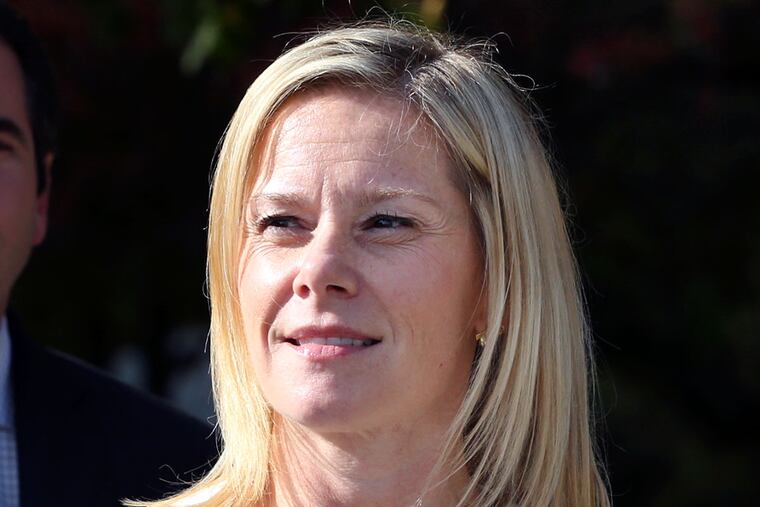
NEWARK, N.J. - Bridget Anne Kelly was duped by a "maniac" and then made a scapegoat by Gov. Christie in a scheme to cause massive traffic jams near the George Washington Bridge in 2013 to punish a mayor she "didn't even know," her defense attorney argued Monday.
Kelly, Christie's former deputy chief of staff, testified that she told Christie a month beforehand that Port Authority official David Wildstein had informed her that the agency was working on a traffic study at the bridge.
Then, when the issue came under scrutiny, Christie "lied about it," attorney Michael Critchley Sr. told jurors, "because it would affect his presidential campaign."
"At that time, he's the No. 1 candidate for the Republican nomination. He wants no blips. He wants no stains," Critchley said during a 2½-hour summation. "How does he avoid blips? How does he avoid stains? He says, 'I don't know anything about it.' "
During an 80-minute rebuttal, Assistant U.S. Attorney Vikas Khanna suggested that Critchley's focus on Christie was a red herring.
"He's trying to distract you from the core of the case," Khanna said. "Why? Because the evidence in this case against his client is devastating."
Jurors began deliberating Monday afternoon after hearing six weeks of testimony from three dozen witnesses, and seeing scores of emails, text messages, and other documents presented as evidence.
Kelly and Bill Baroni, Christie's former top executive appointee at the Port Authority of New York and New Jersey, are charged with obtaining by fraud and misusing the agency's resources, wire fraud, depriving Fort Lee residents of their civil rights, and related conspiracy counts.
Wildstein pleaded guilty last year in the case and testified against Kelly and Baroni.
Prosecutors allege that Kelly, Baroni, Wildstein, and others conspired to close two of three toll booth lanes available to commuters traveling through Fort Lee, Bergen County, in a scheme to retaliate against the town's mayor for refusing to endorse Christie's reelection campaign that year.
U.S. Attorney Paul Fishman has said Wildstein could face 21 to 27 months in prison, though he faces a maximum of 15 years. The most serious charges against Kelly and Baroni, such as wire fraud, carry a maximum penalty of 20 years in federal prison.
They likely will not face more than a few years in prison if found guilty.
Critchley on Monday argued that Kelly had an honest misunderstanding that the lane reductions were part of a legitimate traffic study. That was based on her conversations with Wildstein, who told her about the plan, and Christie, who signed off on it beforehand, Critchley argued.
Kelly testified that she also informed Christie's chief of staff, Kevin O'Dowd, about the traffic study.
Christie and O'Dowd have denied having prior or contemporaneous knowledge of the matter.
Because Kelly acted in good faith, Critchley argued, she should be acquitted of all charges.
Kelly's first honest mistake was trusting Wildstein, who turned out to be the "Bernie Madoff of New Jersey politics," Critchley said, referring to the infamous Wall Street fraudster.
Wildstein, a longtime political operative and trickster, wanted to "shine in Chris Christie's eyes," Critchley said, so that he could earn a top job on his presidential campaign and work in the White House.
In Wildstein's "sick mind," the lane-closing plan would improve traffic flow and demonstrate his value to Christie.
During the course of the week of the lane closures from Sept. 9 to 13, Kelly said, she followed up with Christie, telling him Fort Lee Mayor Mark Sokolich had contacted a staffer in the governor's office raising concerns about public safety and government retribution.
Kelly testified that Christie told her to let Wildstein handle the issue. Around the same time, the Port Authority sent out news releases describing the lane closures as part of a traffic-safety test, and after November's election, Sokolich wrote a letter to the editor of the Newark Star-Ledger in which he took umbrage with suggestions that he was the victim of a retribution plot.
"What is she supposed to do?" Critchley said of Kelly.
When the traffic study explanation started falling apart in December 2013, Christie, O'Dowd, and others Kelly said had been aware of the lane closures suddenly experienced "collective amnesia," Critchley said.
On Dec. 13, Christie told reporters that he was confident that neither his senior staff, which included Kelly, nor his campaign chief, Bill Stepien, had prior knowledge of the lane closures - directly contradicting information he'd received from various aides.
Kelly, whom Critchley repeatedly described as a single mother of four, "panicked" and started deleting text messages and emails related to the bridge. But Kelly said she informed her superiors and faced no trouble until some of her emails were made public on Jan. 8, 2014. She was fired the next day.
Critchley hammered the government for not calling Christie and some of his closest advisers as witnesses, arguing the lack of evidence created reasonable doubt of his client's guilt.
In what was perhaps the trial's climactic moment, Critchley turned toward the courtroom door and bellowed, "Chris Christie, where are you? Kevin O'Dowd, where are you?"
"They want that mother of four to take the fall for them," he said.
"Cowards!" he exclaimed. "Cowards!"
In his rebuttal, Khanna told jurors it was not their job to figure out "what other people did or didn't do, what other people knew or didn't know."
"Your job here is to evaluate all the evidence with respect to the two defendants: Bill Baroni and Bridget Kelly," he said.
Khanna rejected Critchley's characterization of Kelly as a victim, arguing she "embraced the punitive nature of the governor's office."
On Sept. 10, the second day of the lane closures, for example, Wildstein forwarded to Kelly a text he had received from Baroni. Sokolich, the text read, was complaining about "total gridlock" and problems "getting kids to school. Help, please. It's maddening."
"Is it wrong that I am smiling?" Kelly texted Wildstein.
He said no, explaining, "They are the children of Buono voters," referring to Christie's Democratic opponent in the election, State Sen. Barbara Buono.
"Smiling at schoolchildren being stuck in traffic. That's her response. Don't let them whitewash it," Khanna said. "It's as outrageous as it sounds. And Wildstein's response is also outrageous."
But why would he speak to Kelly about the lane reductions in "despicable" terms if he was trying to deceive her about the true nature of the traffic study?
"He wouldn't," Khanna said. "The evidence is as it appears to be, ladies and gentlemen."
856-779-3846
@AndrewSeidman