Obama campaign conjures up some Bubba magic
CHARLOTTE - For women, there was health care, abortion rights, and access to contraceptives. For gays, a celebration of the growing acceptance of same-sex marriage. Latinos got the keynoter, San Antonio Mayor Julián Castro, and President Obama's decision not to deport children of undocumented immigrants.
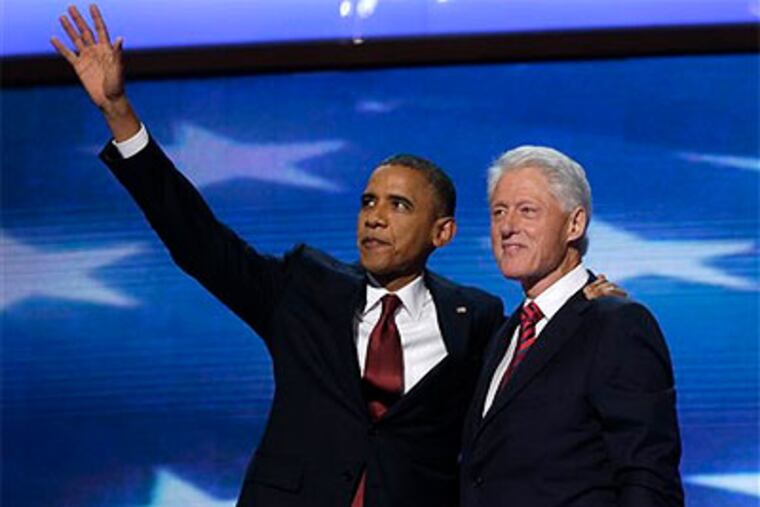
CHARLOTTE - For women, there was health care, abortion rights, and access to contraceptives. For gays, a celebration of the growing acceptance of same-sex marriage. Latinos got the keynoter, San Antonio Mayor Julián Castro, and President Obama's decision not to deport children of undocumented immigrants.
The Democratic National Convention seemed to offer a little something for every important demographic group in the party's coalition. On Wednesday night, though, it reached out to Bubba.
Former President Bill Clinton, the original political Bubba, was tapped to state the case for Obama's reelection in network TV prime time, with a special focus on the working-class white voters, particularly men, who are leaning toward Mitt Romney.
"My fellow Americans, you have to decide what kind of country you want to live in," Clinton said. "If you want a you're-on-your-own, winner-take-all society you should support the Republican ticket. If you want a country of shared opportunities and shared responsibilities- a we're-all-in-it-together society - you should vote for Barack Obama and Joe Biden."
He said that Obama's bailout of the auto industry, which Romney had opposed, saved a quarter of a million jobs. "Are you listening in Michigan and Ohio and across the country?" Clinton said to thunderous roars from his audience. "Here's another jobs score: Obama 250,000, Romney, zero."
In showcasing Clinton, the Obama campaign hopes to bring back some of the working-class white voters who have been slipping away from the historic party of labor for at least a generation. This year, Obama badly trails among them. And that is a threat to the president's reelection - because these so-called Reagan Democrats are concentrated in important parts of industrialized swing states, including Western Pennsylvania.
Recent polls show Obama with the support of just under 30 percent of white men without college degrees, the definition most pollsters use to define the working class. In 2008, Obama received 39 percent of this blue-collar white-guy vote, which actually was a high point for Democratic presidential nominees since 1980.
Democratic strategists know that the president is unlikely to win working-class white men outright, but he doesn't have to; approaching the number he hit four years ago - say, if he gets 35 percent of their votes - would help lift him to a second term.
The group is among the most Republican-leaning, in part, analysts say, because it shares a cultural affinity with the conservative party and a skepticism of the Democrats' support of same-sex marriage, gun control, and abortion rights.
In a Charlotte arena freshly festooned with placards that said "Middle Class First," Clinton faced a tall order - to make Obama's case that the nation's economic problems are deeply rooted and began before this administration, something that could sound like excuse-making coming from the president himself.
Clinton also serves as a reminder of better times, the 1990s prosperity that grew from fiscal policies he worked out with congressional Republicans- accomplishments he pointed out Wednesday night.
"Bubba is in the house," said Democratic pollster Jeffrey Plaut, a partner in Global Strategy Group which, along with a Republican firm, has done polling for The Inquirer. "The singular gift of Bill Clinton is that he appeals to working-class voters in Ohio, West Virginia, and Arkansas - and at the same time to Chardonnay-sipping liberals in Center City."
His empathy is legendary. In 1992, Clinton - battered by scandal over allegations of an extramarital affair with a lounge singer and by his Vietnam draft record - had his back against the wall just before the New Hampshire primary. But in a crowded community hall, the husky-voiced Arkansas governor asked blue-collar voters not to give up on him.
"I'll never forget who gave me a second chance, and I'll be there for you until the last dog dies," Clinton said then.
Just as in 1992, the nation is struggling to recover from an economic downturn - albeit a much deeper one - and the working class has been hard-hit.
"Many of the key swing states are in the industrial Midwest - Ohio, Wisconsin, Michigan - and they are filled with working-class voters who have tremendous economic concerns and stresses," Plaut said. "Clinton 'gets' these voters and is well-positioned to frame the source of the problem and the way forward."
In Pennsylvania, State Rep. Jesse White, a Democrat from Washington County southwest of Pittsburgh, said he believes Obama will benefit in his region from a sense that Romney, a wealthy former private-equity executive, is not on workers' side.
White used a phrase popularized by Republicans in the 1960s: silent majority.
"I think what you're going to see in some of these rural counties is a kind of silent majority, people who will just quietly go into the booth and vote for Obama because they agree with his policies or just don't connect with Romney," White said. "The problem in this area is that the Republicans have made Barack Obama so toxic that people are afraid to come right out and say they're for him."
Still, no amount of exhorting by Clinton or anyone else is likely to change many minds in a year when polls are detecting very few "undecideds." The Obama campaign's high command, while not writing off white working-class voters, is relying in part on a long-term demographic trend: minorities, particularly Latinos, make up a growing percentage of the American electorate, and polls show these voters overwhelmingly back the president.
Lawyer Mark Aronchick of Philadelphia, a longtime Democratic party fund-raiser who was in Charlotte, said the best way for Obama to tackle his problem with working men is to appeal to self-interest.
"It's not a Bubba message. It's an economic message: 'If you're thinking about Romney, you've been sold snake oil. There's nothing there for you.' "
Republicans think that Obama's the one peddling the snake oil - by attacking Romney's wealth, demanding the former Massachusetts governor's tax returns, and talking about abortion rights and other social issues to distract from the lack of economic progress under his administration.
And unemployment numbers between now and Nov. 6 may serve as stark reminders to blue-collar voters of that lack of progress.
"What if you're a middle-class bricklayer?" said Mark Harris, a Pennsylvania Republican strategist. "I don't know where their message is for them. 'We know things are bad but could be worse'?"
Keep up with the latest on the Democratic convention - including live reports from The Inquirer's Thomas Fitzgerald and Matt Katz - at www.philly.com/
conventionsEndText
at 215-854-2718 or tfitzgerald@phillynews.com, or follow@tomfitzgerald on Twitter. Read his blog, "The Big Tent," at www.philly.com/BigTent.