In Lower Makefield, history rides on zoning decision
Patterson Farm, founded in colonial times, has a rich history: The soil is among the most fertile in Bucks County, and patches of pumpkins, fields of corn, and heaps of fresh vegetables have grown there.
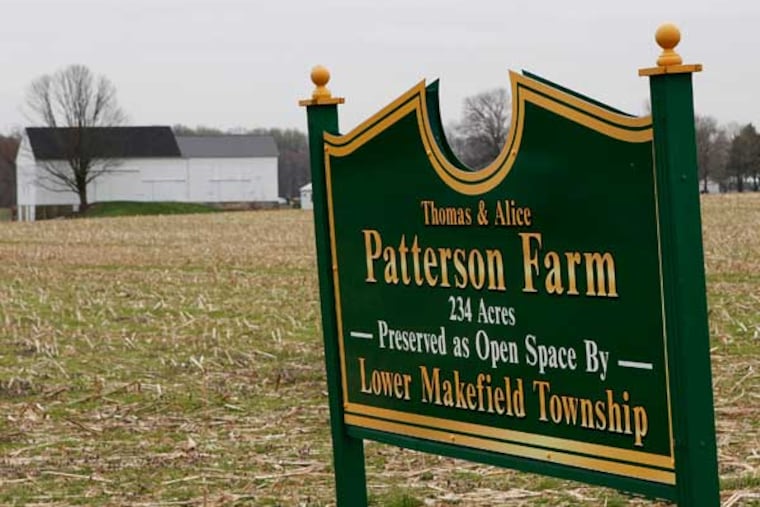
Patterson Farm, founded in colonial times, has a rich history: The soil is among the most fertile in Bucks County, and patches of pumpkins, fields of corn, and heaps of fresh vegetables have grown there.
For decades, Thomas and Alice Patterson owned the 234 acres in Lower Makefield Township and lived in the stone-covered Janney house, one of the property's two homes. The other - the Satterthwaite house, a large home made out of wood painted white - was built in 1760, according to Kaaren Steil, chair of the Lower Makefield Historical Commission.
The township bought the property in 1998 for $7.2 million. No one has lived there since 2002.
A farmer still tills about 180 acres. But the two homes, both eligible to be listed on the National Register of Historic Places, sat vacant for a time, and the legacy of a family-owned farm faded.
This week, however, some township residents hope the township's zoning board considers that legacy. On Tuesday, the board will continue discussions on whether to allow a husband-and-wife team of veterinarians to convert the Satterthwaite house, and a little more than five acres around it, into a hospital for horses.
A group opposed to the project is led by Donna Doan, a Lower Makefield native whose family once lived in the Satterthwaite house. She argues that the land is being parceled off for purposes other than farming, which she says is unacceptable.
The lone township supervisor to agree with her is Jeff Benedetto, who believes development on the property would violate the township's purchase agreement, which limits use of the land to agriculture, horticulture, recreation, and open space.
Doan said selling any of the property imperils the farm's future. She pointed to a variety of other projects that she believes have chipped away at its legacy, including the township's leasing the Janney house to the Artists of Yardley, a local artists group; an off-ramp for I-95 built on the farm's northeast corner; and several acres leased to Brighthouse Farms for hydroponic greenhouses.
"Ten, 15 years from now, we'll look back and wonder whether this was ever a farm," she said.
The potential repurposing of farmland is hardly unique. Tim Kelsey, a professor of agricultural economics at Pennsylvania State University, said that farming becomes much more difficult as areas become suburbanized, and as a result, counties like Bucks, Chester, and Delaware have seen traditional farms fall in numbers.
According to the Census of Agriculture, Bucks County had about 75,000 acres of farmland in 2007, down from about 230,000 acres reported in 1954.
But Kelsey added that land once used for traditional farms - dairy or cattle farms, for example - often finds a second life as nontraditional farms, such as hydroponic or community-supported farms, or can be preserved as open space.
The value of repurposing farmland, he said, is therefore often dependent on specific situations.
"It really depends on what type of agriculture the farmer is interested in wanting to do," he said. "And likewise it depends on the values and concerns of the neighbors."
Several Lower Makefield officials are concerned about the cost of maintaining the property.
Township Manager Terry Fedorchek said the township pays $620,000 annually to pay off the $7.2 million purchase price and has put hundreds of thousands into the houses to keep them standing.
The township collects only about $19,000 per year in farming rights, and about $20,000 per year from the greenhouses, he said.
In addition, according to Pete Stainthorpe, chairman of the Board of Supervisors, the houses on the property were deteriorating, and the township didn't have money to renovate them. So officials welcomed viable tenants, such as the Artists of Yardley - who repair, maintain, and upgrade the house as part of their $1-per-year lease.
The veterinary center has proposed to hire an architect to revitalize the Satterthwaite house.
Plus, Stainthorpe argues, the farm is maintained: 70 acres are protected from future development by an easement, and the township recently applied for another easement to protect an additional 90 acres.
"I think we're doing all the right things," Stainthorpe said. "And if we get all these pieces in place, we've got the gem of Bucks County."
Benedetto disagrees.
"The township bought that farm and is supposed to be protecting it," he said in a recent interview. "It's supposed to remain open space, and open space doesn't mean parceling it off piece by piece."
He thinks it's wrong to sell or lease the property for revenue.
"The reality of it is, that farm as a whole, it's not a cash register for us to go to and say, 'Hey, let's use this money,' " he said. "It's a protected open space piece of the township."
Doan has managed to rally support behind that point of view: A petition she started online to "Preserve Patterson Farm" had garnered nearly 1,000 signatures as of Friday.
Both she and Benedetto also say that the fate of Patterson Farm is about much more than just one farm in Bucks County.
"I'd hate to see an ever-shrinking acreage of farms for the almighty dollar," Benedetto said. "Because once it's gone, it's gone forever."