Security effort for pope's visit has already started
Pope Francis, on his first papal trip abroad, frazzled his security detail in Rio de Janeiro by pushing his open-air Popemobile so deep into the frenzy of adoring fans - some of whom were able to touch him - that the vehicle was stopped dead, completely surrounded by the swarm.
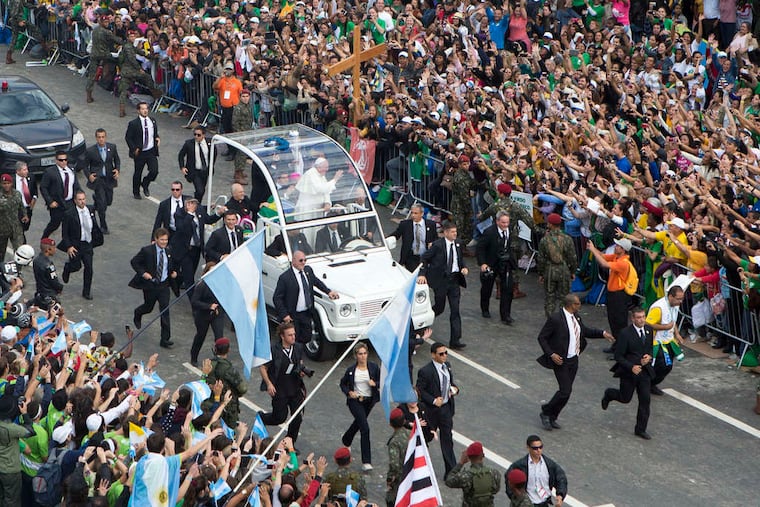
Pope Francis, on his first papal trip abroad, frazzled his security detail in Rio de Janeiro by pushing his open-air Popemobile so deep into the frenzy of adoring fans - some of whom were able to touch him - that the vehicle was stopped dead, completely surrounded by the swarm.
Francis later apologized to Vatican and Brazilian security but when asked whether he worried for his safety, shook his head and smiled: "I'm not aware of being afraid."
When the most popular pope in recent history - who has a tendency to stray from security protocol - comes to Philadelphia for a two-day visit in September, the city will be on its highest alert.
The crowd expected on the Benjamin Franklin Parkway for the pope's two outdoor appearances - a faith festival on Sept. 26 and mass on Sept. 27 - is estimated at 1.5 million people. That is more than 25 times the Center City residential population of 57,000.
Security planning started more than a year ago, before Pope Francis' visit was even confirmed. The U.S. Secret Service, which is in charge, meets daily with dozens of federal, state, and local agencies.
Their training, imagination - and the tragic lessons of history - will be needed to prepare for the expected and the worst.
"This may be the largest event ever in Philadelphia and possibly on the East Coast," said Donna Crilley Farrell, executive director of the World Meeting of Families, which is organizing the visit. "We need a very comprehensive plan that takes all eventualities into consideration."
No camping out will be permitted on the Parkway between the Saturday and Sunday events, so law enforcement must figure out how to safely screen, monitor, and release an enormous crowd twice in less than 48 hours. They'll be alert for any threats and protests, to ensure the safety of the crowd and the pontiff himself.
Francis will visit Cuba, Washington, and New York before his visit to Philadelphia, which is designated a federal Special Security Event. That means nearly every agency imaginable is at the city's disposal. Organizers have already raised $30 million of a $45 million goal for security, logistics, and transportation.
FEMA is on alert in case of a natural disaster or infrastructure crisis. The FBI's hostage team will be on hand, as will the National Guard, Pennsylvania State Police, the Secret Service, Philadelphia police, Vatican City police, Italian police, and the Swiss Guard, the pope's primary security detail.
Many of these agencies will reconvene in July 2016 when the city hosts the Democratic National Convention, also expected to get the federal Special Security Event designation.
Police Commissioner Charles H. Ramsey has said he would seek police reinforcements from neighboring states and send his top brass to the Vatican to prepare for the visit.
Robert Hoback, Secret Service spokesman, said 23 civilian and law enforcement subcommittees were helping plan - including transportation, airspace security, and credentialing of the 7,000 reporters from around the world expected to descend on the city.
True to form and mission, Hoback wouldn't disclose many specifics about preparations.
"Unfortunately, people out there - once you start giving specific information out about assets, the number of people we use, specific tactics, what we're looking for - people use that information to try and circumvent security."
Planning will likely take into account recent threats and the horrors of history, from papal assassination attempts to the 2013 Boston Marathon bombing.
In 1970, Pope Paul VI had to fend off a knife-wielding Bolivian artist dressed as a priest when he arrived at the Manila airport.
Pope John Paul II survived a 1981 shooting in St. Peter's Square in Vatican City. The attack led to adoption of the Popemobile, bubbled with bulletproof glass for amped-up safety.
Last month, acting on wiretap information and other intelligence, Italian authorities charged 10 men belonging to an al Qaeda-linked group with a 2010 terror plot that in part targeted the Vatican when Benedict XVI was pope.
Investigators said there was evidence of a planned suicide bombing attack in a crowded area, discussed as "a big jihad in Italy."
"The good guys are pretty obsessive about doing their jobs well," said Steven Bucci, director of the Center for Foreign and National Security Policy at the Heritage Foundation, a conservative think tank. "And they'll be twisting themselves in pretzels trying to find every possible thing a bad guy might think of, and have a plan to stop them before they get there or deal with them if it does happen."
Bucci said some things were certain: The hundreds of thousands of visitors will likely be asked to come well in advance of the pope's arrival. They and their belongings - if bags are even permitted - will be subject to heavy screening and metal detectors or handheld wands.
"People are going to Mass, so they don't want to put everyone in an invasive position . . . but the pope is potentially a heck of a target . . . so the checks will have to be fairly rigorous," he said.
The most critical monitoring will likely come from snipers on the many rooftops lining the Parkway.
"Their job, frankly, is primarily to spot trouble, not necessarily to shoot it . . . they're the ones who pick up someone who's moving the wrong direction in the crowd or moving a little faster than they need - anything out of the ordinary, they'll report from above," Bucci said.
Ahead of the event, investigators can use search algorithms to screen the Internet and social media for buzzwords suggesting any threats.
"Events like a visit from the pope can bring out all sorts of people, and you have to be concerned about security from everything from very purposeful malicious sophisticated threats to attackers who are upset or deranged individuals," said Henry Willis of the nonprofit RAND Corp., which focuses on national security.
Collaboration with hospitals and emergency medical response teams is also key in case of a terror incident or a more benign medical issue. Rick Hong, head of emergency medical services at Cooper University Medical Center, said Cooper was among several local hospitals on alert.
Hong said plans must include how to get people to the hospitals in an emergency, negotiating large crowds and roadblocks.
"There's a lot to consider to be careful and prepared. It's not just a security issue - there's a huge medical component," he said.
Hong said one hospital, not yet determined, would be designated to treat the pope should he need any medical attention.
RAND's Willis said the rapid emergency response to the Boston Marathon bombing demonstrated how planning and communication can keep a bad situation from becoming worse.
"You want to prevent things from happening, but in the event of an incident, a lot of peoples' lives can be saved through an effective response," Willis said.
215-854-5506 @juliaterruso