More than a church, 'for the service of all'
MALINDI, Kenya - A whiff of wood smoke says there's a shantytown behind a row of little shops, and the smell grows stronger inside that maze of hot, narrow alleys.
MALINDI, Kenya - A whiff of wood smoke says there's a shantytown behind a row of little shops, and the smell grows stronger inside that maze of hot, narrow alleys.
Beyond a vacant dirt lot is the source of the smoke: a ramshackle cube of sooty corrugated steel, six feet square. Inside, a thin young washerwoman, Evelyn Akinyi, crouches over a wood fire, frying fish in a cast iron pan to sell to passersby.
"It's hot," a visiting health-care worker exclaims at the door, and steps back. "Fantastically hot!"
Her supervisor, Sister Margaret Obwoge, nods but says nothing.
Sister Margaret and Rhoda Nyambwogi are health-care workers from a nearby Catholic parish, the closest thing to a nurturing family that Akinyi, 22, and her three children have.
For Akinyi, who has HIV, and thousands others of the area's sickest and poorest, it is the Catholic Church that keeps them alive, comforts and feeds them, and gives them hope.
As Roman Catholicism explodes across Africa - 200 million Catholics now live on the continent, 16 percent of the world's total - the church brings faith and comfort to millions of all religions struggling with war and terrorism, famine, desperate poverty, disease, and human trafficking. Half the African population with HIV is cared for by the church.
In September, the Archdiocese of Philadelphia will host the church's eighth World Meeting of Families. The six-day international gathering, capped by a visit from Pope Francis, will celebrate the role of family in human society.
But here in this city of 68,000 on the Indian Ocean, the institution of family is in tatters, ravaged by poverty, sex tourism, child marriage, human trafficking, and AIDS.
Akinyi, speaking in Swahili, tells the health workers that her aunt, whose shack this is, has gone "up country" to Nairobi for a few days, and so is not here to bar them from seeing how she and her three children live.
She wants them to see.
She dampens the fire and gathers her children.
To call Malindi a city is to challenge any Western understanding of that term. Rather, it is a population center connected by rutted roads to a small "downtown," on the coast, of a few office buildings, banks, shops, street vendors, gas stations, gated and beach resorts, and a red-clay airstrip.
The 13,000-square-mile Roman Catholic Diocese of Malindi has its offices in the city, but its parishes reach far inland and up the coast as well, to encompass a half-million people. About half are Muslim. Only 40,000 are Catholic.
On the city's outskirts, subsistence farmers still live in thatched-roof huts on incomes of about $1 a day.
Closer in, steel-roofed cinder-block shanties, some with vegetable plots that flourish or fail with iffy rains, are what most call home. About a quarter of the homes have earthen floors. Bishop Emanuel Barbara guesses a "normal worker" earns about $130 a month.
With almost no trash collection, roadsides and vacant lots are heaped with black plastic bags, where little goats are left staked to feed. The wood smoke hides the smell.
Few families hold together in such grinding poverty, where jobs are few, sex starts young, HIV is rife, and men leave child-rearing to women.
The Rev. Albert Buijs, vicar of administration for the Malindi diocese, estimates that just one household in five has two parents raising the children and able to make ends meet. "It's a mess," he said.
Yet thanks to international relief organizations and a diocesan network of 17 parishes, 33 priests, 63 nuns and six brothers, the modest Catholic presence in Malindi enjoys a breadth of operation that no single mosque or Christian congregation here can match.
"We are here for the service of all," said Barbara, a 66-year-old missionary of the Capuchin Franciscan order, to which Philadelphia Archbishop Charles J. Chaput belongs.
"We don't distinguish between Catholics and Christians and Muslims," Barbara said. "For us, the human person comes first. But mostly, we target the poor."
The Malindi Diocese operates a network of 36 primary and 19 secondary schools, where 40 percent of pupils are Muslim. It runs five health clinics; promotes clean water projects; teaches agriculture, animal husbandry and hygiene; makes microfinance loans; is about to open a spacious, cheerful shelter for sexually abused children; runs outreach to prostitutes seeking to quit; operates two homes for disabled children; and tends to people of all faiths struggling with HIV or AIDS, like Evelyn Akinya.
Carrying her infant daughter with her older children in tow, she leads the two health-care workers down twisting alleys to a doorway and steps into a dim corridor cluttered with plastic jugs, a water barrel, and clothes drying on a line.
She enters a 7- by 9-foot storeroom where an upright wheelbarrow sits in a corner. On the floor are two thin foam pads, the mattresses where Kevin, 11, Jacquelin, 4, and Douline, 1, sleep with their mother.
This room is their home.
They take seats on the mattresses. Jacquelin plays with a broken glass mirror, her only toy. She, like her mother, has HIV, the potential precursor to AIDS.
Her own mother died when she was 7, Akinya explains, and her father handed her over to his sister to raise. Her aunt has always viewed her as a burden.
Hungry for affection, she was seduced by a 20-year-old man and gave birth to Kevin when she was 11. "I was not raped," she said; he "was my boyfriend." But he soon abandoned them.
She was married at 17, to a man who drank heavily and beat her. He also sired the two other children, she said, and was the source of her and Jacquelin's HIV, which the girl contracted in utero.
Akinya fled her abusive marriage after four years and returned to her aunt's home. "But I am not welcome," she said in a soft voice. "If I live in this house, there is no hope for the future."
As the young woman spoke, Nyambwogi suddenly smacked at her own ankles, then fingered the thin sheets and shot a glance at Sister Margaret. "Bedbugs!" she exclaimed in English. Sister Margaret was soon slapping her ankles, too.
Then Akinya spoke of having a "chest problem." Nyambwogi said she would have her tested for tuberculosis. A significant health problem in Kenya, TB appears frequently in crowded slums and affects about half of HIV patients.
And when Akinya, a Catholic, mentioned that none of her children was baptized, Sister Margaret replied, "I will see to it."
Outside, both health workers were distraught. "This is among the worst I've ever seen," Sister Margaret said, and the two began identifying the steps they needed to take.
"Beds would cost 35,000 shillings," or about $38, Sister Margaret said, and getting the Akinyas into a new home might cost $100. Nyambwogi agreed. "We have to get them out of there," she said.
As grim as the situation seems, both women voiced confidence that they could turn Akinya's life around - just as the Catholic Church had turned around Nyambwogi's.
"In 2009, I found out I had HIV," she explained. "I thought my life was over, that I would die." A widow with a young daughter, she had no one to turn to until she met Sister Margaret, then director of a diocesan outreach to people with HIV and AIDS. Funded from 2005 to 2010 by the U.S. government, it was a project of Catholic Relief Services.
Although Nyambwogi, 49, is Baptist, "Sister Margaret brought me food for two years," she said. "She helped pay my rent. She helped me educate my girl.
"From there, I got courage. I became strong," she said, and laughed as she pinched her forearm to show how plump she had become. "Now I'm a volunteer, helping others."
For all its grinding poverty, Malindi is a paradise - for foreigners. Boasting palm trees and sandy white beaches gently lapped by the blue Indian Ocean, its waterfront became a popular resort destination for Europeans, especially Italians, starting in the 1960s.
Dozens of elegant resorts, many themed with Kenya's traditional high, cooling thatched roofs, dot the coastal landscape - albeit behind gates and security guards. Small children regularly greet white tourists with "Ciao," assuming they are Italian.
The flow of wealthy tourists "has been a mixed blessing," said Buijs, a Dutch-born missionary (pronounced bowse) who serves as a parish pastor as well as diocesan vicar. Now 74, he has served in Kenya for 45 years.
"Tourism gives the people jobs. They drive taxis, work in the hotels, and sell their fruits and vegetables. But it has also brought with it prostitution, child abuse, human trafficking, and AIDS."
Nearly a quarter of all girls in the Malindi region between ages 12 and 18 trade sex for money or favors, a 2006 study by UNICEF found, with about half starting by age 14. Tellingly, one pastor lamented to the researchers that of the 17 girls who started in his confirmation class, 10 dropped out to join the sex trade.
And that was when times were good.
Since 2013 the radical Islamist group al-Shabaab, the Somali arm of al-Qaeda, has conducted a string of massacres across Kenya, leaving 67 dead at a shopping mall in Nairobi, and 60 Christians slaughtered last June in Mpeketoni, a town at the north end of the Malindi Diocese. About half were Catholic.
Then, in April, on Holy Thursday, its soldiers murdered 148 Christian students at a college in Garissa, near the Somali border.
Malindi has been spared "up to now," said Barbara, adding that most locals feel safe. Catholics there even held a defiant three-hour Good Friday procession through the streets on the day after the Garissa massacre.
But tourism is draining away.
Many Western nations, including the United States, are warning citizens to exercise extreme caution when traveling in Kenya, especially near the coast, and in Malindi the resorts and spas are closing, putting thousands out of work and straining already fragile families to the breaking point.
"The situation must change by the end of the year," said the bishop, "or there will be real poverty" in a region where two-thirds of the population already lives below the "absolute poverty" line of 200 Kenyan shillings, or $2, a day. Forty-three percent cannot meet the "minimum food requirements," said Buijs.
It is a prospect all too real for 42-year-old Joel Kingori.
Married, with four young children, he was procurement manager at a resort when its European owners abruptly closed it. "I have not been paid since January," he said. Once middle-class by local standards, "now we are not able to meet expenses."
"We might open a shop," Kingori said, sounding brave but looking worried. "We would sell flour, rice, sugar - common things. You must have a good job to raise the children. To feed them and clothe them, to live as other people."
Devout Catholics, the Kingoris said their parish has helped them pay for food and school tuition as they struggle.
But many of the region's most desperate families look to prostitution as "a way to put food on the table," the UNICEF study found. The report estimated that 15,000 women under 18 were engaged in prostitution in Malindi and three other coastal cities, including the port city of Mombasa. Many of the patrons are European, and will pay $20 and more for a sexual encounter with a teenager - more than her parents might earn in a week.
An older white boyfriend, called in Swahili a mzungu, "can be seen as perhaps the only hope of lifting the child and her family out of poverty, or at least to a better standard of living," according to UNICEF.
And yet "the level and acceptance of sexual exploitation of children in coastal areas . . . represents a fundamental breakdown and corruption of families and communities," the report said.
About 2,500 women are sex workers in Malindi, according to Elizabeth Nafula, who heads the diocese's outreach to prostitutes.
On nighttime forays into the bars and hotels where they solicit, she steers about 50 each year into new careers, such as hairdressing, she said, but many of the women are "hard to reach."
On a recent foray to a beach-area bar that's a popular pickup joint, the prostitutes refused to talk to Nafula when they saw her in the company of a photojournalist. An angry man - likely a pimp - barred the door and demanded to know who Nafula was.
A sexualized childhood is a way of life for many girls here. Despite laws barring marriage before 16, some parents still arrange marriages for underage daughters, often for a dowry of a few cows and goats.
In the rural Bamba district of Kilifi county, for example, fathers annually parade their daughters - some as young as 10 - in the market square as prospective brides. Men call them katsanga kenye, or "young catch."
There is also a significant problem with incest in the coastal region, according to Catholic Relief Services.
The situation is so difficult that Barbara, who became Malindi's bishop four years ago, "was having sleepless nights," he said, "because of the children of the diocese."
"I began to ask myself, 'How can we help these people?' " he recalled recently.
Children fleeing prostitution, incest, unwanted marriage, and other abuse needed a safe haven, Barbara concluded, where they could get counseling and peer support.
He would name it, he hoped, after the new pope, Francis.
But "I am from Malta, an island of 500,000," he explained in accented English. "So it was very difficult to raise money in my own country" - and impossible within his diocese.
Last month, however, the Rev. Bernard Malasi, head of the diocesan office for children, turned his car onto a dirt road on Malindi's outskirts.
Smiling broadly, he paused and gestured toward what lay ahead.
"I think," he said, "the bishop's prayers were answered."
Ahead, in an open field, sat a compound of 13 one-story structures surrounded by a high yellow wall. Malasi honked his horn, and a security guard opened a steel gate to admit him.
Inside, just weeks from completion, sat a remarkable new campus of 13 buildings on 21/2 acres, funded by an American donor.
It's called the Pope Francis Home. [See story, Page P6.]
One piece of good news about Malindi is that most of the Muslims, Christians, and traditional religionists get along.
True, last year's al-Shabaab slaughter of Christians in Mpeketoni was within the Diocese of Malindi, but 110 miles away - far enough for most Malindians to feel safe.
Yet poor young men without jobs can turn volatile, as the U.S. Military Academy noted in a 2012 report on who joins al-Shabaab.
And so, interfaith bridge-building is another partnership project of the Catholic Church here.
"We're not looking for altar boys," Grace Ndugu, program manager for the Catholic Relief Services justice and peace-building program in Kenya, told 20 clergy gathered last month in a Malindi hotel. They included Muslims, Catholics, Anglicans, Pentecostals, and leaders of the indigenous religions.
It was the last day of a conference where Ndugu was trying to get the clerics thinking about possible "connector projects" that CRS is prepared to fund.
The idea, she explained, is to get young Christians, Muslims, and those of the traditional faiths working together and getting to know one another.
Ndugu strolled over to Sheikh Abdulrahmad Ahmed Badawy, who sat flanked by two other senior imams in ivory robes and kufis.
"But we're not singing to the boys in the choirs, are we?" she asked.
The elderly imam shook his head and smiled.
"No, no," Badawy replied. "We must reach those who are vulnerable to the fanatics."
A connector project could be a school, or a clinic; an irrigation dam or a "bore" for drinking water, Ndugu said.
Catholic Relief Services hopes to fund two connector projects, at a cost of about $400,000, on the Kenyan coast, according to country director Lane Bunkers. He said his agency has invested $4.6 million in the Malindi Diocese over the last decade, and projects it will spend $2.5 million over the next two years.
He is also waiting to hear about a five-year, $42 million U.S. Agency for Economic Development grant to provide services to vulnerable children in Kenya's five coastal counties. The area comprises the diocese, whose employees, like Sister Margaret, would likely administer local services.
"It would be fair to say that the Catholic Church provides a significant amount of the social services in the area, including health and education, and certainly more than the Anglicans, the Muslims, and other religions," he said.
World Vision, an evangelical Christian relief organization based in the United States, is also a major presence in Kenya.
After 45 years as a missionary in Africa, "Father Albert," as Buijs likes to be called, tries to be sensitive to cultural differences. But he has a problem with some.
Like most people who live in Africa, for example, he takes a dim view of Europe's and America's newfound enthusiasm for same-sex marriage. And yet he treads cautiously around the church's insistence that marriage be between one man and one woman.
Buijs was cordial and engaging as he paid a visit one afternoon to the small, neat home of Francis Katma Charo, 47, and his 36-year-old wife, Josephine Haluwa.
Charo has two wives. Haluwa is his second. She greeted Buijs with a rosary around her neck.
He and his first wife were unable to have children after 10 years, Charo explained, so his wife proposed she find him another "so you may have children." He agreed.
She then asked Haluwa, who said yes. A Baptist, she was rebaptized Catholic because Charo asked her to do so.
The two soon had a son, he said, but then he and his first wife got pregnant, and they have three more. "A miracle," he said with laugh.
Even more miraculous, Haluwa raises the three children from her husband's other marriage in her small home during the school year, because her house is closer to the local school than theirs. Along with her son, they range in age from 8 to 15.
In Swahili, Haluwa said she and the first wife "get along very well."
"We share ideas all the time," Haluwa said. Her great regret, however, is that she and her husband cannot receive Communion because of their marriage.
"I cannot change church law" that bars Communion to divorced-and-remarried Catholics, and those in multiple marriages, Buijs told them. "I would like to. But until the pope changes things, we can do nothing."
On the drive back to his rectory, he was philosophical.
"With polygamy, you can't make a general judgment," he said as he drove along Malindi's two-lane coastal road.
In western Kenya, where he began as a young priest, it was the custom for a man whose brother had died to "marry his widow and take care of her - sexually and financially," he recalled. A pipe smoker, his manner is affable, his Dutch-traced English impeccable.
"Well, the church comes down and says, 'No, you can't do that. If you do, you can't receive Holy Communion.' But if this custom did not exist, many women would have no choice but prostitution.
"They have no education, so what else is there? So [polygamy] gives them a security and a place to live."
Buijs was not so forbearing, however, when he passed a white man in his 60s driving a motorcycle with a black African girl of about 14 gripping his waist. Asked if he supposed their relationship was sexual, he said, "You can be sure of it."
"That's why they come here," he said. "And he's just what many of these girls and their parents are looking for: a rich American, a rich Italian," who might father a child with her and "leave her a legacy. But mostly, the men just disappear."
He also lamented human trafficking, for which Malindi is notorious.
"Someone goes to a girl's parents and says, 'I'll give you 200,000 [shillings, about $2,023] for your daughter," said Buijs. "It's more than they've ever seen. And they say OK. Next thing you know, she's in Germany or Italy or Dubai, on the streets, or working as a servant."
Malindi's young males are likewise vulnerable to the charms of older foreign women - and men - who use them as "beach boys" - sexual playthings for a night or a summer.
"We teach children about the dangers of tourism and pregnancy and AIDS" in grades four through eight, Buijs said. "But making them aware is one thing. Getting them to do it is another."
None of Malindi's Catholic clergy expects the bruising poverty here to end any time soon. Al-Shabaab's vow to make Kenya's cities "red with blood" may elicit shrugs from most Malindians, but they fear that the wealthy foreigners may be gone for good.
Some said their departure might lead to a decline in the city's corrosive sex industry, but it might also compel more young people into prostitution, still earning less than before.
Civic leaders must cultivate new sources of revenue, like commercial pineapple and mango groves, Barbara has told them, but "I see very little happening," he said.
Like poor people the world over, however, many take comfort that a loving God watches over them.
On Friday afternoons, Malindi's streets are busy with Muslim men and boys, looking noble in their caps and ironed robes, walking to prayer.
And on a Sunday morning, a whiff of incense says there's a church behind that stuccoed wall, and it grows stronger beyond the gate.
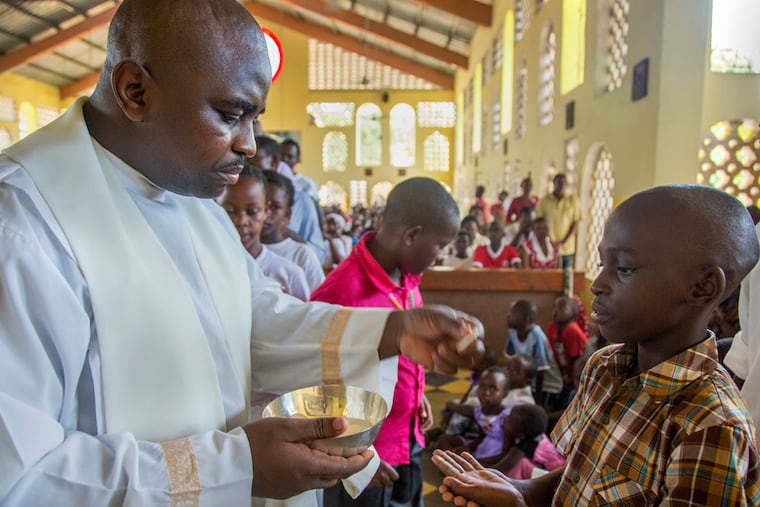
Inside St. Francis Xavier Church, where Buijs is pastor, the 700 hard, slatted seats are filled. Its walls, inside and out, are painted gold and lime green - the same as Pope Francis Home.
The processional begins, elaborate as a High Mass. It features six altar boys in white cassocks, 100 men who have just finished a diocesan retreat, a dozen young girls dancing in T-shirts and white satin skirts, a man carrying a Bible over his head, and three priests.
"Bwana Ulinde," cries the choir in Swahili: "Lord, God."
"Watato wako," the congregation refrains: "Save the children."
And they sing it again and again - "Bwana Ulinde, watato wako" - as the procession surges and sways up the main aisle.
At the rear, flinging holy water on the crowd from a palm frond, comes Buijs, in cream-colored vestments.
The people are swaying and clapping. On the left, a man lets out a deep, musical "Brrrrrrr." To the right, a white-haired woman pierces the singing with loud ululation, the high, tremulous wail that many Africans use for mourning and celebration.
Later, when another procession brings gifts of flour, beans, sugar, vegetables, bananas, mangoes and bread to the altar, Sister Margaret whispers to a visitor: "I will be bringing those to families tomorrow."
The collection plate on a typical Sunday brings in about $200 - about 30 cents for each parishioner.
"For me, the church is a very great comfort," said Christina Mbwili, 45, who sat with her husband and preteen son and daughter.
"In 2012 I suffered an attack of breast cancer," she said in English. "It is through the church I am still living. It is because of the church I did not despair."
Her husband, Boniface, 40, nodded. "We are living by the grace of God," he said. A sculptor who once made fine wood carvings for tourists, his business was now "over 90 percent down" from a year ago. "We are doing nothing," he said, but selling for export.
But the parish "is helping us financially with fund-raising," he said, "and with money for your treatment," he said to his wife, who is "still under medication."
She nodded. "I cannot tell if I am well or not well."
"And yet the music, the Mass - to be with the people here is so arousing," Boniface said.
"Yes," said Christina. "When you don't come to church on Sunday, you feel you are missing something. But when you're here, it makes you very happy. It lasts throughout the week."
The Mass, in Swahili, lasts three hours and eight minutes. "Why not?" Buijs asked afterward, feigning surprise that anyone would think it lengthy. "It's a celebration."
It's also plenty of time to study the large mural of the Holy Family to the left of the altar. Mary, a black African, is smiling as she weaves a basket. A black Joseph also smiles as he clasps a hand on young Jesus' head.
But Jesus is not smiling. Looking about 6, in shorts and sandals, he is holding a hammer, about to strike the first of three large nails - a clear foreshadowing of his crucifixion. His reproachful glance at Joseph seems to ask: "Do you know what awaits me?"
It is the somber question that seems to hang over all of Malindi region, especially its young. Watato wako.
Yet here in the pews on a Sunday morning, thoughts of HIV and al-Shabaab, the next meal, and the vanishing tourists seem banished by the joyful singing and dancing and prayers - and a confidence that their church walks with them.
"God is helping me and showing me light when there is darkness," said Akinyi, whom Sister Margaret and Rhoda Nyambwogi had visited earlier in the week at the fish-fry shack. She walks to St. Francis Xavier almost every morning for Mass.
"He gives me courage," she said, pressing her palms together and pointing them skyward, then closing her eyes for just a moment. "He gives me strength."