Spiritual journey from singular place
Luis Medina's eyes wandered curiously upward to the stained glass windows of St. Joseph Pro-Cathedral in Camden. He tapped his ring finger repeatedly against his thumb and swayed in the pew.
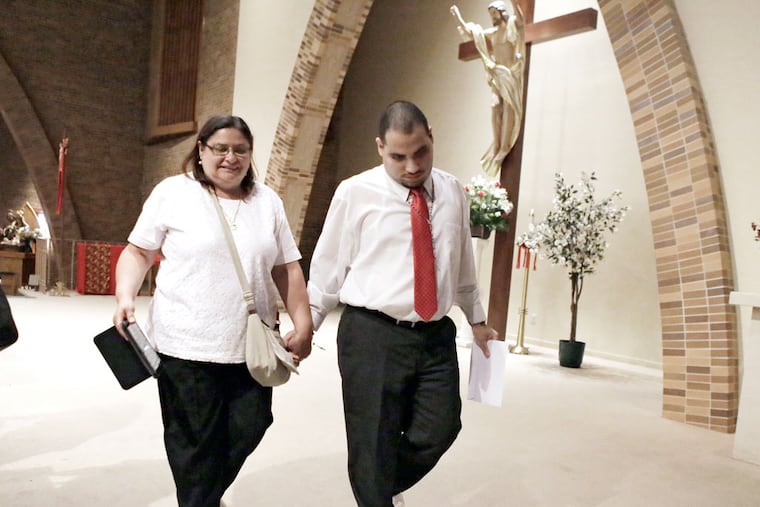
Luis Medina's eyes wandered curiously upward to the stained glass windows of St. Joseph Pro-Cathedral in Camden. He tapped his ring finger repeatedly against his thumb and swayed in the pew.
Medina, 23, stood beside his much younger peers, whose eyes were focused on the priest welcoming them into the church on their confirmation day.
With very limited language and the cognitive skills of a 4-year-old, Medina, who has autism, is locked in his own world - but is also every bit a part of the one at St. Joseph's. There, he finds comfort in the familiar tenor of the cantor's voice, the call-and-response cadence of the Mass. There is peace in knowing that each Sunday morning will begin with the smell of incense and end with McDonald's pancakes.
Church is a constant he can rely on in a sometimes painfully chaotic world.
"He's an individual - he's a person that needs special supports, but we still want to give him the chance to be able to do everything all the other families do," said his mother, Susana, who prepared him for confirmation. "Whatever he learns, he learns. He may not be able to grasp all of it, but you have to give him that opportunity."
Susana and her husband, Hector, of Camden, have been bringing Luis to St. Joseph's since he was a baby. Both are eucharistic ministers and are heavily involved as volunteers in the parish.
Luis was baptized in this tight-knit place, where everyone holds hands during the Our Father and the sign of peace lasts five minutes, as parishioners crisscross the church to find and embrace friends.
When a young man with intellectual disabilities starts shouting and moaning during an opening prayer, the celebrant says gently, "He's excited to be here. Aren't we all."
It's also a community that showered the Medinas with love and encouragement after an accidental shooting in 2013 wounded Luis and his caregiver.
The Medinas go to the English-speaking Mass at 9 a.m. - slightly quieter than the crowded Spanish one afterward - and always sit in the fourth pew from the front on the right side.
Luis sucks on peppermints when he gets antsy and runs his hands over his buzz cut as the cantor sings. He rests his head on his dad's shoulder when he gets tired, and makes the sign of the cross with an extra tap over his left shoulder.
"He did good today," Susana said following the ceremony.
Her son needs 24/7 monitoring. Now that he's gotten stronger with age - about 5-foot-6 and 200 pounds - two people need to be around him in any public setting, in case he tries to run away. He can't communicate easily if agitated, which makes bringing him to crowded places difficult. But the Medinas don't want to keep him inside. They want him in the light of the community and their faith.
"This is a place where people care deeply about each other," said Sister Veronica Roche. "It's a place of merciful hearts."
The Catholic Church's guidelines on inclusion and support for its disabled members predate the 1990 Americans With Disabilities Act. A 1978 pastoral statement by the U.S. Conference of Catholic Bishops encouraged all churches to make their facilities accessible and "embrace our responsibility to our own disabled brothers and sisters." A revision in 1995 reaffirmed that all sacraments should be accessible to people with disabilities.
Last year, the Pontifical Council for Health Care Workers held an international conference to discuss autism and how the church can better support those affected by it. Pope Francis has called for greater acceptance of people with autism, and a dismantling of the "isolation" and "stigma" families often face.
The church offers religious classes to people with disabilities, but because those with autism often need individualized attention, Susana, a teacher's aide in the Camden School District, decided to teach her son herself. With Luis, she spent September through May teaching two other young men with autism, all confirmed last month.
"They need their own program, five-minute breaks, a lot of repetition. What I'm doing is whatever is most comfortable for them," she said.
Using picture books and programs on a tablet, she helped them identify cartoon images of God the Father, Jesus, and the Holy Spirit.
Luis can usually point to each when asked, and his parents celebrate those victories. "He never gave up," Hector said. "He learned that from us, too."
Hector and Susana met taking college courses in Massachusetts and moved to Camden in 1989. They had Hector in 1990 and Luis in 1991. Each also has three children from previous marriages.
When Luis was almost 2, he fell backward in his crib and started seizing. Doctors at a hospital could not immediately diagnose him. Once home, his behavior became strange.
"It was like something stopped," Susana said. He'd sit by himself and tap on the four corners of a table. They took him to a specialist at Cooper University Hospital, where he was diagnosed with autism.
"We had no clue what autism was then. There were the usual emotions - 'I don't do drugs, I took care of myself during the pregnancy,' " Susana said.
Hector and Susana had help from their older children when Luis was growing up. Now he goes to a day program at the Jacob Schaefer Center run by Bancroft, a health-care provider for adults with autism and other intellectual disabilities. His parents care for him at home.
Rosa Moya, Susana's only daughter, discovered several years ago that her son, Jose, 14, also has autism.
Her reaction, she said, was just, 'OK, he's my son and I'm going to be here for him,' " Moya said. "People say I got patience from my brother Luis - I don't really know if I did."
Moya is raising Jose on her own while taking nursing classes. She also brings him to church every Sunday. The boys received confirmation together.
"It's pretty hard going with him [to church] and people not understanding what we go through," Moya said. "If they have an off day, other people won't understand why they're acting this way - why are they upset - and ... sometimes we have to explain they don't really understand. They're not technically here, per se, but they feel like us, they still hurt and stuff."
The church is trying to reach out to families in different ways - in the Camden Diocese, six parishes offer monthly Masses for people with disabilities, a number that Sister Bernadette McMenamin hopes to see grow.
"We need to do a better job encouraging those folks that have special needs to make their needs known to the pastors so we can be more welcoming," said McMenamin, who directs the Camden Diocese's ministry for deaf and disabled people.
Autism has risen consistently over the last decade, a disorder about five times more common in boys than girls. It affects one in 68 children nationally, according to the U.S. Centers for Disease Control and Prevention.
In New Jersey, one in 45 children - one in 28 boys - are estimated to be affected. At 21.9 kids per 1,000, New Jersey's is the highest autism rate in the country, according to CDC.
Living in the heart of Camden, congregants at St. Joseph are no strangers to the senseless violence that can shake even the most fervent believers.
In February 2013, tragedy struck the Medinas. Luis got off a bus after a school program and darted away from his aide - as he does sometimes when things pique his curiosity - and ran toward a neighbor's house.
As he banged on the door, his aide chased after him. The homeowner, possibly mistaking them for intruders, opened fire with a gun, hitting Luis in a shoulder and the caregiver in the chest.
They were rushed to a hospital, Luis in stable condition and the caregiver in critical condition. Both survived.
The shooter, an off-duty police officer, was not charged and the Prosecutor's Office determined there was no criminal conduct.
Susana Medina said it frustrates her because she can never hear from her son exactly what happened that day.
"I think our faith got us through it. Being spiritual is the best medicine," Susana said.
She and her husband worry sometimes about what lies ahead - more misunderstandings - or the day when they can no longer care for their son. She tries to suppress those fears by focusing on the next day - the next milestone.
At least 500 members of the community filled St. Joseph for the Tuesday evening confirmation. Red and white rose bouquets decorated the altar. Young women wore white dresses. Luis wore a dress shirt and tie, his rosary around his neck.
Bishop Dennis J. Sullivan told the confirmands to have merciful hearts and treat one another with dignity.
Afterward, the families filed outside to pose with the bishop. When it was Luis' turn, he yelled "cheese" as his mother snapped a photo.
Out in the parking lot, he hugged his mother and then his father, who kissed him on the cheek. "You know who I am?" Hector whispered into his son's ear. "Dad," Luis said in a low whisper.
"You're the love of my life," his father whispered back, flicking a tear off his cheek, as crowds of children and proud parents got into their cars.
This sacrament, which most teenagers prepare for in the throes of hormones, is traditionally pegged to some heightened spiritual self-awareness, a knowing confirmation of one's faith.
But McMenamin, the sister from Camden, put it in more universal terms, terms Medina could understand.
"You know, it's really not so much that we are declaring, 'We love God,' as much as we are accepting the fact that he loves us," McMenamin said. "So it's really a celebration of the whole community of love."
215-854-5506@juliaterruso