In Philadelphia, linking Passover to the Civil War
To adorn his Passover table, J.A. Joel could find no sweet paste to represent the mortar that Jews used to build Egyptian storehouses. Instead, he used the closest symbol he could find - a brick.
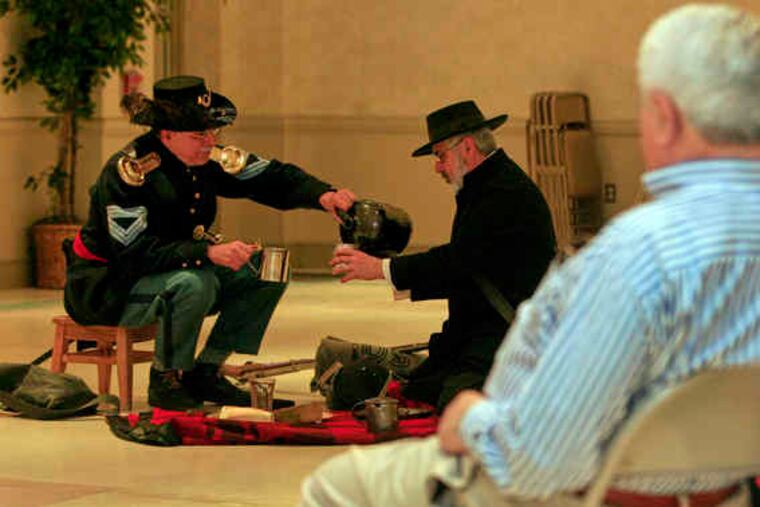
To adorn his Passover table, J.A. Joel could find no sweet paste to represent the mortar that Jews used to build Egyptian storehouses. Instead, he used the closest symbol he could find - a brick.
Joel had no choice but to improvise. He was in the Union Army on the front lines of the Civil War, but still he found a way to observe the festival that marks the Israelites' freedom from slavery.
That scene, which Joel later recounted in a letter, was reenacted last week as part of a yearlong program in the Philadelphia region to illuminate the lives of Jews during the War Between the States. It was one of 60 events here since November in One Book, One Jewish Community.
The program is designed to generate conversation about Jewish issues, themes, and history through the communal reading of a book, said Debbie Leon, who is directing it. In its third year, the initiative is a project of the Jewish Federation of Greater Philadelphia in partnership with the Auerbach Central Agency for Jewish Education/Jewish Outreach Partnership.
This year's book, All Other Nights, is a 2009 historical novel about a group of Jewish spies during the Civil War. In a story that begins with the murder of one Jew by another for the Union cause, the book tackles themes including loyalty, freedom, faith, and country. Passover, which ends Tuesday, is an important part of the story.
"There is an assumption that the Jewish community was lined up with the North on the side of antislavery forces," said Rabbi Lance Sussman, senior rabbi at Reform Congregation Keneseth Israel in Elkins Park and a Civil War scholar.
"The Jewish community of the 1860s was a mirror of the general American community," Sussman said. "The Jews were divided the way the rest of America was divided."
Those fissures and the historical backdrop behind them are being discussed in book groups, on museum tours, and during lectures and reenactments that are part of One Book, One Jewish Community.
Dara Horn, author of All Other Nights, wrote the book after visiting a Jewish cemetery in New Orleans. She saw names on tombstones that dated to the early 1800s.
"I started looking into it, and I discovered a tremendous amount of Jewish participation in the Civil War: in the army, politics, and espionage," Horn said.
The main fictional character in her story is Union spy Jacob Rappaport, who kills his uncle, a Confederate spy, during a Passover seder in New Orleans.
The book's historical characters include Judah P. Benjamin, a Jewish official in the Confederacy who held cabinet positions including secretary of state.
The book also touches on Jewish female spies and families separated by geography who fell on opposing sides of the conflict. Horn also incorporates Gen. Ulysses S. Grant's order expelling Jews from parts of Kentucky, Mississippi, and Tennessee - a decree that President Abraham Lincoln quickly overturned.
About 150,000 Jews lived in the United States when the war started. About 10,000 of them served in the army: 7,000 for the North, 3,000 for the South, Sussman said.
The largest Jewish communities in the North were in New York, Philadelphia, and Chicago. New Orleans had the largest number in the South.
Horn found her book title, and a critical irony, in the observance of Passover.
Rappaport murders his uncle at the family's celebration of freedom, a seder served by slaves. Even though slavery conflicts with Jewish values, Horn said, the characters are so eager to adapt and blend in as Southerners that slavery becomes an accepted part of their lives.
The book's title comes from the Passover liturgy. It is a phrase in one of the four questions asked during the seder when the story of the escape from slavery is told: "Why is this night different from all other nights?"
"The question is asked to emphasize the escape from slavery, but what the question really emphasizes is that freedom is not just a physical state, but a mental one," Horn said. "It takes real imagination to see that tonight doesn't have to be the same as every other night. We can make choices."
Last week, Civil War reenactors re-created period scenes in the lives of Jewish soldiers, at Congregation Or Ami in Lafayette Hill and at Temple Sholom in Broomall.
At Temple Sholom, Mira and Bruce Form became Myer Asch, a Union soldier, and Rebecca Moss, of the Ladies Hebrew Association for the Relief of Sick and Wounded Soldiers.
In Lafayette Hill, 15 reenactors led by Florence Williams portrayed scenes, including Union Army soldier Joel's seder experience. They remembered Joel's own words:
"There in the wild woods of West Virginia, away from home and friends, we consecrated and offered our prayers and sacrifice," Joel wrote to the Jewish Messenger newspaper. "There is no occasion in my life that gives me more pleasure and satisfaction than when I remember the celebration of Passover of 1862."