Philadelphia's oldest synagogue thriving with hope
After laboring for 12 years to revive historic Congregation B'nai Abraham in Queen Village, Rabbi Yochonon Goldman will begin Yom Kippur services Friday evening with a sense of hope.
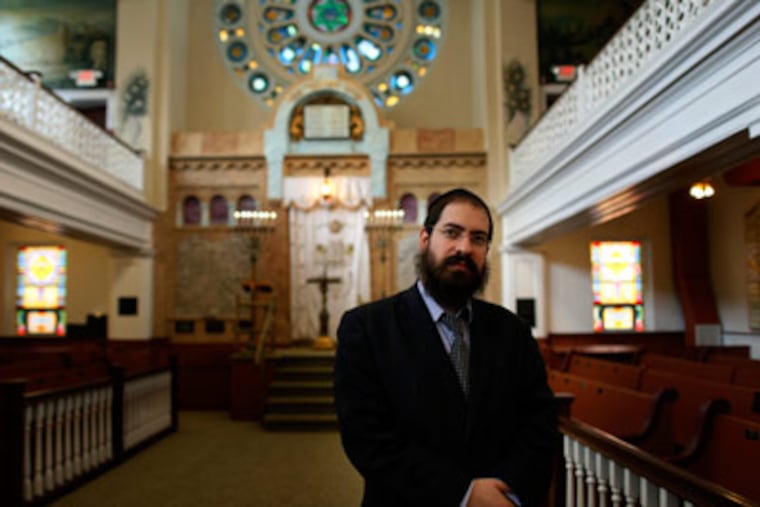
After laboring for 12 years to revive historic Congregation B'nai Abraham in Queen Village, Rabbi Yochonon Goldman will begin Yom Kippur services Friday evening with a sense of hope.
"Thank God, I can say we are no longer focusing on surviving, but on thriving," Goldman said this week after lugging a stack of High Holiday prayer books into the vestibule of his capacious, Old World sanctuary.
Thriving is in the eyes of the rabbi.
The oldest Philadelphia synagogue in continuous use, B'nai Abraham a century ago drew as many as 1,000 worshipers - women upstairs, men on the main floor - to its Rosh Hashanah and Yom Kippur services.
But after World War II, the offspring of its mostly Russian-immigrant founders began their own migration, this time northeast through the city and into the suburbs, leaving South Philadelphia behind. By the 1950s, the remnant congregation could not afford a permanent rabbi; by the 1970s, it could not even gather the 10 men needed for a prayer service.
Today, however, the 137-year-old Orthodox congregation is resurgent, with 75 members.
Just how many prayer books, or mahzors, might be needed this weekend is hard to say. B'nai Abraham is that rare synagogue that does not issue tickets or charge a fee for its High Holiday services.
Its open-door policy is just one way of attracting Jews of all denominations and levels of observance looking for a place to worship. And a few of those who make their way to 527 Lombard St. for Yom Kippur just might decide to be a part of B'nai Abraham's future.
"If you consider every Jew a member of the community," said Goldman, a rabbi of the Hasidic Lubavitcher tradition, "you want to welcome them."
Yom Kippur, the solemn Day of Atonement that starts the Jewish new year, begins at sundown and continues through Saturday. The summit of the High Holidays, which began Sept. 29 with Rosh Hashanah, Yom Kippur is the "holiest day of the year, when all Jews feel the need to renew their relationship with God," Goldman said.
No ordinary rowhouse shul, this tan-brick building fronted by columned arches and a stained-glass window was built in 1910 and became home to the city's chief rabbi. Its congregation, which formed in 1874, was made up mostly of Russian Jews fleeing persecution by Czar Alexander II. They filled the painted pews to overflowing.
Goldman, who grew up in South Africa, shook his skullcapped head as he told the story of B'nai Abraham's decline in the second half of the 20th century. The synagogue president would roam sidewalks, asking passersby whether they were Jewish and imploring them to come in.
"The big question," Goldman said, "was whether this synagogue would even make it to the 21st century."
Today, Goldman asserts, B'nai Abraham appears to have a sustainable future.
It is home to a Jewish preschool, hosts an educational website called Phillyshul.com ("shul" is Yiddish for "synagogue"), and sponsors numerous courses and classes on Jewish faith and practices.
Built in traditional Ashkenazik or Eastern European Jewish style, its sanctuary features a central bema: the enclosed platform and table where the Torah is read during services.
Women are still restricted to the upstairs balcony, in accordance with Orthodox traditions, but there are a few concessions to modernity.
Services are in Hebrew, but the prayer books feature English translations. The sanctuary's many menorahs and chandeliers are fitted with energy-efficient fluorescent bulbs, and the 600 wall plaques memorializing the dead are illuminated with computer chips.
Those plaques will be ablaze during Saturday's yizkor service, when the congregation - and Yom Kippur visitors - will honor the memories of their loved ones and say prayers for their atonement.
Jews "don't need a synagogue to connect with God," said Goldman, but on Yom Kippur, most seek to do so with traditional prayers and rituals in community. "In our final prayer, we celebrate that God has answered our prayers and that the year ahead will be one of blessing, health, happiness, and prosperity."
Last year, B'nai Abraham drew about 250 worshipers to each of its free Rosh Hashanah and Yom Kippur services. Goldman wonders whether he will see more this year because of the struggling economy and high unemployment.
Experience has taught him that only a few of the strangers who push through the doors will likely become members.
But it is to God, not his historic sanctuary, that Goldman seeks to ultimately steer the unaffiliated and less-observant Jews of Queen Village and beyond.
"On Yom Kippur," he said, "God lets us in."