Celebrating a life, a life's work
Priest turns 100 next week, his voice as strong and clear as ever.
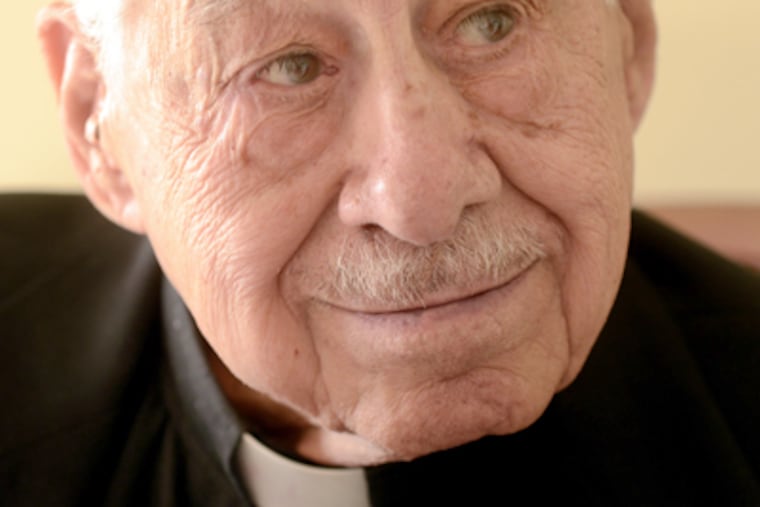
Don't be surprised if the Rev. Thomas W. Logan smiles during next Sunday's Gospel reading.
It will be on eternal life - a topic about which he seems to know a thing or two.
And don't be surprised if the friends, family, congregants, and bishops packed into St. Thomas African Episcopal Church in Overbrook applaud his sermon.
Logan turns 100 next week, and the historic parish, where he is an active associate priest, is celebrating the life of the oldest African American cleric in the Episcopal Church.
"My father was a devout churchman, and I guess you could say I was nudged to follow him," Logan said last week at his Center City apartment.
Born March 19, 1912, the era of the Model-T Ford, the white-haired cleric gave up driving just last year - and only because his family insisted. "He gave us quite a fight about that," said a niece, Anita Trotman.
His voice has the strength of a 60-year-old's. He reels off dates and names in a finger snap, and instantly recognizes old acquaintances in photographs and newspapers (Jesse Jackson, Justice Robert Nix, singer Nat King Cole, President Gerald Ford) without benefit of glasses.
Rector of Calvary Episcopal Church at 41st and Brown Streets from 1940 to 1984, Logan is the third-oldest living priest in the Episcopal Church and oldest alumnus of Central High School, from which he graduated in 1930.
The younger half
But he's the junior partner at his three-room apartment overlooking Logan Circle. As he reminisced about the Tom Mix movies that he showed in the basement of his father's South Philadelphia church, his wife, Hermione, listened quietly. She turns 101 on Friday.
They met in 1934 when he played varsity football at Lincoln University and she was an undergraduate at the rival Institute for Colored Youth - today's Cheyney University - where her Harvard-educated father, the poet Leslie Pinckney Hill, was president.
They married in 1938, after he earned his divinity degree from General Theological Seminary in New York and she hers from Columbia University. Although she is in frail health, theirs is the longest clergy marriage in the Episcopal Church, according to church officials.
'A joy'
"He's been a blessing to me and a blessing to this church," said the Rev. Martini Shaw, rector of St. Thomas, which was founded by black abolitionist Absolom Jones in 1792. Jones was also a pioneer in African American freemasonry.
Logan reads the Gospel and distributes Holy Communion most Sundays, and preaches several times a year at St. Thomas and other churches.
"He's really a joy," said Shaw, who arrived at St. Thomas about 10 years ago and discovered Logan, who had retired as a rector at age 72, sitting in the pews as a congregant. Shaw quickly made him an assistant priest.
Logan served for years as a dean in the Diocese of Pennsylvania, where he was also a canon, or adviser to the bishop. The recipient of seven honorary degrees, he also served on the board of Haverford Hospital, and was longtime grand master of the Prince Hall Grand Lodge of Pennsylvania, the state's black Freemasons.
Standing in a spare bedroom overflowing with photos, diplomas, Masonic insignia, and other memorabilia, he held out a black-and-white photo of the late Rev. John R. Logan surrounded by six young men.
"That's me," he said, pointing to a mustachioed man standing close to his father, "and those are my brothers." Logan, who still sports the same Cab Calloway mustache he wore a half-century ago, gazed for a moment at the photo.
"All of us went to college," he said. Their oldest brother, John, succeeded their father as rector of St. Simon the Cyrenian parish on South 22d Street.
He has survived them all, as well as his three sisters, and last April even buried his son and only child, Thomas Jr., also an Episcopal rector. "Father, son, and grandson," Logan said. "All priests."
But the liberal Episcopal Church of today was a far more conservative church when Logan entered the ministry. Like most African American priests of his day, he was assigned to "colored work," serving black parishes. When Logan's predominantly black Calvary parish merged in 1945 with mostly white St. Michael's, the white rector of another parish urged Logan's white parishioners to defect.
"Within three years, we [at Calvary] were all-black again," Logan recalled.
He describes himself as having been "conservative" in the early days of the civil rights movement. As president of the Hampton University Ministers' Conference in Virginia in 1961, he turned down a request by several "freedom riders" integrating Southern lunch counters to speak to the all-black gathering.
"Most of our members were older," he explained, and viewed the riders as "too radical."
By 1968, however, he was cofounder of the Union of Black Episcopalians, and Coretta Scott King, wife of the Rev. Dr. Martin Luther King Jr., once spent a winter's night at the Logans' home in Yeadon after a visit to Philadelphia.
"The airport was snowed in and she needed a place to stay," he said. He served many years on the board of the Philadelphia chapter of the NAACP.
Although he opposed the women's ordination movement of the 1970s, Logan said he had met some "wonderful" female clergy. "Why, now we've got women bishops, and black bishops," he said, "and even black women bishops!"
His sermon for next Sunday is forming, he said, but is on a theme of "the Lord is my Shepherd."
Shaw, who calls Logan his "true mentor" and "inspiration," is not sure how the sermon will unfold, "but I'm sure it will be memorable."
"His faith is strong, he loves the Lord, he loves the church," said Shaw, "and it shows in the life he lives."
at 215-854-5723 or doreilly@phillynews.com.