It began with an e-mail nine years ago. Novelist Jonathan Safran Foer asked a friend to join in a writing project.
That touched off nearly a decade of meditation and reeducation in the Judaism of Foer's youth.
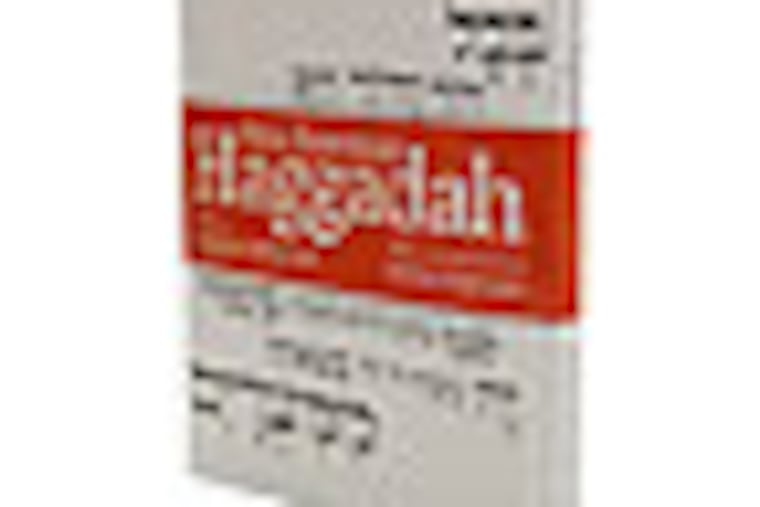
The result - or, says Foer, the beginning, the thing that started it - is the New American Haggadah (Little, Brown, $29.99), just out.
The Haggadah ("Narration") is the text of prayers and readings that constitute the order of the seder at Passover. On April 6, Jews all over the world will sit down to the table for a family meal, a retelling of the Exodus account of the Jews' delivery from Egypt, and above all, questions. Why, after all, is this night different from all other nights?
"To my mind," Foer says, "the success of a Haggadah corresponds to how vibrant and unresolved the questions are. These are questions that have survived for 3,000 years. The challenge is to keep them alive, not answer them."
He approached his chosen task, he says, "with humility and anxiety." There are more than 7,000 Haggadoth in print, and many more handmade Haggadoth, created and preserved, in the culture of their origin, by families everywhere.
(Thus the title: New American Haggadah. "That's just traditional: you name it after the nation of origin. It's meant for people everywhere.")
Why one more? "I've been attending and loving seders my whole life," says Foer, author, among other books, of Extremely Loud and Incredibly Close, the 2005 novel that was the basis of the film nominated for a best-picture Oscar this year. He describes his family as "a pretty classically assimilated American Jewish family, nonobservant, although I did go to Hebrew school and did have a bar mitzvah." Family seders created wonderful memories. "They're precious - the only time of the year when my extended family gathers at the table to discuss the biggest of all themes and the hardest of all questions."
Still, Foer began to wonder: "Is a seder good enough if it creates nice memories, or is there more? Can it change us? Question who we are? Activate a personal, familial, communal ambition?" Such questions spurred the idea of a new Haggadah, and the nine years of study.
It's quite a production, expansive and instantly striking thanks to the watercolors and calligraphy of Israeli artist Eded Ozer. Foer presided and edited. He enlisted novelist Nathan Englander, author of What We Talk About When We Talk About Anne Frank and other books, to translate the text. Then he invited a range of fine writers - who at one time included Tony Kushner, Simon Schama, and Susan Sontag - to write brief commentaries.
But "the book wanted to be something different," says Foer, "a unified, functioning, useful document."
So the present Haggadah offers four sets of commentaries: "Playground," playful observations by Daniel Handler, the beloved "Lemony Snicket" of kid-lit; "Library," by philosopher and novelist Rebecca Newberger Goldstein; "Nation," political ruminations (often provocative) by journalist and foreign-affairs writer Jeffrey Goldberg; and "House of Study," religious takes by Jewish studies expert Nathaniel Deutsch. A timeline tracing the history of the Haggadah, by Mia Sara Bruch, runs along the top of the pages, from 1250 B.C. to here and now.
The irrepressible Englander waxes rapturous when asked what he discovered in translating the original text. "It changed the way I see the world," he says. "This text is so powerful and stunning in the Hebrew and Aramaic. It's a text you should read it and weep, it's so beautiful."
Englander, who calls himself "a terrible choice for a translator," did a preliminary version, but as he worked, "I'd look at a line and I'd say, 'That's not what I hear in my head.' I began to understand just what I was taking on: I wanted something that anyone reading in English would hear what it truly says in the Hebrew."
Which meant "I had to commit myself utterly to it, take ownership, not only for meaning but also for rhythm, sound, the length of the word - and even for what the translation would mean for readers years from now, in the continuance of the tradition."
What once seemed a straightforward task now became a passion. Englander sought out a partner, Baruch Thaler, with whom he could engage in the intense partner-study traditionally known as hevruta. Just as Foer had been led on a nine-year study of Judaism (Foer: "I wrote my friends, saying, 'Send me the 20 best books about being Jewish' "), Englander was on his own path, discussing, comparing, studying, arguing.
Details exploded with cosmic significance. "Think of the phrase 'our God.' That's the usual translation," Englander says, "but the feeling is wrong, of ownership, as if God belongs to us. Think of the difference between that and 'God of us,' which is closer to the intent of the original. A small, crucial thing."
Englander reflects with a laugh on Foer's concept. "It's risky. There's so much, so much here."
Goldstein, who wrote the "Library" commentaries, agrees. "Jonathan had us all work separately," she says, "quite without reference to one another. I'm astonished he pulled it together, and how well it holds together."
Foer gave her "next to no instructions, trusting us," she says. "But my understanding was that I would take on the universal issues arising from the text: freedom and belief, the problem of suffering, how much are we in control and how much are we not." Goldstein "was thinking about the broadest possible audience, believers, unbelievers, Jews, and non-Jewish guests at the table, children and adults." Above all, she was seeking to remain true to her sense of the text and its fountaining meanings: "It's painful when you can't find your way to something that's absolutely authentic."
For the passage "In every generation each person must look upon himself as if he left Egypt," Goldstein writes: "Haggadah means narration, and tonight's celebration insists on the moral seriousness of the stories that we tell about ourselves."
It's that deep respect, even in the midst of playful or challenging comments, that comes across with the New American Haggadah.
"It's about being loyal to the text," says Englander, "not just what it means but what it's meant to mean."
The last pages are reserved for family notes and memories. Editor Foer expresses a hope that could stand for the whole book: "Over time, this book will become a living record of its use."