State laws vary, often leaving out LGBTQ protections
Even among the 45 states with hate crime laws, provision vary widely.
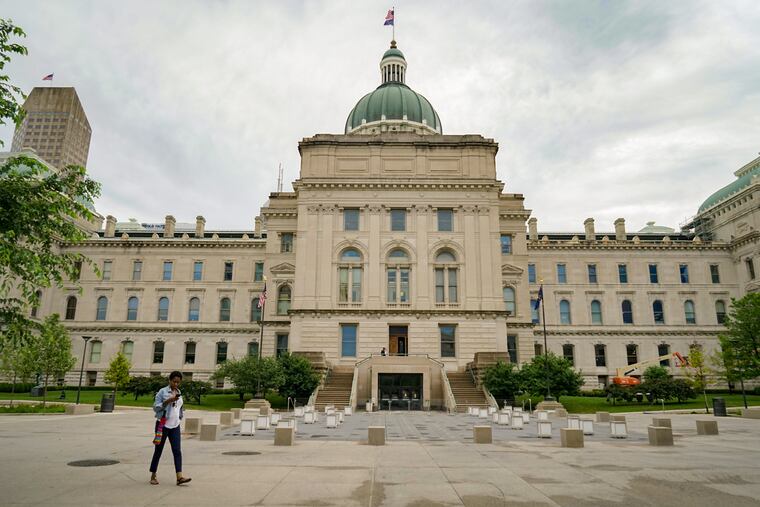
INDIANAPOLIS — Pastor Ron Johnson has long played a role in conservative politics in Indiana. Three years ago, he stood behind Mike Pence as the then-Indiana governor signed a religious-freedom bill designed to offer legal remedies for people whose "exercise of religion has been substantially burdened."
The legislation thrust Indiana into the national spotlight as local and national business leaders feared the law might be used to "justify discrimination based upon sexual orientation or gender identity." In the week after Pence's signing, lawmakers scrambled to enact a legislative fix declaring that the religious-freedom law does not allow discrimination.
Since then, Johnson, pastor of Living Stones Church in Crown Point, has opposed legislation that would specifically criminalize targeted hate crimes, including those committed against lesbian, gay, bisexual and transgender people. The state is one of only five — along with Arkansas, Georgia, South Carolina, and Wyoming — without a law specifically criminalizing hate crimes that target people by race, religion, gender, sexual orientation, or other characteristics.
"It's a bad path for everybody," Johnson said of the hate-crime legislation in an interview with News21. Last year, he created a video series titled "Why I Hate 'Hate Crime' Legislation" that was distributed online to a network of 500 pastors through Johnson's Indiana Pastors Alliance.
Like other religious conservatives in the state, Johnson contends such legislation treats citizens unequally and could be used to criminalize his belief that marriage should be between a man and a woman.
"Anybody who loves religious liberty and loves freedom of speech should hate hate-crime legislation," he said.
Among the 45 states with such laws, provisions vary widely. Most designate race, religion, and national origin as motivations for hate crimes. However, 13 states do not include sexual orientation, and 33 do not include gender identity. Laws in California, Iowa, and West Virginia include political affiliation as a consideration in defining hate crimes. Other states have recently added designations for law enforcement, the homeless and disabled people.
Some state laws make it possible to charge someone specifically for committing a hate crime, while others provide for increased sentencing for those convicted of underlying crimes, such as murder, rape, assault or vandalism.
Indiana State Rep. Greg Porter, a Democrat, told News21 that hate-crime laws are needed to give prosecutors the power to seek sentencing proportional to the nature of the offense.
"If a crime is committed against you because of your race, that's not just a crime against you," Marion County Prosecutor Terry Curry said in an interview with News21. "That is a crime against the entire community."
In Utah, where the law only prohibits crimes committed "with the intent to intimidate or terrorize another person," Salt Lake County District Attorney Sim Gill said he has never brought a successful hate-crime prosecution. It's the only state whose statute does not list specific factors, such as race or religion, that might motivate a hate crime.
Gill said this has more than once put him in the uncomfortable position of explaining to victims why he may not be able to help them find justice.
"Justice should not be the accident of geography," he said. "You should not say that I have a measure of justice because I happen to live on this side of a geographic boundary vs. across the street.
"There is a justice being denied to a whole large section of our citizens in this day and age who deserve a better response from our elected officials and our elected representatives."
In December 2014, Rusty Andrade, a gay man, was attacked when returning with a friend to his Salt Lake City apartment, which was across the street from a gay club. Andrade's memory of that night is blurry. He just remembers sharing a goodbye hug with his friend, then two strangers approaching.
"Do you want a problem, faggot?" the men yelled, according to court records, after Andrade, 37, asked them to leave the property.
The men beat Andrade, an attorney, outside his apartment building. He remembers his friend's screams, his head striking the ground and his skin tearing against the stucco wall.
Two Wyoming men were identified as the attackers after leaving a wallet behind. State and federal authorities investigated, but the FBI decided not to pursue the case. The state didn't file misdemeanor assault charges until a year and a half after the attack. The two accused men fled to Wyoming, though the attack was never classified as a hate crime under Utah law.
Since then, Andrade has repeated his story to media and lawmakers, citing the lasting effects of the attack, including head trauma and PTSD. He has lobbied lawmakers to make Utah's law stronger and more inclusive. The state's handling of his case has left Andrade feeling revictimized.
"It tells you that who you are and your very existence is not worthy of dignity," he said. "It's not worthy of protection. It's not worthy of respect."
In Arkansas, the conversation about a hate-crime law has stalled, state legislators say, because of an inability to compromise on inclusion of LGBTQ people. State Rep. Greg Leding, a Democrat, called his 2017 bill a "lonely cause."
"People thought it was establishing some crimes, some murders, were more important than others, and that's not the case," Leding said. "If the crime is motivated by hate, then that entire community is targeted and feels terrorized."
It has been 19 years since hate-crime legislation was last introduced in Wyoming, the state where in 1998 Matthew Shepard, a 21-year-old gay college student, was beaten in the head with a .357-caliber revolver and left to die. Former Wyoming State Sen. Mike Massie tried four times in the 1990s to sponsor legislation but was shut down every time.
If not for the proposed LGBTQ protections, Massie said, his legislation would have passed. He said fellow senators and representatives approached him repeatedly, asking that he remove specific protections for the LGBTQ community. The senator refused.
"There was a very strong sentiment in the house at that time against any type of legislation pertaining to the LGBTQ community," Massie said. "That one was never verbalized on the floor; it was much more behind the scenes, at the same time quite powerful in defeating the legislation."
In Indiana, after several legislative defeats, members of the Indiana Alliance Against Hate — a group of interfaith leaders, business owners, law enforcement officers, prosecutors and lawmakers — is shifting its message. The alliance, which has grown to nearly 100 partner organizations since its inception in March 2017, learned in January that Indianapolis would be one of 20 finalists for Amazon's lucrative HQ2, which promises to bring a $5 billion worth of investment and 50,000 jobs.
But after passage of the 2015 Religious Freedom Restoration Act, advocates worry Indiana's lack of a hate-crime law could deliver an economic blow.
"When you have laws that are oppressive, that stunts growth and that's something we feel is unacceptable," said Tim Brown, director of policy and legislative affairs for the Indianapolis Chamber of Commerce. "We want to always have the perception and make sure that people understand that our city overall is a welcoming city."
Last month, a Nazi flag and Iron Crosses were spray-painted on a brick shed owned by a synagogue in the wealthy Indianapolis suburb of Carmel, renewing calls for greater hate-crime protections after legislation failed in committee this year. Past attempts had advanced to the Senate floor, and one bill even passed the Senate before dying in a House committee.
The vandalism at Congregation Shaarey Tefilla drew the attention of key political figures on both sides of the hate-crime debate, and the Legislature's Corrections and Criminal Law Committee will study the issue in late August and September.
Indiana Gov. Eric Holcomb, a Republican, spoke out for the first time in support of legislation, saying, "No law can stop evil, but we should be clear that our state stands with the victims and their voices will not be silenced. For that reason, it is my intent that we get something done this next legislative session, so Indiana can be one of 46 states with hate-crimes legislation — and not one of five states without it."
News 21 reporters Alexis Egeland and Rebecca Walters contributed to this story.