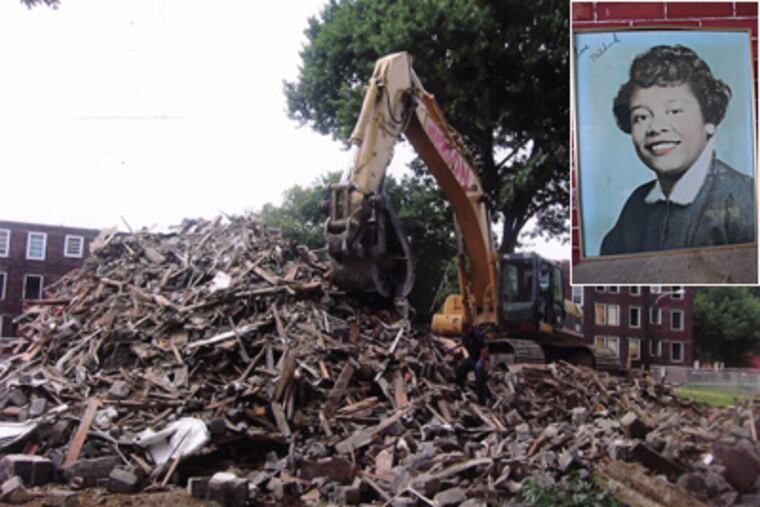
In her signature pink bonnet and pink pants, Mildred Barnes was the lost soul of Abbottsford Homes.
With $25 for her favorite J&B scotch tucked in her black bra, Barnes suffered from dementia and saw and spoke to people long ago dead.
Managers at this Philadelphia Housing Authority development knew that Barnes was delusional. They also knew she was stubborn and wanted to stay in her home of 39 years, one that was slated for demolition.
But crews failed to make sure her building was empty before the excavator's metal claw tore it into rubble.
Barnes died alone at the age of 65, buried under a mountain of steel, stone and rubble in what was the only refuge that looked familiar to her.
PHA workers didn't realize their fatal error until the next morning, July 15, 2005, when they arrived with a backhoe to chop up the debris.
The family of Mildred Barnes filed suit against PHA, and on the eve of the trial, in July 2008, relatives settled with PHA for $115,000.
But PHA's Board of Commissioners was never told of the settlement, according to an internal report presented to the board last month.
Mildred Barnes' death, if widely known, would have put a blemish on PHA's national success story of sprucing up public housing. But former PHA Executive Director Carl R. Greene wanted nothing to taint his legacy.
Secrets were easier, tidier. Between 2004 and 2008, Greene failed to disclose to the board a combined $648,000 in settlements with three former female employees who filed sexual-harassment complaints against him.
In September, the PHA board fired Greene, concluding that he orchestrated a coverup of the settlements.
In Barnes' case, PHA hired the Center City law firm of Kolber & Freiman to fight the lawsuit, spending more than $100,000 in legal fees and expenses.
PHA paid for three expert reports, two of which argued that Barnes didn't experience fear or pain when she died.
"Her dementia and psychosis precluded her from fearing her obvious peril and imminent pending demise," a forensic pathology expert concluded in one report. "The rapid fall of heavy building debris on her head precluded her from being conscious long enough to consciously perceive pain."
David Kwass, the attorney who represented Barnes' son and sister, called the report "the final indignity" suffered by Barnes.
"They paid thousands of dollars for an expert to say that she probably was knocked out when the first brick came down and hit her in the head and she never would have felt any pain, which is the biggest load of crap that one could possibly imagine," said Kwass, a partner at Saltz, Mongeluzzi, Barrett & Bendesky.
Failed precautions
PHA managers keep handwritten logs on each tenant. Most are mundane, about rent collection, complaints about leaky pipes or problems with other tenants. The file on Mildred Barnes was different.
In February 2004, a tenant told an Abbottsford manager that he believed that Barnes suffered from dementia. The manager asked PHA police to check on Barnes and also called Barnes' brother, David Roane. Roane later reported that his sister had been placed in a mental ward, according to notations in Barnes' file.
In 2005, as PHA prepared to demolish Barnes' three-story East Falls apartment and 41 others rendered unsafe by severe termite damage, the Abbottsford staff grew increasingly worried about her.
Managers asked PHA's senior and social-services workers to help convince her to relocate. A social worker said that Barnes refused help.
Finally, on April 14, 2005, they moved her to a new apartment around the corner from her old one.
PHA workers boarded up the row of homes where she'd lived and had them fenced off.
"They put the gates around, but what they did not do was close those gates tight enough," said her best friend, Abbottsford tenant Michael Littlejohn, in a deposition.
"A gorilla, King Kong, could have went between those fences," said Barnes' brother David Roane in a deposition.
Vandals and scavengers ripped through the fence in search of aluminum to sell, Daniel Quimby, PHA's former general manager of maintenance, who oversaw the demolition, said in a July 2007 deposition.
He said that he called the fence company several times to make repairs.
Meanwhile, Barnes kept telling Littlejohn that she had to go back to her old apartment because her only child, Tyrone, had bought it for her.
"And I was trying to explain to her, 'Ms. Barnes, Tyrone cannot buy this house. This is a Philadelphia Housing Authority property. . . . You're renting it,' " Littlejohn said.
Littlejohn tried to help her accept her new home, enticing her inside with a shrimp dinner that he'd prepared. "This is where you live at now," he gently told her.
A grisly surprise
On the morning of July 14, 2005, PHA worker Paul Clements climbed atop the hulking excavator. He prepared to tear down the Abbottsford Apartments, the biggest demolition project ever undertaken by PHA workers rather than outside contractors.
Clements, PHA's longtime plumbing superintendent, was up for doing the job.
Not only was he a whiz on the excavator, but he was specially trained to rescue people pinned by construction debris.
He had served on the city's Emergency Response Team and, a few years back, he had received an award from the city Fire Department for rescuing a teenage boy who was buried in a trench collapse.
His job this day was to collapse the roof and smash out the walls of Barnes' old apartment on McMichael Street. Clements quickly reduced the building to a heap of splintered wood and crumbled red bricks.
He had no idea that Barnes' broken and battered body was buried in the rubble.
The apartment's windows and doors were sealed tight with plywood —or so he thought. Before he began demolition, Clements walked around the building's perimeter to make sure that no one had breached the boards, he said in a July 2007 deposition.
Under city and PHA regulations, demolition crews should "carefully inspect the entire site and structure" before work begins.
Clements acknowledged that he and his crew were required to look inside the apartment, but didn't.
"We would have had to rip off the boards, and the building inside was unsafe," Clements said.
The next morning, Shirleen White, who had worked for PHA since 1995, arrived at the site to clear debris.
Using an excavator with a claw, she lifted piles of mortar. About 10:15 a.m, she suddenly spotted what looked like a bloody arm in the excavator's bucket.
"I thought it was a child," she said in a July 2007 deposition. She jumped to the ground to find her supervisor. They couldn't believe that a body was buried under the rubble. They called police.
A tenant told Littlejohn that he should go down the hill to McMichael Street. Something terrible had happened. Littlejohn rushed down the street.
"I look up and the [excavator's claw] was in the air like that and her pants were hanging there," he recalled. "And I recognized her pants. They were pink, and the blood was coming.
"I was just devastated. I mean, the pain . . . I mean, somebody you love and care for, that pain. . . . I would not inflict that pain on Satan himself."
Horrifying news
Barnes' son, Tyrone Barnes, had two duffel bags packed, ready to head out for a mission with the National Guard.
Before he walked out the door, he checked a message on his answering machine. It was from a police detective.
The message chilled Tyrone to the bone. "If you're Sgt. Barnes in the military," it said, "please come to the city's morgue to possibly identify your mother's remains."
"I was so shocked," he recalled, sitting on the front steps of his West Philadelphia house, his eyes misty behind thick glasses. "I could barely move."
He called Wendell Storey, a close family friend, the man he calls "Pop," to ask if he could drive him to the morgue. Storey arrived in 12 minutes.
An assistant medical examiner told Barnes that his mother had been crushed to death in her apartment.
Raw flesh, broken limbs and distended organs were not foreign to Barnes; he'd seen his share as a combat medic. But photographs of his mother's remains were like nothing he'd ever seen. Her body had been brought to the morgue in two parts. She was unrecognizable — her spleen and left eye were missing, her heart and both lungs were thrust into her brain.
"She was like hamburger from the waist up and I could see her eye hanging out," he said. "It was like I was looking at someone from the X Files.
"I had to have her cremated. There was nothing for anyone to see."
Nobody from PHA ever came to him to apologize or explain, Barnes said. In fact, PHA's Quimby said in a 2007 deposition, "As bad as it sounds, she was a trespasser."
"I wouldn't have sued," Barnes said, "if someone had come to me, man-to-man, and told me what happened. Nobody said, 'I'm sorry for your loss.'
"I'm hurt. I'm just really hurt that no one said they were sorry."
Barnes, now 53, said that he received about $40,000 from the $115,000 settlement and that he shared it with his relatives. Most of the money went to lawyers.
PHA Board Chairman John Street declined to comment about either the incident or the settlement. Tillman, the agency spokeswoman, said that under PHA policy, Greene didn't have to inform the board because the bulk of the Barnes' settlement was paid by PHA's insurer. But when Street moved to fire Greene over the secret sexual-harassment payouts, he argued that Greene simply used the insurer as cover to deceive the board.
Greene could not be reached for comment. His attorney, Clifford Haines, did not respond to a request for comment.
Tyrone Barnes never drives by Abbottsford Homes. "To this day" he said, "I can't go up there. I just can't go."
But back at Abbottsford, where Littlejohn still lives, he can't escape McMichael Street or his pain. For him, the accident happened yesterday.
"It's hard. It's really, really hard," Littlejohn said last week, tears streaming.
"You can hug somebody one day and then the next day they're gone. I don't want to lose anyone ever again."