Thomas Eagleton, 77, ill-fated McGovern running mate
Thomas Eagleton, 77, a Missouri Democrat and U.S. senator who spent two weeks as the vice presidential running mate of George S. McGovern in 1972 before leaving the ticket after revelations of his earlier psychiatric hospitalization for depression, died yesterday at St. Mary's Health Center in Richmond Heights, Mo. He had heart and respiratory ailments.
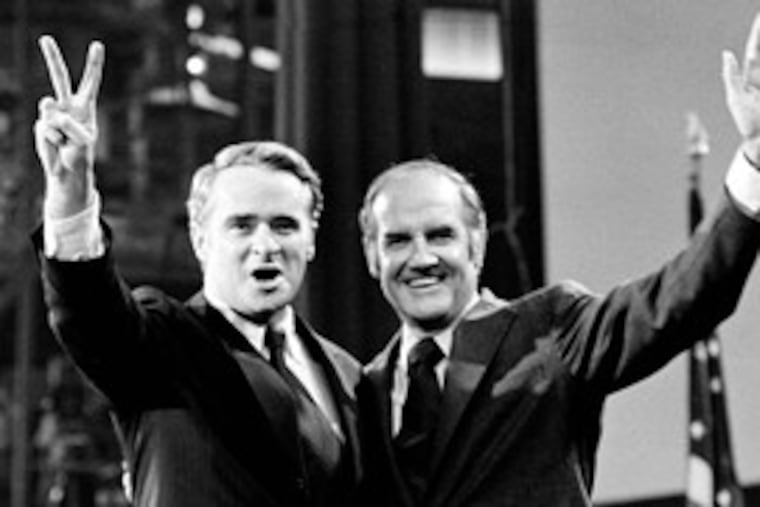
Thomas Eagleton, 77, a Missouri Democrat and U.S. senator who spent two weeks as the vice presidential running mate of George S. McGovern in 1972 before leaving the ticket after revelations of his earlier psychiatric hospitalization for depression, died yesterday at St. Mary's Health Center in Richmond Heights, Mo. He had heart and respiratory ailments.
Mr. Eagleton made his name as a crusading young lawyer and politician in his home state before winning election to the Senate in 1968. He supported consumer-protection laws and labor-union rights, but it was his strong opposition to the Vietnam War that made him a natural political ally of McGovern, a South Dakota Democrat who had long denounced the war.
For Mr. Eagleton, being tapped as the vice presidential nominee among a dozen other potential candidates was a signal of his rise in the party leadership. Future Colorado senator Gary Hart, who was McGovern's campaign director, once wrote that Mr. Eagleton's appeal was "primarily because he was Catholic, urban and an unknown from a border state."
Although McGovern's staff knew that Mr. Eagleton had been hospitalized for fatigue, the campaign went ahead with the nomination on the assurance that his time under care was brief. They also thought they could present the vice presidential nominee as a man of relentless verve who once "campaigned [himself] right into the hospital."
But under media questioning prompted by anonymous tips, Mr. Eagleton was compelled to announce he had "voluntarily" hospitalized himself for nervous exhaustion and depression three times since 1960, usually after the campaign season. He also said his treatment regimen included psychiatric counseling, chemotherapy and electric shock treatment. He said he was in "good, solid, sound health" for the 1972 race.
McGovern said he was "1,000 percent" behind Mr. Eagleton but soon reversed himself. There had been a significant drop in campaign contributions and many calls for Mr. Eagleton's resignation among influential newspapers that questioned his suitability for a high-pressure job. Mr. Eagleton said he would withdraw for party unity.
Sargent Shriver, the Peace Corps founder and a Kennedy family intimate, became the vice presidential nominee. McGovern lacked the national prominence of many of his predecessors, and few political observers thought the team could realistically beat President Richard M. Nixon. He and Shriver lost in a landslide, winning only Massachusetts and the District of Columbia, even amid early revelations of the Watergate scandal.
Mr. Eagleton was reelected in 1974 by a wide margin and spent two more terms in the Senate. He served on the Foreign Affairs, Governmental Affairs and Intelligence Committees.
He advocated home rule for the District of Columbia and a war-powers bill to limit presidential actions without congressional consent. Although the bill was approved, Mr. Eagleton questioned its effectiveness.
Thomas Francis Eagleton was born in St. Louis on Sept. 4, 1929. His father, a lawyer, lost a mayoral bid but served on the city police board and the board of education.
After Navy service, he graduated from Amherst College in 1950 and from Harvard Law School in 1953. Anticipating a political career, he also studied speech at Northwestern University.
He became assistant general counsel to Anheuser-Busch Inc., the St. Louis-based brewery, before winning election in 1956 as St. Louis circuit attorney - the city's chief prosecutor - at 27. He followed with election victories as state attorney general (1960) and lieutenant governor (1964).
In 1968, he won the Democratic senatorial primary against incumbent Edward Long and beat former Republican Rep. Thomas Curtis in the general election.
Mr. Eagleton did not seek reelection in 1986, and he returned to St. Louis to practice law.
Survivors include his wife, the former Barbara Ann Smith, whom he married in 1956; a son, a daughter, a brother and three grandchildren.