His vaccine combated the limits of penicillin
Robert Austrian, 90, a maverick researcher who ignored the hubris of the medical community after the discovery of penicillin and developed a vaccine for a bacterium that kills many pneumonia victims, died of a stroke last Sunday at the Hospital of the University of Pennsylvania.
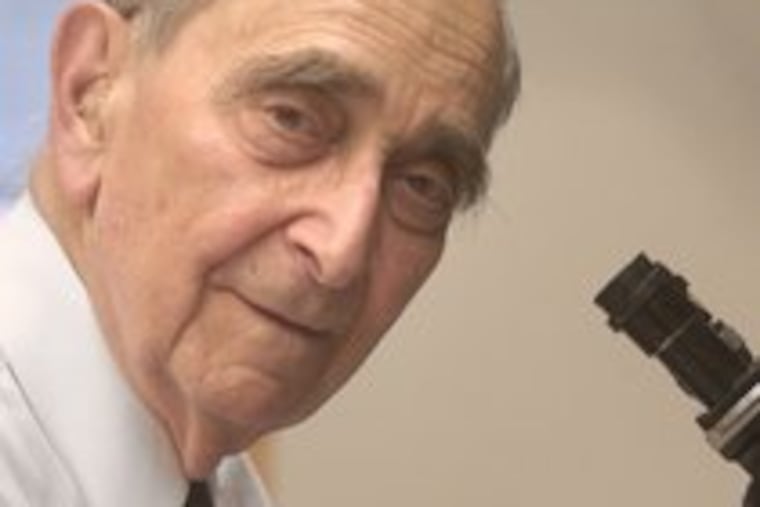
Robert Austrian, 90, a maverick researcher who ignored the hubris of the medical community after the discovery of penicillin and developed a vaccine for a bacterium that kills many pneumonia victims, died of a stroke last Sunday at the Hospital of the University of Pennsylvania.
Dr. Austrian, a world-renowned researcher of infectious disease and a Penn professor since 1962, lived in Center City.
"Antibiotics do not always destroy pneumococcal bacterium in the elderly and victims with compromised immune systems," said John Cohn, an allergy and pulmonary specialist at Thomas Jefferson University. "Patients who develop pneumonia who had not been vaccinated could die within hours. Robert Austrian was a research giant in this field."
For more than five decades, beginning in the late 1940s, Dr. Austrian studied pneumococcal pneumonia, which killed thousands each year despite antibiotics. When penicillin began being used in the 1940s, many thought deaths from pneumococcal pneumonia would disappear. After identifying pneumococcal types, Dr. Austrian developed a vaccine and supervised trials to prove its value.
Born in Baltimore, Dr. Austrian earned a bachelor's degree in 1937 and medical degree in 1941 from Johns Hopkins University, where he completed a residency. In 1944, he joined the Army and was a medic in China, Burma and India until the end of World War II. He taught at the State University of New York College of Medicine at Brooklyn until joining Penn, where he was named a professor and head of research medicine.
Efforts to develop a pneumococcal pneumonia vaccine had begun in 1911 and were advanced in 1930, when it was learned that sugar molecules on the surface of the pneumococcus are important components of a vaccine. By the late 1940s, two vaccines had been developed, but the introduction of penicillin discouraged their use, and they were withdrawn from the market.
Dr. Austrian, however, did not believe antibiotics could cure everyone, and thousands of patients still died from pneumococcal infections. After an extensive study of patients in New York's Kings County Hospital from 1952 to 1962, the skeptical medical community was finally convinced that the vaccine could reduce deaths.
At Penn, Dr. Austrian continued clinical and epidemiological work by developing a vaccine under the aegis of the National Institute of Allergy and Infectious Diseases and by studying gold miners in South Africa who had the disease.
"In 1976, he reported that the vaccine was safe and efficacious. His efforts culminated in 1977 with the licensing of a vaccine containing antigens of 14 serotypes of pneumococcus and in 1983 with expansion of the vaccine to contain 23 serotypes that accounted for 85 percent of bloodstream infections associated with pneumococcal pneumonia," said Harvey Friedman, an infectious-disease specialist at Penn.
"The recent emergence of resistance of pneumococcus to penicillin and other antibiotics highlights the importance of the vaccine," Friedman said. "What Dr. Austrian did to solve a major human disease, almost totally by himself, is extremely rare in modern medicine."
Dr. Austrian had a fun side. "One year at the infectious-disease summer baseball game, Bob came in his usual uniform - dress pants, shirt, tie and jacket. When it was his turn to bat, he surprised us," Friedman said. "The jacket was off and replaced by a 'bug-team' T-shirt decorated with drawings of bacteria."
Dr. Austrian remained active in infectious-disease studies at the Hospital of the University of Pennsylvania. He was huddled over a microscope five or six days a week until shortly before his death, assessing pneumococcal strains for the World Health Organization. In a 2004 Inquirer article, Dr. Austrian described the bacterium as a beautiful and "fastidious organism."
"Dr. Austrian was given the highest honor in medicine in this country in 1978 - the Albert Lasker Clinical Medical Research Award, which is like an American Nobel prize," said Patrick Brennan, chief of infectious-disease medicine at Penn. "I think he deserved to be awarded the Nobel for his research." Dr. Austrian was also given the coveted Philadelphia Award in 1979.
Dr. Austrian had a soft, romantic side. He sent his wife, Babette, flowers every week for most of their 37 years of marriage. She died in 2000.
Friedman recalled: "Bob and his wife, Babette, were driving me and my wife, Cindy, to an event. To our surprise this elegant and gentle couple started to argue about whose turn it was to walk the dog. Cindy politely interrupted and asked what kind of dog they have. Bob turned to her and said, 'It is a pretend dog. It gives us something to fight about.' "
Dr. Austrian is survived by two stepdaughters, Toni Amber and Jill Bernstein, and a sister, Janet Fisher.
Burial will be private. A memorial service will be held at Penn at a later date.
Memorial donations may be made to the Robert Austrian Fellowship Fund, 502 Johnson Pavilion, Infectious Disease Division, University of Pennsylvania, Philadelphia 19104-6073.