Ralph Bernstein, retired sportswriter
THERE WAS the time that Phillies manager Danny Ozark threatened to punch him. There was the rage of Larry Bowa, who launched a memorable barrage of obscenities at him.
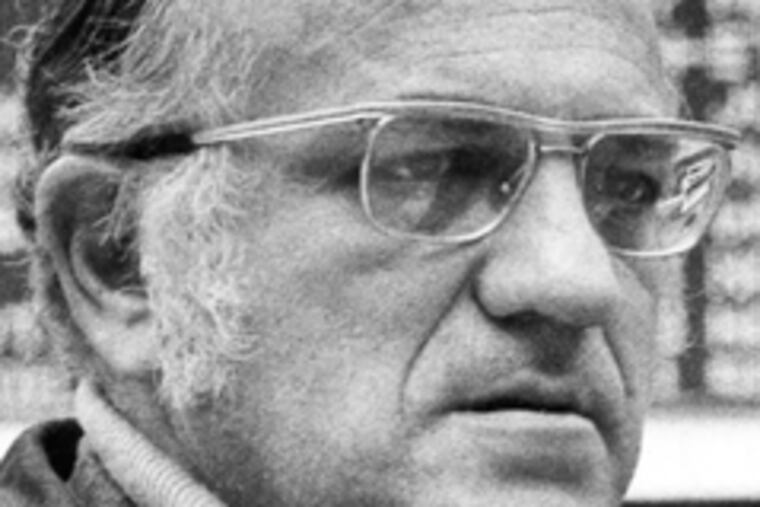
THERE WAS the time that Phillies manager Danny Ozark threatened to punch him.
There was the rage of Larry Bowa, who launched a memorable barrage of obscenities at him.
Bill Conlin, veteran Daily News sports columnist, once called him the "Che Guevara of Veterans Stadium."
He sent the normally placid Dallas Cowboys coach Tom Landry stalking angrily from a stage.
Sports figures of every stripe and rank, from players to owners, to managers, to coaches, trembled at his approach, notepad and pencil in hand, and a list of tough questions to pursue.
He was Ralph Bernstein, for four decades the Associated Press' Pennsylvania sportswriter and editor who enlivened many a press conference of sport execs and coaches with probing, persistent and passionate questioning that could send them into fits of frustration.
He might have driven many a subject of his inquisitions to the edge, but he was so greatly respected that, after his retirement in 1994, Eagles coach Rich Kotite, after fielding a series of innocuous questions from other reporters, muttered, "I miss Ralph."
Ralph Bernstein, whose sports coverage centered mostly on Philadelphia teams, especially the Phillies and Eagles, but who also wrote about other sports with the same penetration and depth, died Saturday. He would have been 86 on Thursday. He lived in Pembroke Pines, Fla.
"He was the best and most relentless interviewer I ever saw in action," Conlin said. "He refused to take 'no comment' for an answer.
"But his questions were straight-ahead. He never set anybody up for a cheap shot. And when his story appeared, the quotes were accurate and in context."
"No sportswriter in the history of Philly had a more widespread influence or presence," Conlin added. "He covered every Phillies spring-training and home game, every Eagles pre-season and home game, every Sixers and Flyers home game, every Big 5 doubleheader, all the press conferences for hirings and firings, and everything in between.
"He was on call 48 hours a day."
Frank Bilovsky, retired sportswriter for the old Philadelphia Bulletin and longtime friend of Ralph's, said, "I can still see Ozark kicking a trash can in the Phillies clubhouse and yelling at him.
"Nobody - and I mean nobody - could grill someone in an interview the way he could."
Ralph rarely admitted he was wrong, but he had to amend his assessment of Phillies legendary shortstop and manager Larry Bowa. In Bowa's rookie year, Ralph commented in print that Bowa's bat work belonged in the Little League ballpark in Williamsport.
Bowa, not known for his patience, lit into Ralph next time he saw him at batting practice in Clearwater, calling him a string of obscene names, in addition to "old."
Ralph took most of the epithets in stride, but told Bowa, "Don't call me old."
Bowa had a .260 batting average, with 2,191 hits, in his 15-year playing career.
Larry Shenk, Phillies vice president for public relations and a longtime friend of Ralph's, recalled how Ralph never gave up trying to get an interview with the Phillies great pitcher Steve Carlton.
Carlton had made it a policy never to talk with reporters. One time in spring training, Larry recalled, Ralph went up to Carlton and said something like, "Look, Lefty, I'll put my tape-recorder down and my notebook."
"Carlton placed a hand on Ralph's shoulder and said, 'Ralph, policy is policy,' and walked away," Shenk said.
"I had a great deal of respect for Ralph," he said. "When you got to know him, you found out that he was a kind man with a big heart."
Shenk said Ralph blew up when he discovered while Veterans Stadium was being built that TV stations were to be assigned to a box behind home plate.
He complained so loudly that an agreement was reached that would place the TV cameras on the left side and the writers on the right side.
"Anybody who had issues with a team, the word went out, 'Get Ralph,' Shenk said. "He would go in and scream and yell."
"He was highly respected in the industry," said Jack Scheuer, longtime Associated Press sports stringer. "He could be combative. He would never back down. But he was a very dedicated writer. He worked hard."
Ralph was born in Philadelphia to Abraham and Esther Bernstein. He graduated from Northeast High School and Temple University. He was a stringer for the old Philadelphia Record while in college.
He served in the Army in World War II and afterwards worked for the old United Press before switching to the Associated Press in Philadelphia.
Ralph's first wife, Barbara, was stabbed to death in their Jenkintown condominium on Dec. 29, 1982, while he was in New Orleans covering the Sugar Bowl. George E. Lindemann Jr., a former Philadelphia police officer, was found guilty of third-degree murder.
Ralph later married the former Mary Ann Melincoff. She died in 2003.
Ralph was the author of books on A's pitcher Bobby Shantz, La Salle University coach Ken Loeffler and Phillies pitcher Jim Bunning.
Ralph's son, Robert, said that while growing up he and his late brother, Andrew, got to see all the games for free.
"He was a tough, hard-nosed writer," Robert said. "He made us tow the line. In later years, he softened up."
Ralph is also survived by a brother, Bernard, and two grandchildren.
Services: A celebration of life observance will be held Thursday at Robert Bernstein's home in Flourtown. *