Penn rowing coach and war hero
Joseph William Burk, 94, the South Jersey farm boy who went on to become a world-class sculler and later the head rowing coach at the University of Pennsylvania for nearly 20 years, died last Sunday at the home of his daughter in Scottsdale, Ariz., after surgery for a broken leg.
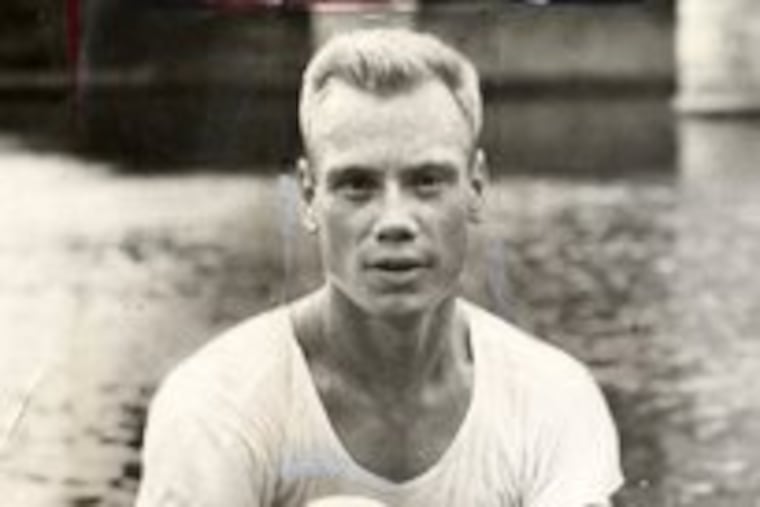
Joseph William Burk, 94, the South Jersey farm boy who went on to become a world-class sculler and later the head rowing coach at the University of Pennsylvania for nearly 20 years, died last Sunday at the home of his daughter in Scottsdale, Ariz., after surgery for a broken leg.
In his time, Mr. Burk was one of the Philadelphia region's biggest sports stars, an amateur who was considered the world's best at his pursuit in the years leading up to World War II. Then, as a PT boat captain in the South Pacific, Mr. Burk distinguished himself in the military as well, earning multiple medals for heroism.
Born in 1914, Mr. Burk grew strong working in the family fruit orchard in Bridgeboro. He rose before dawn to help prune thousands of trees and heft heavy baskets of fruit.
He built up his strength rowing his brothers to school in a rowboat on the Rancocas Creek, which ran beside the Burlington County farm.
He was football captain at Moorestown High School and, at 195 pounds, played varsity football at Penn before picking up a sculling oar. Penn rowing coach Rusty Callow, who was impressed by his size, strength, skill and spirit, encouraged Mr. Burk to join the crew team his sophomore year.
When Mr. Burk graduated in 1934 with a degree in business, Penn was practicing for the Olympic trials of 1936. To keep in shape, Mr. Burk joined the Pennsylvania Athletic Club Rowing Association, the famed Penn AC.
His scull was made by George Pocock, who also had made sculls for three-time Olympic champion John B. Kelly Sr. Beginning on Boathouse Row in the 1930s, followed by decades of correspondence from Seattle, Pocock guided Mr. Burk.
Instead of commuting to the Penn AC headquarters on Boathouse Row from his home in Bridgeboro, Mr. Burk trained year-round (sometimes having to chop through ice) on the Rancocas Creek in his scull while racing against a stopwatch taped between his toes.
He placed second in the 1936 Olympic trials. In the next four years, he never lost a race.
"Mr. Burk was a free thinker who competed against himself," said Peter Mallory, whom he coached at Penn.
Mr. Burk developed a distinctive stroke that made him go faster. The typical sculler's rate was about 28 strokes per minute; Mr. Burk's was 40 to 42.
"My technique seemed to enable me to go sufficiently fast with a minimum of effort," he told Mallory for a book. "It was very simple - arms, legs and back all started together, and all finished together."
Defying tradition with what Time magazine described in 1940 as "a jerky, robot-like chop with no layback," Mr. Burk won 37 consecutive races from 1937 to 1940. These included the famed Diamond Sculls at the Henley Royal Regatta in England in 1938 (when he broke the record set in 1905 by eight seconds) and 1939. He won the U.S. and Canadian championships from 1937 to 1940.
"But he was not just about winning. He was a modest man," former Penn rower Reed Kindermann said.
In 1939, Mr. Burk received the Sullivan Award, the highest U.S. amateur athletic prize for excellence and sportsmanship. The Sullivan judges called him "a fine example of young American manhood with indomitable perseverance, self-discipline and an ability to take victory without conceit."
Mr. Burk won at the 1940 Olympic trials and was the overwhelming favorite for the Helsinki Games, but they were canceled because of the war in Europe.
World War II changed Mr. Burk's destiny forever. As captain of PT-320, he commanded hundreds of attacks that sank many enemy ships and submarines in the Philippines.
Mr. Burk was awarded the Gold Star, Silver Star, Bronze Star and Navy Cross. After his discharge in 1945, he met Kathryn Black. They married, and raised a son and a daughter.
In 1950, after a short stint coaching at Yale University, Mr. Burk was named coach of the heavyweight crew at Penn.
Mr. Burk coached Penn to wins at Henley and several Intercollegiate Rowing Association championships. "But more importantly, he taught that winning was not everything," said Ted Nash, Penn's rowing coach from 1970 to 1983.
"During 19 years as coach at Penn, he established a reputation as one of the finest coaches in the history of the sport and as a magnificent human being," Kindermann said. "Generations of rowing luminaries learned that, in the game of life, hard work and perseverance pay off and losing well is as important as winning - and how to do both with grace."
Exactly 30 years after Mr. Burk's 1939 Diamond Sculls victory, his Penn team won the Grand Challenge Cup at Henley, and Mr. Burk retired.
He left his oars and boat behind and moved to Montana, where he and his wife built a log cabin. They lived there in the summer - gardening, hunting for arrowheads and banding birds. The couple also bought a home in Tucson, Ariz., where they spent winters.
Mr. Burk's wife died in 2001, and he eventually moved to Scottsdale to be close to his daughter, Kathryn Burk McCaffrey.
"My father was humble," she said. "He was not about glory. He did not compete with others. He said life is about the journey, not winning. He never considered himself special."
In addition to his daughter, Mr. Burk is survived by a son, Roger, and two grandchildren. There will be no funeral.