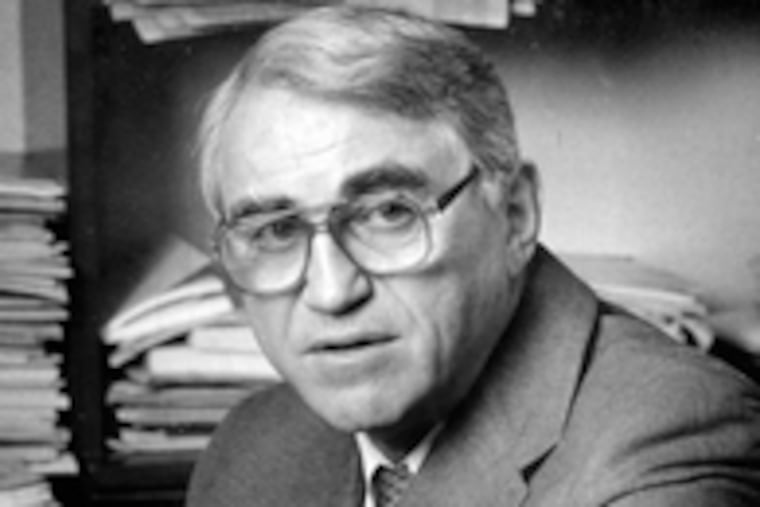
Edwin O. Guthman, 89, a Pulitzer Prize-winning newsman respected for his unwavering integrity and whose storied career included stints as a soldier, a public servant, an educator, and editor of The Inquirer's editorial pages, died Sunday at his home in Los Angeles.
The cause was complications of amyloidosis, a degenerative blood disorder, according to his family.
After a stellar career as a Seattle Times investigative reporter, where he exposed corrupt labor leaders and won a Pulitzer for exonerating a professor unjustly accused of being a communist, Guthman became press secretary to Attorney General Robert F. Kennedy in 1961. As Kennedy's aide, Guthman had an insider's view of historical dramas, such as the Cuban missile crisis and the civil rights movement.
As The Inquirer's editor from 1977 to 1987 - the position is now known as editorial page editor - Guthman guided the newspaper's opinion pages during a tumultuous decade that included the Three Mile Island crisis and the city's disastrous encounters with the radical group MOVE. He wrote a weekly column with authority and wit on a range of subjects from foreign affairs to his pet peeve, the lack of clear highway signs and exit ramps to Center City.
After retiring from The Inquirer at age 68, Guthman taught journalism at the University of Southern California.
After 20 years in the classroom, he stepped down from teaching last year while remaining on the faculty as a senior scholar.
"He was one of the most extraordinary mentors and journalists," said Acel Moore, The Inquirer's associate editor emeritus.
James B. Steele, a former Inquirer investigative reporter whom Guthman called upon frequently in recent years for material for his classroom, said Guthman was always curious about the changing world and felt no need to reside in the glow of his accomplishments.
"He was a noble man, and there are very few people you can say that about," said Steele.
Guthman's admirers compared him to a quintessential Jimmy Stewart character - wry, self-effacing, unpretentious and unfailingly fair. He gave janitors and editorial assistants the same respect and attention he gave to the highest elected officials. His journalism and his manners were measured and unambiguous. But he pulled no punches.
"You always knew whatever he told you could be taken to the bank," said Jack Nelson, former Washington bureau chief of the Los Angeles Times, where Guthman was national editor before coming to The Inquirer in 1977.
"He was very plain-spoken and of the highest character," said John S. Carroll, retired editor of the Times and a former Inquirer editor. "If I wanted the public to see how a journalist worked, I would want them to see Ed Guthman."
At a ceremony in December, the Los Angeles City Council honored Guthman for a lifetime of public service; he had helped organize the city's ethics commission. He also served on a federal panel that investigated the government's 1993 assault on the Branch Davidian compound near Waco, Texas.
Guthman, speaking at the ceremony, said he was grateful to his father, a German Jewish immigrant who settled in Seattle, for instilling in him an obligation to serve. "He always taught us that we had to give something back to this great country and the freedom we enjoy and experience," he said.
Guthman's experiences as an Army platoon leader in North Africa and Italy - he was wounded twice, and was awarded the Silver Star and Purple Heart - were recounted in Tom Brokaw's book The Greatest Generation. The war shaped Guthman's intolerance for tyranny and his outlook on life.
"He told a story about going to sleep in a foxhole, and waking up to find the guy next to him dead," said his daughter, Diane. "He just felt he was given a gift of life, and he really wanted to give back as long as he could."
Edwin Otto Guthman was born in Seattle on Aug. 11, 1919. He was drawn to journalism at a young age, and studied it at the University of Washington. He was covering high school sports when he was drafted into the Army in July 1941.
Guthman worked his way up the ranks, serving as leader of a reconnaissance platoon in the 339th Regiment, 85th Division. He was discharged as a captain in 1946.
Guthman joined the Seattle Times in 1947. Two years later, his series of stories proved that a Washington state investigative committee accused a professor of anti-American activity though it had evidence of his innocence. After winning the Pulitzer, Guthman received a Nieman Fellowship to study at Harvard for the 1950-51 academic year.
In the 1950s, Guthman turned his focus on the head of the International Brotherhood of Teamsters. His work brought him together with Kennedy, who was investigating labor racketeering as counsel for a U.S. Senate committee. Initially suspicious of Kennedy as a "politician," Guthman came to greatly respect him.
"Kennedy admired Ed for his directness," said John Siegenthaler Sr., a journalist who also joined Kennedy's staff and later became publisher of the Nashville Tennessean. "If you asked Ed a question, you were going to get an honest answer, unvarnished."
After Kennedy was elected to the Senate in 1965, Guthman became the national editor of the Times.
"Guthman was highly respected in the profession, and even though he had flacked for Bobby Kennedy, he had never been perceived as a flack, but rather as a man of strong social conscience whose roots were in investigative reporting," David Halberstam wrote in his 1979 book on journalism, The Powers That Be.
After Kennedy's assassination in 1968, Guthman devoted himself to preserving the memory of his slain friend. He wrote or edited four books about Kennedy, including an autobiographical account, We Band of Brothers. In recent years, he led a drive to build a school honoring Kennedy on the Los Angeles site of the assassination.
Guthman was an unapologetic Kennedy loyalist, and proudly wore a PT 109 tie clip President John F. Kennedy had given him. Because of his identification with the Kennedys, Guthman was listed on President Richard M. Nixon's "enemies list," which called Guthman "a highly sophisticated hatchetman."
In 1977, Inquirer executive editor Eugene L. Roberts Jr. hired Guthman to direct the newspaper's editorial pages, giving Guthman the freedom to develop The Inquirer's editorial policy independent of the news operation.
Michael Pakenham, Guthman's deputy for seven years, recalled Guthman as "driven by decency."
"To the steady passage of public officials who met with the editorial board, Guthman was unfailingly polite, but also to the point," he said.
Editorial Board members fondly recall that Guthman had a weakness for walnut cookies from the Famous Fourth Street Delicatessen.
Tony Auth, the paper's editorial cartoonist, said Guthman influenced the board through persuasion. "He was a wise man," said Auth. "He could bring people along by raising questions that had a sound basis."
Diane Guthman recalled that her father relished the give-and-take of encounters with figures such as Mayor Frank L. Rizzo, who frequently telephoned the editor to bark his opinion - usually disagreement - with an Inquirer editorial.
William K. Marimow, then an Inquirer reporter and now the newspaper's executive editor, recalls that Guthman made a point of never going home at night without returning every phone call - a practice he expected of all public servants.
"To me, Ed Guthman stood for what's right, regardless of the consequences," said Marimow.
After Guthman moved to California, friends collected funds to endow a scholarship in Guthman's honor and presented it to him at a surprise party. Guthman was gracious, but demanded that the scholarship be renamed to include his wife of 43 years, JoAnn, who had died in 1990.
After the diagnosis last year of his terminal illness, Guthman spent his last months at his Pacific Palisades home, receiving visits and phone calls from friends and family.
In addition to his daughter, Guthman is survived by sons Lester, Edwin H. and Gary, and five grandchildren.
Services will be Friday at Hillside Memorial Park and Mortuary in Los Angeles.
Donations may be made to the Edwin O. and JoAnn Guthman Endowed Scholarship for Investigative Reporting at the University of Southern California Annenberg School for Communication, 3502 Watt Way, Los Angeles, Calif. 90089.
.