Kidney leader at Jefferson
Laurence G. Wesson, 90, a leading researcher in kidney dialysis and transplants who founded the division of nephrology at Thomas Jefferson University, died Sept. 2 in Scarborough, Maine.
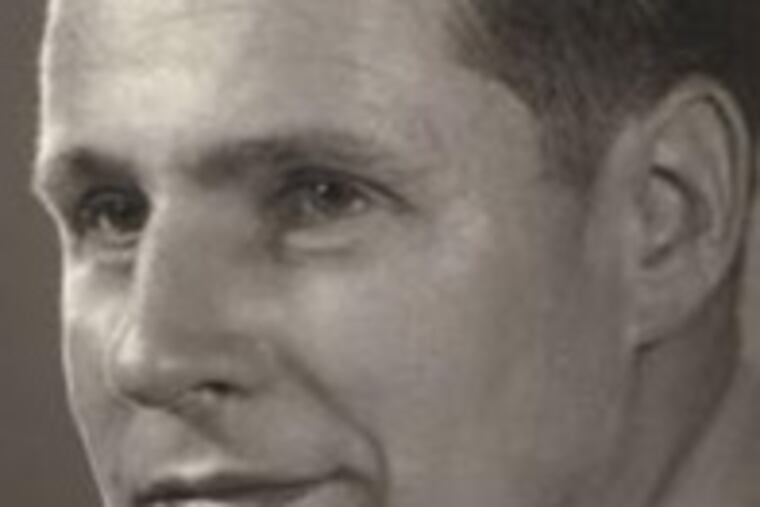
Laurence G. Wesson, 90, a leading researcher in kidney dialysis and transplants who founded the division of nephrology at Thomas Jefferson University, died Sept. 2 in Scarborough, Maine.
A descendant of successful and colorful New England families, Dr. Wesson had some hard acts to follow. He was related to one of the founders of the Smith & Wesson gun company, the chemist who developed Wesson oil, rocket pioneer Robert H. Goddard, and writers Robert, Nathaniel and Peter Benchley.
During his childhood, Dr. Wesson spent time with his grandparents in Jackson, Ohio, where he and his brother, Robert, explored the forests and developed a lifelong appreciation of nature. By the time he was 22, Dr. Wesson was an expert entomologist and had discovered and named six species of ants, including the slave-making ant,
Leptothorax duloticus
. To honor Dr. Wesson's research, fellow experts named a genus of ant after him:
Wessonistruma
.
Dr. Wesson earned a bachelor's degree in chemistry from Haverford College in 1938 and a medical degree from Harvard University in 1942.
He joined the Army in 1943 and landed in Normandy in 1944. Dr. Wesson was an artillery battalion surgeon with the medical corps in Gen. George Patton's Third Army and with Gen. Alexander Patch's Seventh Army.
"My father was among the first Americans to relieve the Dachau concentration camp and to visit Hitler's refuge near Berchtesgaden," son John said.
After being discharged as a major in 1946, Dr. Wesson taught physiology at the New York University College of Medicine in Manhattan until 1962. There, he was a protege of Homer W. Smith, the leading authority on human kidney physiology, and Dr. Wesson developed an interest in nephrology that became the focus of his career.
Dr. Wesson married Eleanor Fessenden Roelse in 1948, and they raised four children while living in New York, New Jersey, Rosemont and Phoenixville.
In 1960, Dr. Wesson was awarded a 27-year life grant from the National Institutes of Health to study kidney physiology. In 1962, he came to Philadelphia, where he became a professor of medicine at Jefferson Medical College and founded the division of nephrology, where he worked until 1974.
At Jefferson, Dr. Wesson directed the clinical research center, improved kidney dialysis, was a leader in increasing the number of kidney transplants in Philadelphia, and was a consultant for the Food and Drug Administration.
In 1969, Dr. Wesson published Physiology of the Human Kidney, a standard textbook. From 1949 to 1998 he published more than 65 scientific research articles.
As Dr. Wesson gradually retired between 1982 and 1987, he fed his love of nature by studying mushrooms, birds, flowers and trees. He took whitewater-rafting trips and canoed in the wilderness. His interests were eclectic and useful. He built stone walls and wood fireplaces, made wine, cut logs, and was a self-taught carpenter, electrician and plumber.
Dr. Wesson had a home on a private island in Bremen, Maine. He preserved land in Ohio for the Lake Katharine State Nature Preserve and a portion of the private island in Maine with a conservation easement.
Dr. Wesson and his wife moved to Lansdale in 1994 and to Maine in 1998, first to Topsham and then to Scarborough in 2003.
In addition to his wife and son John, Dr. Wesson is survived by sons Laurence and Robert; a daughter, Anne; and eight grandchildren.
A memorial service will be held at 1 p.m. Oct. 12 at the Hobbs Funeral Home, 230 Cottage Rd., South Portland, Maine.