Author, filmmaker Michael Crichton
Michael Crichton, the million-selling author who made scientific research terrifying and irresistible in such thrillers as Jurassic Park, Timeline and The Andromeda Strain, died Tuesday at his home of cancer at age 66, his family said.
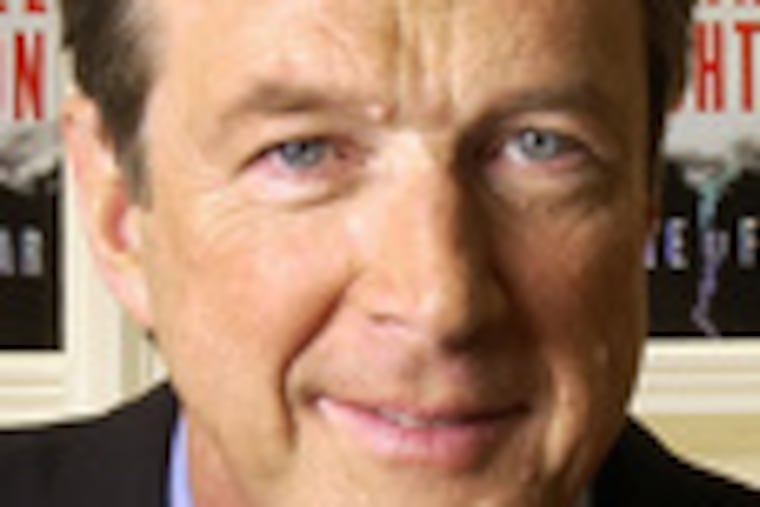
Michael Crichton, the million-selling author who made scientific research terrifying and irresistible in such thrillers as
Jurassic Park
,
Timeline
and
The Andromeda Strain
, died Tuesday at his home of cancer at age 66, his family said.
"While the world knew him as a great storyteller that challenged our preconceived notions about the world around us - and entertained us all while doing so - his wife Sherri, daughter Taylor, family and friends knew Michael Crichton as a devoted husband, loving father and generous friend who inspired each of us to strive to see the wonders of our world through new eyes," his family said in a statement.
He was an experimenter and popularizer known for his stories of disaster and systematic breakdown, such as the rampant microbe of The Andromeda Strain or the dinosaurs running madly in Jurassic Park. Many of his books became major Hollywood movies, including Jurassic Park, Rising Sun and Disclosure. Mr. Crichton himself directed and wrote The Great Train Robbery and he cowrote the script for the blockbuster Twister.
In 1994, he created the award-winning TV hospital series ER. He even had a dinosaur named for him, Crichton's ankylosaur.
"Michael's talent outscaled even his own dinosaurs of Jurassic Park," said that film's director, Steven Spielberg, a friend of Mr. Crichton's for 40 years. "He was the greatest at blending science with big theatrical concepts, which is what gave credibility to dinosaurs again walking the Earth. . . . Michael was a gentle soul who reserved his flamboyant side for his novels. There is no one in the wings that will ever take his place."
John Wells, executive producer of ER, called the author "an extraordinary man. Brilliant, funny, erudite, gracious, exceptionally inquisitive and always thoughtful.
"No lunch with Michael lasted less than three hours and no subject was too prosaic or obscure to attract his interest. Sexual politics, medical and scientific ethics, anthropology, archaeology, economics, astronomy, astrology, quantum physics, and molecular biology were all regular topics of conversation."
Neal Baer, a physician who became an executive producer on ER, was a fourth-year medical student at Harvard University when Wells, a longtime friend, sent him Mr. Crichton's script.
"I said, 'Wow, this is like my life.' Michael had been a medical student at Harvard in the early '70s, and I was going through the same thing about 20 years later," said Baer. ER offered a fresh take on the TV medical drama, making doctors the central focus rather than patients. In the early life of ER, Mr. Crichton and Spielberg would take part in writers'-room discussions.
In recent years, Mr. Crichton was the rare novelist granted a White House meeting with President Bush, perhaps because of his skepticism about global warming, which Crichton addressed in the 2004 novel State of Fear. Crichton's views were strongly condemned by environmentalists, who alleged he was hurting efforts to pass legislation to reduce emissions of carbon dioxide.
If not a literary giant, he was a physical one, standing 6 feet 9 inches, and ready for battle with the press. In a 2004 interview with the Associated Press, Crichton came with a tape recorder, textbooks and a pile of graphs and charts as he defended State of Fear and his take on global warming.
"I have a lot of trouble with things that don't seem true to me. . . . I'm very uncomfortable just accepting. There's something in me that wants to pound the table and say, 'That's not true.' "
One of four siblings, Crichton was born in Chicago and grew up in Roslyn, on Long Island. His father was a journalist, and young Michael spent much of his childhood writing extra papers for teachers. In third grade, he wrote a nine-page play that his father typed for him using carbon paper so the other kids would know their parts. He was tall, gangly and awkward, and used writing as a way to escape; Mark Twain and Alfred Hitchcock were his role models.
Figuring he would not be able to make a living as writer, and not good enough at basketball, he decided to become a doctor. He studied anthropology at Harvard and later graduated from Harvard Medical School. During medical school, he turned out books under pseudonyms. (One that the tall author used was Jeffrey Hudson, a 17th-century dwarf in the court of King Charles II of England.) He had modest success with his writing and decided to pursue it.
His first hit, The Andromeda Strain, was written while he was still in medical school and quickly caught on upon its 1969 release. It was a featured selection of the Book-of-the-Month Club and was sold to Universal in Hollywood for $250,000.
Mr. Crichton had a rigid work schedule: rising before dawn and writing from about 6 a.m. to around 3 p.m., breaking only for lunch. He enjoyed being one of the few novelists recognized in public, but he also felt limited by fame.
"Of course, the celebrity is nice. But when I go do research, it's much more difficult now. The kind of freedom I had 10 years ago is gone," he told the AP. "You have to have good table manners; you can't have spaghetti hanging out of your mouth at a restaurant."
Mr. Crichton was married five times and had one child. A private funeral is planned.