Vietnam War mastermind dies
Driven, cerebral, and pugnacious, Robert S. McNamara was the preeminent policymaker overseeing the massive buildup of U.S. forces in Vietnam from 1964 to 1968, who masterfully deployed facts and figures to press the case for sending military advisers and then ground troops in a "limited war" to counter the advance of Communist forces in North Vietnam and Viet Cong guerrillas in South Vietnam.
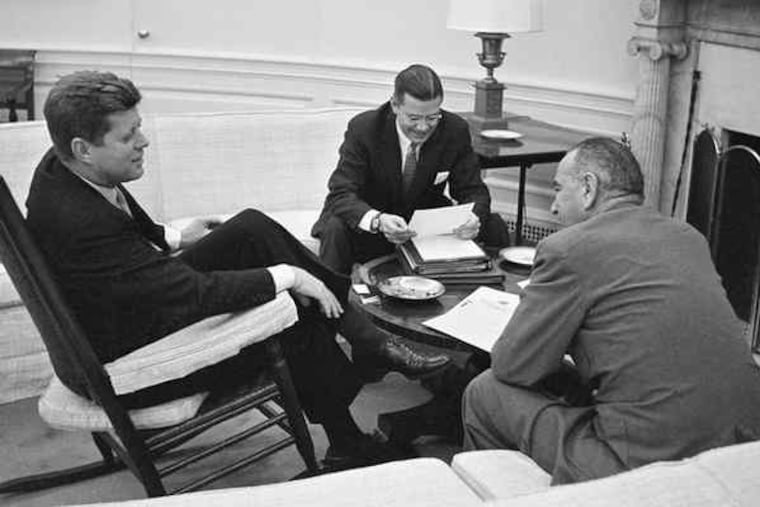
Driven, cerebral, and pugnacious, Robert S. McNamara was the preeminent policymaker overseeing the massive buildup of U.S. forces in Vietnam from 1964 to 1968, who masterfully deployed facts and figures to press the case for sending military advisers and then ground troops in a "limited war" to counter the advance of Communist forces in North Vietnam and Viet Cong guerrillas in South Vietnam.
He was the Vietnam War's tireless cheerleader, the U.S. defense secretary who traveled to the battle zones more than 40 times to show the flag for two administrations.
But Mr. McNamara, 93, who died yesterday at his home in Washington after a period of ill health, came to harbor regrets about his role in Vietnam. He kept his private doubts buttoned up for nearly three decades before finally going public.
He gave a carefully parsed reassessment of his wartime decisions in a 1995 memoir and in the 2004 Oscar-winning documentary The Fog of War, which mollified some critics but infuriated others.
Mr. McNamara was a former president of Ford Motor Co. who headed the Defense Department for seven years under Democrats John F. Kennedy and Lyndon B. Johnson.
During the height of his influence and for decades afterward, he personified both the early promise and the spiraling misjudgments that enmeshed the nation in the Southeast Asian conflict.
A master of statistical analysis, Mr. McNamara wielded blizzards of facts and figures to press the case for what he called a "limited war." By the time he left office in 1968, 535,000 U.S. servicemen had been pressed into service and nearly 30,000 had died in the conflict. More than 58,000 Americans and 3,000,000 Vietnamese on both sides eventually died in more than a decade of war. His private doubts grew as the American death toll soared, leading to his departure from government.
He was a dynamic figure whose trademark wire-rimmed glasses and carefully slicked and parted hair gave him the appearance of a tautly wound schoolmaster. Athletically trim and boundlessly energetic, he won over both Kennedy and Johnson with his unflagging optimism, peerless management skills, and bureaucratic gamesmanship that cowed his rivals.
He was a colossus of the briefing room, equipped with a steel-trap memory and a facility with numbers that dominated cabinet meetings and congressional hearings. Early on, a dazzled Republican Sen. Barry Goldwater called him "one of the best secretaries ever, an IBM machine with legs." Goldwater later altered his view, echoing veteran generals who felt that Mr. McNamara was "a one-man disaster."
During one classic encounter in 1961, Mr. McNamara absorbed a complex one-hour presentation on nuclear deterrence from a RAND Institute expert, glanced over 54 detailed slides, and quickly decided to jettison the Eisenhower administration's policy of nuclear targeting of Russian cities and shift to military installations. Without debate, his "doctrine at the flick of his pen" set in motion the nuclear "counterforce" policy that would govern U.S. military strategy for the next 40 years, wrote biographer Deborah Shapley.
But critics accused him of misleading his presidential patrons and the American public by manipulating statistics and presenting a falsely optimistic portrayal of the war's grim prospects.
David Halberstam excoriated Mr. McNamara as a "fool" in The Best and the Brightest, his account of the high officials who pressed for U.S. involvement in Vietnam. He said Mr. McNamara's "loyalty was to his bosses and not the truth. He lied to them."
Mr. McNamara surrounded himself with a bevy of analysts who became known as his "whiz kids," and they played a prominent role in drafting the classified Pentagon Papers, an exhaustive history of the U.S. entry into Vietnam that he secretly commissioned in 1967.
Mr. McNamara transformed the Defense Department into the giant military and civilian fiefdom it remains today. But it was Vietnam that defined him.
When an antiwar opponent, Sen. Wayne Morse (D., Ore.), cracked in 1965 that Vietnam had become "McNamara's War" - a sardonic take on a 1940s Bing Crosby tune, "McNamara's Band" - the defense secretary unblinkingly took the line as a compliment.
But by 1968, after he had balked at further escalation and urged a freeze on troop levels, he was eased out by Johnson, then appointed president of the World Bank, a position he held for 13 years before retiring in 1981.
Mr. McNamara finally went public in 1995 with a memoir, In Retrospect: The Tragedy and Lessons of Vietnam, that deconstructed many of his once-cherished assumptions and landmark decisions. He conceded that he and other administration officials had misjudged Vietnamese popular support for Ho Chi Minh's National Liberation Front and overestimated the limits of America's military reach.
"My aim is neither to justify errors nor to assign blame, but to identify the mistakes we made," he wrote.
But his painstaking language and desire to instruct without admitting guilt failed to reckon with the formidable emotional sway the war still exerted on the American psyche. On a limited speaking tour, he was confronted by bitter Vietnam veterans and relatives of the dead.
He kept a tight rein on his private thoughts, but his haunted features gave him away. He appeared to be "a ghost of all that had passed and rolled on beneath his country in barely a generation," wrote Paul Hendrickson in a devastating portrait of Mr. McNamara in old age.
Mr. McNamara took a final chance to salvage his reputation by sitting for a series of filmed interviews with the director Errol Morris that resulted in The Fog of War.
Robert Strange McNamara was born June 9, 1916, in San Francisco. A straight-A student, he was also a disciplined athlete. He later developed an interest in mountain climbing, and during his cabinet years, scaled the Matterhorn in Switzerland.
He was a graduate of the University of California, Berkeley, and of Harvard's Graduate School of Business Administration.
Mr. McNamara's first wife, Margaret Craig, died in 1981. He is survived by his second wife, Diana Masieri Byfield; three children from his first marriage, Craig, Margaret and Kathleen; and six grandchildren.