Don Hewitt, creator of '60 Minutes,' dies
Don Hewitt, 86, who created 60 Minutes and launched television's newsmagazine format, died of pancreatic cancer yesterday in Bridgehampton, N.Y.
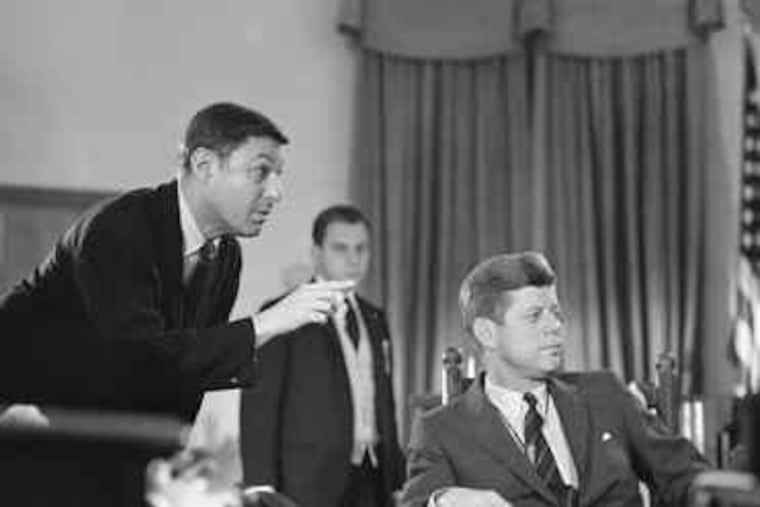
Don Hewitt, 86, who created
60 Minutes
and launched television's newsmagazine format, died of pancreatic cancer yesterday in Bridgehampton, N.Y.
The hyperactive Mr. Hewitt worked more than half a century for CBS in a career that began in 1948 in the first flickering light of television news. His death followed by a month the passing of another CBS giant, Walter Cronkite.
Mr. Hewitt remained at the helm of 60 Minutes until his retirement in May 2004, and he retained the title of executive producer of CBS News until his death. A generation of news producers learned from him and saluted him as nonpareil.
"I think for anyone who grew up in my generation of news producers, in the 1970s, two people were hewn into the side of Mount Rushmore - Roone Arledge [of ABC] and Don Hewitt," said Paul Gluck, a longtime Philadelphia television executive and now associate professor of broadcasting, telecommunications, and mass media at Temple University.
"He always had this vision to take traditional television storytelling to a higher and more intricate level," Gluck said.
And he did it not with fancy visuals but with "tight shots, faces, and facts," Gluck said. "He knew that if you could get the facts and the relevant faces and voices, you could tell a good story."
In a statement released yesterday, Leslie Moonves, president of CBS News Corp., said: "In the history of journalism, there have been few who were as creative, dynamic and versatile as Don Hewitt. . . . [He] quite literally invented so many of the vehicles by which we now communicate the news."
Donald Shepard Hewitt was born Dec. 14, 1922, in New York City, the son of an advertising salesman for Hearst newspapers, and grew up in nearby New Rochelle. He entered New York University on a track scholarship in 1940 but dropped out after a year to take his first job as a $15-a-week copyboy for the old New York Herald Tribune.
When World War II began, he joined the Merchant Marine and was sent to London, where he wrote for Stars and Stripes, the U.S. military newspaper.
After the war, he sped through a succession of short-term wire-service and newspaper jobs. In 1948, he found his lifetime working home at CBS.
His rise was rapid. Within two years, he was producing and directing CBS's 15-minute nightly newscast, Douglas Edwards With the News. He produced the coverage of the coronation of Queen Elizabeth II in 1953 and the installation of Pope John XXIII in 1958.
In 1960, Mr. Hewitt produced and directed the momentous first presidential debate between John F. Kennedy and Richard M. Nixon. In 1962, when Walter Cronkite replaced Edwards as the anchor of the renamed CBS Nightly News, Mr. Hewitt was his producer.
Mr. Hewitt's freewheeling, flamboyant style put him at odds with Fred Friendly, the conservative president of CBS News. In 1964, Friendly took Mr. Hewitt off the Nightly News and shunted him off to do documentaries.
"Fred thought I was too glitzy," Mr. Hewitt said, "that I wasn't serious enough. It was devastating at the time. I had my legs cut off."
"Don was fighting for his professional life at that moment," said his longtime associate Mike Wallace.
Out of the ashes, Mr. Hewitt rose like a phoenix. Taking Life magazine as his model, he devised the 60 Minutes format of three reports per episode: a hard-news story, a feature, and an investigative piece. He also thought up the show's introduction, the ticking stopwatch.
Mr. Hewitt's managerial style was unorthodox: no staff meetings, no memos, no assignment desks. Story ideas came from ad-hoc meetings and hallway conversations.
After giving a green light to start work on a story, Mr. Hewitt did nothing else with it until he screened the finished product, critiquing it with a master's eye and ear and a field general's bluntness. He wrote the teasers at the top of the show and the on-air promos.
His correspondents, whom he called his "repertory company," spoke of him in tones that bordered on awe.
"Don is close to genius when it comes to television," Andy Rooney said.
"He has the magic," Dan Rather said. "There's something mystical about his judgment."
"He probably has a better understanding of why people watch TV than anybody I know," Morley Safer said. "His instincts are superb."
But nobody's perfect. The two most criticized sequences in the long run of Mr. Hewitt's 60 Minutes popped up unexpectedly in the 1990s.
In 1995, Wallace and producer Lowell Bergman teamed up on an interview with Jeffrey Wigand, a former vice president of Brown & Williamson who became an informant about the tobacco giant's business practices. Fearing a lawsuit by B&W, CBS brass killed the story.
A 1999 movie, The Insider, in which Christopher Plummer played Wallace and Philip Baker Hall portrayed Hewitt, depicted them as caving in to corporate pressure. Wallace was furious, but Mr. Hewitt took the film in stride.
Referring to the story's suppression, Mr. Hewitt told PBS's American Masters series in 1998: "I was very unhappy about the decision. I didn't have the power to change it. I was forbidden to do that story.
"It was not my proudest moment," he concluded. "I was sometimes a bowl of Jell-O."
In 1998, Wallace interviewed Dr. Jack Kevorkian, nicknamed "Dr. Death" after he assisted in the suicides of more than 130 people. Kevorkian showed a video of himself administering a lethal injection to Thomas Youk, 52, of Waterford, Mich., terminally ill with amyotrophic lateral sclerosis, Lou Gehrig's disease. Youk died on camera.
Offsetting these controversies were two coups 60 Minutes aired about President Bill Clinton.
In 1992, during the presidential primaries, Clinton appeared on the show with his wife, Hillary, to deny he had had an extramarital affair with Gennifer Flowers. In 1998, Kathleen Willey aired her accusation that Clinton had made a sexual advance toward her in 1993, the year he was inaugurated.
From start to finish, Mr. Hewitt's credo remained the same. "I believe," he said, "it all comes down to that ancient phrase: 'Tell me a story.' "
Mr. Hewitt won virtually every honor available in his craft, including multiple Emmy Awards, induction into the Television Academy Hall of Fame, and, ironically, the 2000 Fred Friendly First Amendment Award.
Mr. Hewitt was married three times. His first wife, Mary, with whom he had two sons, Jeffrey and Steven, died in 1963. He was divorced from his second wife, Frankie, with whom he had a daughter, Lisa. He also adopted Frankie Hewitt's daughter, Jilian Childers Hewitt. In 1979, he married journalist Marilyn Berger, who survives him, along with his four children and three grandchildren.
Services will be private.