Irving Penn, 92, master photographer
Irving Penn, 92, a grand master of American fashion photography whose "less is more" aesthetic combined with startling sensuality defined a visual style he applied to designer dresses or fleshy nudes, famous artists or tribal chiefs, cigarette butts or cosmetics jars, many of them now-famous photographs owned by leading art museums, has died.
Irving Penn, 92, a grand master of American fashion photography whose "less is more" aesthetic combined with startling sensuality defined a visual style he applied to designer dresses or fleshy nudes, famous artists or tribal chiefs, cigarette butts or cosmetics jars, many of them now-famous photographs owned by leading art museums, has died.
Mr. Penn died yesterday at his New York apartment, according to his brother, film director Arthur Penn.
He became a Vogue contributor in 1943 and was one of the first photographers to cross from commercial to art photography, using the same technique no matter what he photographed - isolating his subject, eschewing props, and building perfection through his printing process.
"In Penn's photographs, generations of brilliant artists and lovely young women are endowed with dignity for their enduring moment," fashion critic Kennedy Fraser wrote in a 2007 Vogue magazine tribute to Mr. Penn at 90.
He was a purist who mistrusted perfect beauty, which brought an engaging tension to his fashion photographs as well as his still lifes and portraits. Among his most familiar photographs are ads he shot for Clinique that have appeared since 1968. Each is a balancing act of face-cream jars, astringent bottles, and bars of soap, photographed at close range to suggest the monumental scale of Pop-art soup cans and baseball bats.
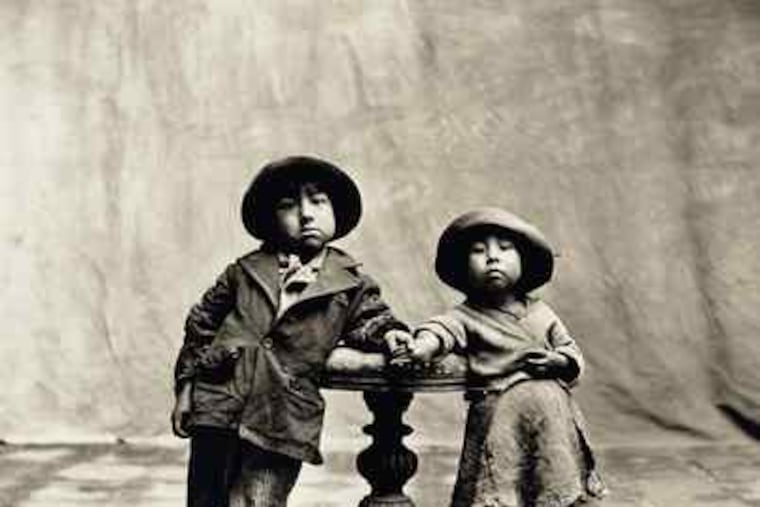
From the time he began his career, Mr. Penn's personal interests took him far afield, carrying his own portable studio and photographing Peruvians in native dress, veiled Moroccan women, and the Mudmen of New Guinea. Many of these photographs are collected in books that are luxurious objects in their own right.
Despite an obvious appreciation for the art and craft of a beautifully made dress, Mr. Penn strained against fashion's confines. In the late '60s, he started photographing crushed cigarette butts and street debris in rich closeups. The change in subject matter only proved how well-suited he was to couture's labor-intensive detail and attention to style. Farsighted reviewers praised his ability to turn discarded objects into art.
For years he wore jeans, work shirts, and sneakers everywhere. "He considered himself a workman," photography historian Diana Edkins said. "His uniform was his way of saying, 'I may be king of fashion photography, but I'm not going to play that game.' "
Born in Plainfield, N.J., in 1917, Irving Penn was the son of a watchmaker and a nurse. Aspiring to be a painter, he studied from 1934 and 1938 at the Pennsylvania Museum School of Industrial Art (later Philadelphia College of Art, now University of the Arts). His most influential teacher was the designer Alexey Brodovitch, longtime art director of Bazaar, who took him on as an unpaid assistant.
His first fashion photo was a still life with scarf, gloves, leather bag, fruit, and a topaz. In October 1943 it became Vogue's first-ever still-life cover; he went on to shoot more than 150 Vogue covers.
Maria Morris Hambourg, a photography curator at the Metropolitan Museum of Art, predicted in 1990 that "after the end of this century when we look back at what was done in fashion, Penn will be at the top of the heap."
His wife of 42 years, model and sculptor Lisa Fonssagrives, died in 1992. Survivors include a son, stepdaughter, and grandchildren.