A St. Christopher's pioneer on ailment
In a 1995 Inquirer interview, Angelo M. DiGeorge was enthusiastic that, after more than 30 years, his work on a Chromosome 22 disorder was "becoming more fascinating all the time."
In a 1995 Inquirer interview, Angelo M. DiGeorge was enthusiastic that, after more than 30 years, his work on a Chromosome 22 disorder was "becoming more fascinating all the time."
"We've been seeing these problems and been asking questions for so many years. Now we're getting some answers."
Few might have better known.
Dr. DiGeorge's research into the genetic disorder - described in a 1965 edition of the journal Nature - had been persuasive enough that the condition, which occurs in one in 4,000 live births, is known as DiGeorge syndrome.
Last Sunday, Dr. DiGeorge, 88, a retired endocrinologist at St. Christopher's Hospital for Children, died of kidney failure at his home in East Falls.
Although the effect of DiGeorge syndrome is mild, in some cases it can cause problems, the 1995 article reported. Among them are heart malformations, facial abnormalities, and an underdeveloped or missing thymus gland, which can cause immune problems.
Dr. DiGeorge's son Christopher said that "most, but not all, of the affected individuals have a specific section of Chromosome 22 deleted."
The achievement, his son said, was "his groundbreaking discovery of the role of the thymus gland in human immunologic function."
Dr. DiGeorge was the primary author of the Nature article, along with Harold Lischner and Hope Punnett.
Iraj Rezvani, who followed Dr. DiGeorge as endocrinology and metabolism chief at St. Christopher's, said Friday that "pediatricians in the '50s and '60s were radiating the thymus . . . to kill it."
But Dr. DiGeorge's research, Rezvani said, showed that "it had a major role in cellular immunity. That understanding was very critical."
The further impact of that research was described Friday by Tony J. Simon, an associate professor of psychiatry and behavioral sciences at the University of California, Davis.
Many people affected by the syndrome, he said, "have great difficulty in learning a lot of things - issues of space and time and numbers - the nonverbal kind."
"It makes it difficult to succeed in school and live independently," Simon said, though "some people do quite well and go on to college."
Dr. DiGeorge, he said, "identified some of the major features that later we came to understand were caused by a deletion on the 22d chromosome."
Besides his work on the disorder, his son said, Dr. DiGeorge was for several decades the primary author of the endocrinology chapter for periodic editions of the Nelson Textbook of Pediatrics.
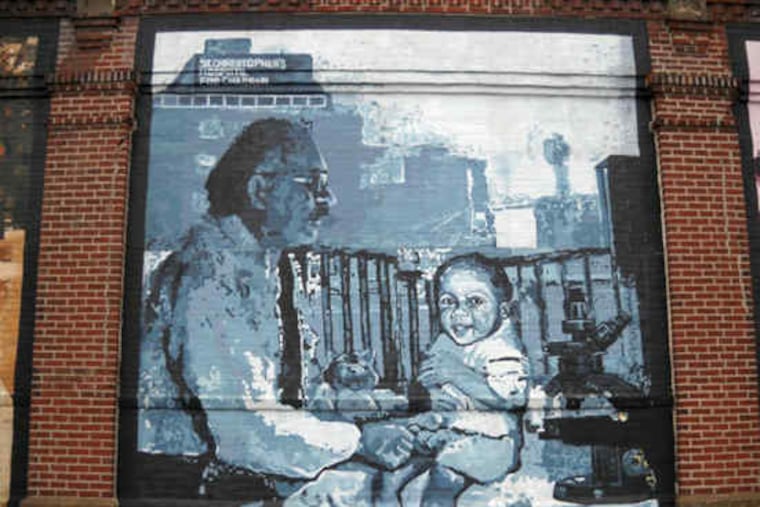
Dr. DiGeorge's street credentials were established in 2005 when the Philadelphia Mural Arts Program placed his portrait on an outdoor wall of St. Christopher's.
And in 2006, the hospital dedicated its main auditorium as the Angelo M. DiGeorge Teaching Center.
A 1939 graduate of South Philadelphia High School for Boys, he received a White Williams scholarship to Temple University, where he earned a bachelor's degree in chemistry in 1943 and a medical degree with honors in 1946.
During his 1947-49 military service, he was chief of medical services at an Army hospital in Linz, Austria. He then returned for a 1952 master's degree in pediatrics from Temple.
In 1952, he became an assistant attending pediatrician and endocrinologist at St. Christopher's and in 1953 a pediatrics instructor at Temple.
From 1961 to 1989, he was endocrinology and metabolism chief at St. Christopher's and from 1967 to 1991 a pediatrics professor at Temple.
In 1972, he was a founding member of the Lawson Wilkins Pediatric Endocrine Society, a physicians organization, and in 1983-84 was its president.
The Philadelphia Pediatric Society named him to its hall of fame in 1996, the same year that the Temple University School of Medicine made him its alumnus of the year.
Besides his son Christopher, he is survived by his wife of 58 years, Natalie; another son, Anthony; a daughter, Anita Brister; a sister; and six grandchildren.
A Memorial Mass will be said at 4 p.m. Friday at Immaculate Heart of Mary Church, 819 E. Cathedral Rd., in the city's Andorra section.