Reclusive author spoke for alienated youth
J.D. Salinger, 91, in whose fiction anguished adolescents search for their place in the world, died Wednesday in Cornish, N.H., where he had long lived in hermetic isolation.
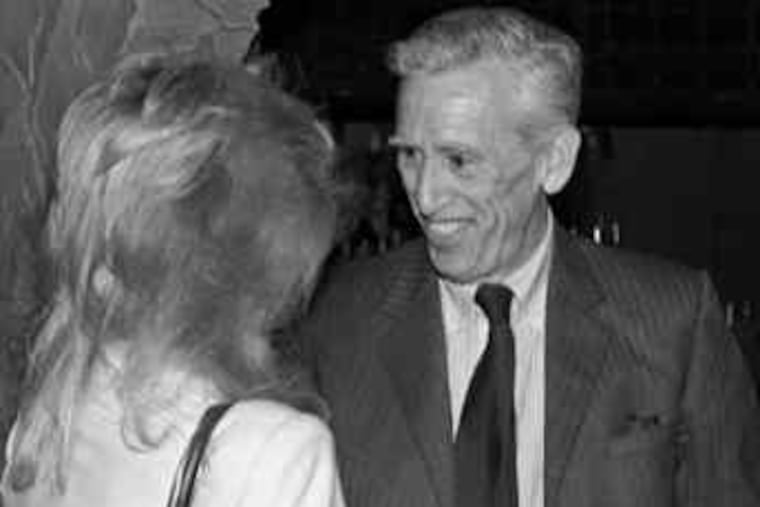
J.D. Salinger, 91, in whose fiction anguished adolescents search for their place in the world, died Wednesday in Cornish, N.H., where he had long lived in hermetic isolation.
His work - especially the 1951 novel The Catcher in the Rye - has influenced generations of American fiction. His stories captured the predicament of a disaffected, anxious generation growing up after World War II, and his themes and shifting style - now laconic, now biting, now comic, now sad, now coarse, now poetic - had many imitators.
Jerome David Salinger was born in New York City. He was a troubled and troublesome student. Among the schools he attended was the Valley Forge Military Academy (1934-36), where he worked on the newspaper and yearbook and, he later said, started writing stories while holding a flashlight under the covers. The academy may have been the basis for Pencey Prep in Catcher.
After dropping out of New York University, he worked at a slaughterhouse in Bydgoszcz, Poland, and left disgusted. He worked for 10 months for a meat-processing company in Vienna, Austria, leaving the country shortly before its 1938 annexation by Adolf Hitler. He also attended Ursinus College for a semester in 1938, writing a column for the school newspaper. His first stories appeared in 1940.
His World War II years proved formative. He fought in some of the most important battles of the war, landing at Utah Beach with the 12th Infantry Regiment of the Fourth Infantry Division and fighting in the battles of Normandy, St. Lo, Mortain, Hürtgen Forest, and the Bulge. He was among the first troops to enter liberated Paris - where he met fellow writer Ernest Hemingway. Astonishingly, Mr. Salinger, who brought a typewriter everywhere he went, continued to write and publish stories throughout the war.
His fluency in German and French made him useful for interrogating prisoners. He met prisoners of war and entered camps of the Dachau system. Later, he said the experience may well have scarred him. His story "For Esmé, With Love and Squalor" features a soldier who apparently has post-traumatic stress disorder, and many believe it is a self-portrait. Shell shock and fears of mental illness crop up frequently in his writing. Holden Caulfield narrates Catcher in the Rye from a mental facility.
Mr. Salinger published stories featuring Holden in several places in the 1940s, pulling them together in Catcher in the Rye and beginning one of the oddest and most mysterious careers in American literature. Catcher's central figure, Holden, encounters the perplexities, hypocrisy, and ugliness of adult life, and tries to protect his sister, Phoebe, whom he sees as an innocent threatened by a polluting world (a central Salinger obsession). In this novel of disaffection, protest, and anxiety, Holden emerged as one of the most unforgettable voices since Huck Finn.
The book was gritty and adventurous for its time: Some critics were shocked by its language and called it perverted or pornographic. It was a perennial target of local library censorship efforts into the 1980s, and remains widely read and taught.
In capturing the balked outcry of isolated young-adult misfits, Catcher caught something afoot in the 1950s, reflected in films such as The Wild One and Rebel Without a Cause, and in the rise of youth culture and rock-and-roll. And those themes keep reverberating, through films such as The Graduate and The Breakfast Club, through the work of writers as different as Curtis Sittenfeld and Jeffrey Eugenides.
Kerry Sherin Wright, director of the Philadelphia Alumni Writers House at Franklin and Marshall College in Lancaster, says, "He was showing us the postwar generation from a very different angle. We hear Tom Brokaw talking about a 'greatest generation,' but Salinger was saying, 'We saw things you don't want to see. We don't feel like heroes. We don't buy what they're selling us about America.' You can see why he became a voice for several generations."
The Pulitzer Prize-winning novelist Michael Chabon read the book, as so many do, when he was in middle school. He says it had a great impact on him, mostly because "it had such a recognizable authenticity in the voice that even in 1977 or so, when I read it, felt surprising and rare in literature."
The next Salinger success was Nine Stories, a 1953 collection that stayed on best-seller lists for months. Several stories concerned the Glass family, Les and Bessie (two old-time vaudevillians) and their seven children, an assortment of tortured, out-of-place, idiosyncratic souls - Franny, Zooey, Waker, Buddy, Boo-Boo, Walt, and the brilliant, doomed Seymour. The Glass family saga continued with Franny and Zooey (1961), and "Raise High the Roof Beam, Carpenters" and "Seymour: An Introduction" (1963). The latter book was one of the biggest U.S. sellers of that year.
Mr. Salinger's is one of the most celebrated silences in literary history. Hating the demands of notoriety, he withdrew from New York literary life, ultimately retreating to Cornish for good in 1953. There he created a kind of personal compound, patrolling around in his Jeep and avoiding the public eye. His last published work was a Glass family novella, "Hapworth 16, 1924," in the New Yorker in 1965. For the next 45 years he wrote and wrote, reportedly completing several novels but never publishing.
His relations with the media, the publishing industry, family members, and other writers were fitful and often bad. He didn't answer fan mail and gave few interviews. Married briefly in the 1940s, he wed Claire Douglas in 1955; they had two children together and were divorced in 1967. Stories and rumors came and went of love affairs, varied religious practices (at various times, he was into Buddhism, macrobiotics, and Christian Science), and/or promised novels or stories. One especially durable rumor, never confirmed, concerns a secret safe holding Salinger manuscripts.
He was remarkably protective of his creations. Once he was famous, he refused to let U.S. publishers depict his characters on book jackets. After his story "Uncle Wiggly in Connecticut" was made into the 1949 film My Foolish Heart, he was so displeased he never again allowed a film to be made of his fiction. That explains why Catcher in the Rye, one of the best-known works of 20th-century American fiction, has never been made into an authorized film.
He repeatedly sued to block publication of adaptations or sequels, including a Swedish novel and an Iranian film. He also wrangled with would-be biographers. When Ian Hamilton announced a book containing Salinger letters, Mr. Salinger sued, and a court ruled he held the copyright to his letters as he did to his literary works. Hamilton was forced to paraphrase. Mr. Salinger also battled former love Joyce Maynard and even his own daughter, Margaret, when they published memoirs.
What cannot be disputed is that his novel, novellas, and short fiction have influenced half a century of writers, including Philip Roth, John Updike, Sylvia Plath, and contemporary writers from Jay McInerney to Dave Eggers. Wright, who teaches Catcher in the Rye in her courses - "Who doesn't want to teach it? It's just so extraordinary" - says, "The work has a life of its own. It's incredibly American."
This reclusive man, who fled the public eye, identified deeply with his young characters. "Some of my best friends are children," Mr. Salinger once wrote. "In fact, all of my best friends are children." Catcher may be a little dated. Yet a freshness remains in Holden's direct, slang-spangled American voice. And since many of us must go through what Holden goes through - frightened young adult, unwilling to let go of childhood, faced with the cul-de-sac fakery of the adult world - every generation has to rewrite Huck, and with him, Holden.
A Taste of Salinger
If you really want to hear about it, the first thing you'll probably want to know is where I was born, and what my lousy childhood was like, and how my parents were occupied and all before they had me, and all that David Copperfield kind of crap, but I don't feel like going into it, if you want to know the truth.
- The Catcher in the Rye (1951)

I'm the most terrific liar you ever saw in your life. It's awful. If I'm on my way to the store to buy a magazine, even, and somebody asks me where I'm going, I'm liable to say I'm going to the opera. It's terrible.
- The Catcher in the Rye
Sex is something I really don't understand too hot. You never know where the hell you are. I keep making up these sex rules for myself, and then I break them right away. Last year I made a rule that I was going to quit horsing around with girls that, deep down, gave me a pain in the ass. I broke it, though, the same week I made it - the same night, as a matter of fact. I spent the whole night necking with a terrible phony named Anne Louise Sherman. Sex is something I just don't understand. I swear to God I don't.
- The Catcher in the Rye
I keep picturing all these little kids playing some game in this big field of rye and all. Thousands of little kids, and nobody's around - nobody big, I mean - except me. And I'm standing on the edge of some crazy cliff. What I have to do, I have to catch everybody if they start to go over the cliff - I mean if they're running and they don't look where they're going I have to come out from somewhere and catch them. That's all I'd do all day. I'd just be the catcher in the rye and all. I know it's crazy, but that's the only thing I'd really like to be. I know it's crazy.
- The Catcher in the Rye
"All I know is I'm losing my mind," Franny said. "I'm just sick of ego, ego, ego. My own and everybody else's. I'm sick of everybody that wants to get somewhere, do something distinguished and all, be somebody interesting. It's disgusting - it is, it is. I don't care what anybody says."
- Franny and Zooey (1961)
I keep a good neurotic's calendar, and it's three years, to the day, since Seymour killed himself. Did I ever tell you what happened when I went down to Florida to bring back the body? I wept like a slob on the plane for five solid hours. Carefully adjusting my veil from time to time so that no one across the aisle could see me - I had a seat to myself, thank God.
- Franny and Zooey
She was a girl who for a ringing phone dropped exactly nothing. She looked as if her phone had been ringing continually ever since she had reached puberty.
- "A Perfect Day for Bananafish," Nine Stories (1953) EndText
Salinger Book List
The Catcher in the Rye (1951).
Nine Stories (1953).
Franny and Zooey (1961).
Raise High the Roof Beam, Carpenters and Seymour: An Introduction
(1963).
EndText