Benjamin L. Hooks, 85; led NAACP and fought injustice
NASHVILLE - Civil rights leader Benjamin L. Hooks, 85, who shrugged off courtroom slurs as a young lawyer before earning a pioneering judgeship and reviving a flagging NAACP, died Thursday in Memphis.
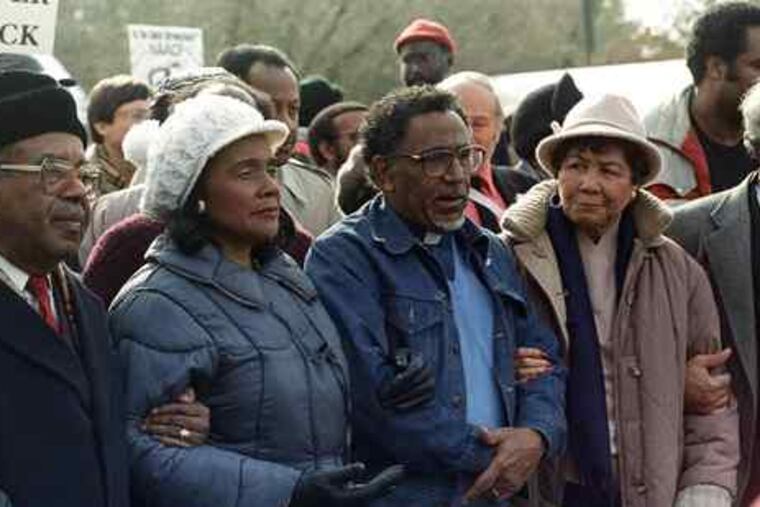
NASHVILLE - Civil rights leader Benjamin L. Hooks, 85, who shrugged off courtroom slurs as a young lawyer before earning a pioneering judgeship and reviving a flagging NAACP, died Thursday in Memphis.
Across the country, political leaders and Dr. Hooks' peers in the civil rights movement remembered his remarkably wide-ranging accomplishments and said he would want the fight for social justice to continue. State Rep. Ulysses Jones, a member of the church where Dr. Hooks was pastor, said that Dr. Hooks died at his home following a long illness.
"Right up to the last, he conveyed . . . the need for us to fight," said NAACP president Benjamin Jealous, recalling a speech Dr. Hooks gave last year. Dr. Hooks "gave a speech as fiery as any he's given 50 years earlier."
Dr. Hooks took over as the NAACP's executive director at a time when the organization's stature had diminished in 1977. Years removed from the civil rights battles of the 1960s, the group was $1 million in debt and its membership had shrunk to 200,000 members from nearly a half-million a decade earlier.
By the time he left as executive director in 1992, the group had rebounded, with membership growing by several hundred thousand. He used community radiothons to raise awareness of local NAACP branches' work and to boost membership.
Dr. Hooks' inspiration to fight social injustice and bigotry stemmed from his experience guarding Italian prisoners of war while serving overseas in the Army during World War II. Foreign prisoners were allowed to eat in "for whites only" restaurants while he was barred from them.
When no law school in the South would admit him, he used the GI bill to attend DePaul University in Chicago, where he earned a law degree in 1948. He later opened his own law practice in his hometown of Memphis.
"At that time you were insulted by law clerks, excluded from white bar associations and when I was in court, I was lucky to be called Ben," he once said in an interview with Jet magazine. "Usually it was just 'boy.' "
In 1965 he was appointed to a newly created seat on the Tennessee Criminal Court, making him the first black judge since Reconstruction in a state trial court anywhere in the South.
President Richard Nixon nominated Dr. Hooks to the Federal Communications Commission in 1972. He was its first black commissioner, serving for five years before resigning to lead the NAACP.
At the FCC, he addressed the lack of minority leadership in media and persuaded the commission to propose a new rule requiring TV and radio stations to be offered publicly before they could be sold. Minority employment in broadcasting grew from 3 percent to 15 percent during his tenure.
In the waning years of his leadership of the NAACP, Dr. Hooks pressed then-President George H.W. Bush for action on a string of gasoline bomb attacks in the South that killed a federal judge in Alabama and a black civil rights lawyer in Georgia in December 1989.
The man later convicted of the killings and other charges remains on Alabama's death row.
President George W. Bush in 2007 presented Dr. Hooks with the Presidential Medal of Freedom, one of the country's highest civilian honors.
"Dr. Hooks was a calm yet forceful voice for fairness, opportunity and personal responsibility," Bush said in 2007. "He never tired or faltered in demanding that our nation live up to its founding ideals of liberty and equality."