Henry Tyler Washington, of the Buffalo Soldiers, dies at 85
HENRY TYLER Washington made it his life's work to tell people about the "Buffalo Soldiers." A proud member of that legendary band of African-Americans who fought in every war from the Indian campaigns of the 19th century through World War II, Vietnam and Iraq, Henry donned his military regalia with all his ribbons and insignia and traveled the country to talk about those soldiers and his own experiences.
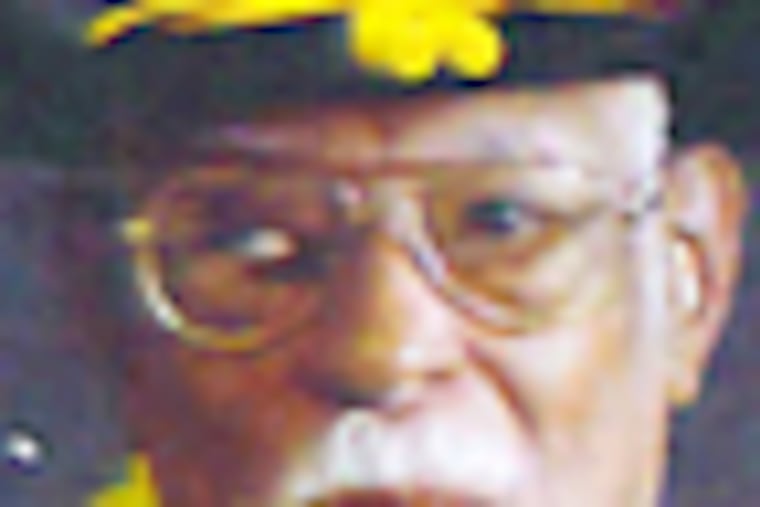
HENRY TYLER Washington made it his life's work to tell people about the "Buffalo Soldiers."
A proud member of that legendary band of African-Americans who fought in every war from the Indian campaigns of the 19th century through World War II, Vietnam and Iraq, Henry donned his military regalia with all his ribbons and insignia and traveled the country to talk about those soldiers and his own experiences.
He talked with young people and military personnel. He visited bases, spoke at universities, military academies, churches, conventions - wherever he could get a receptive audience.
He also marched or rode horses in parades. His mission was to let everybody know what black troops have done for this country.
Henry Washington, who worked mostly in security and law enforcement after his Army service, died Thursday at St. Joseph Manor in Meadowbrook, Montgomery County, after a lengthy illness. He was 85 and lived in Elkins Park.
Although Henry did not fight in any wars, he nevertheless had some dangerous experiences as a member of the 10th Cavalry Regiment, a segregated unit and one of the original Buffalo Soldier regiments.
The 10th was truly a cavalry unit in the early '40s. Henry rode horses and drove horse-drawn wagons over the Western landscape. His job was to deliver supplies to other military units, some scattered many miles from each other.
Working out of Fort Bliss, Texas, he also was assigned to provide security for equipment, horses, payrolls, railroads and utility lines operating in the West.
The Army used horses to get around a landscape that did not offer many easy ways to get over mountains and deserts.
He wrote a book about his experiences with author Shirley B. Collins that recounted many of his adventures, some life-threatening in the unforgiving terrain of the Wild West.
Once while taking part in an operation in the desert of West Texas, he became separated from his unit. He made the mistake of taking a shot at a snake, which spooked his horse. He was pitched into the sands and the horse ran off.
All he had on him was a small amount of water, a compass and matches. For three days and three nights, he endured 100-plus-degree temperatures during the day, and 40 degrees at night. Using the matches, he was able to build fires.
But he was near death when he was spotted by an airplane and rescued. He was malnourished and dehydrated and required weeks in a hospital.
When he returned to duty, his fellow soldiers called him "dead man walking."
His horse, by the way, was found later on an Indian reservation.
Henry was discharged in December 1943, and, using the GI Bill, enrolled at Tuskegee Institute, home of the legendary Tuskegee Airmen, the all-black unit that flew in combat in World War II. There he met a young student named Syliva Jones and they were married shortly afterward.
Henry was born in Culpeper, Va., to Frederick Douglass Washington Sr. and the former Elva Tyler. He went to school there and continued his education when the family moved to Jenkintown. However, he didn't go past the seventh grade.
Among his many civilian jobs, he worked for the Abington Police Auxiliary, Penn State security, the Montgomery County Prison, the United Detective Agency in Willow Grove and other law-enforcement agencies and fire police. He also served as a security guard at his church, Salem Baptist in Jenkintown.
"He was a person who loved to introduce himself to people, to break the ice," said his son Al Washington. "He would say hello to anybody. He was a real people person.
"He was always willing to help people, to lend a hand wherever he was needed. He loved dressing up in his uniform, shining his shoes. He loved everything military."
Thomas said his father was committed to "giving back. He was always trying to enlighten young people about the contributions of African-Americans in the military."
Besides his wife and sons, he is survived by five other sons, Henry Jr., Ulice, Warren, Kenny and Leo; a daughter, Antoinette Robinson; 22 grandchildren, and 22 great-grandchildren.
Services: 11 a.m. Friday at Salem Baptist Church, 610 Summit Ave., Jenkintown. Friends may call at 9 a.m. Burial will be in Washington Crossing National Cemetery.