Dino De Laurentiis, blockbuster producer
LOS ANGELES - Dino De Laurentiis, 91, a prolific movie producer of blockbuster hits such as Serpico, expensive duds such as Dune, and sweeping epics including War and Peace, died Wednesday night at his Beverly Hills home.
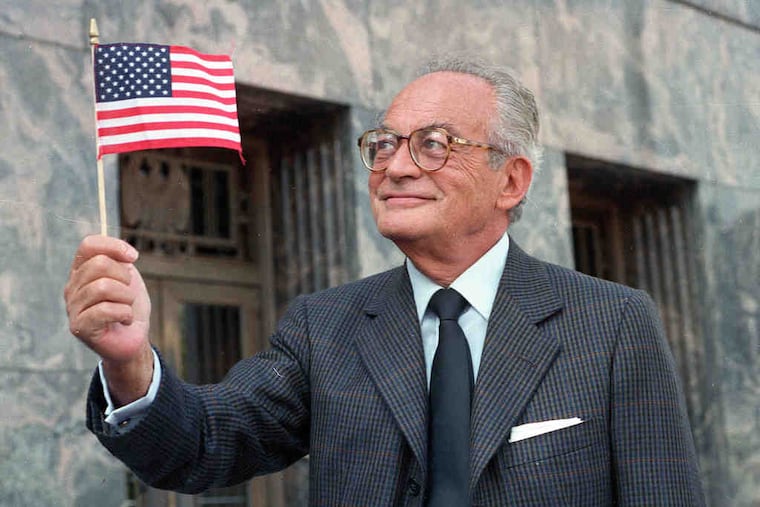
LOS ANGELES - Dino De Laurentiis, 91, a prolific movie producer of blockbuster hits such as Serpico, expensive duds such as Dune, and sweeping epics including War and Peace, died Wednesday night at his Beverly Hills home.
A statement from his daughter Raffaella De Laurentiis did not give a cause of death.
In his native Italy, then in the United States, Mr. De Laurentiis combined marketing flair, an eye for talent, and a fearlessness of failure to produce more than 600 films, some prodigious in scale and ambition, often featuring superstar names in action thrillers.
Agostino De Laurentiis, the third of seven children, was born Aug. 8, 1919, in Torre Annunziata, near Naples. His parents ran a pasta factory. He won his father's permission to study acting at Rome's Centro Sperimentale di Cinematografia. He shortened his name to Dino in his early 20s, when he entered the Italian movie business.
After military service, he was back in Rome in 1944. He founded Dino De Laurentiis Studios in 1947 and had quick success with Bitter Rice (1949), nominated for an Academy Award for best story.
In the 1950s he began the epics that would help define his career. With Carlo Ponti he produced Ulysses (1954), with Kirk Douglas, and War and Peace (1956), with Audrey Hepburn and Henry Fonda, nominated for three Academy Awards.
Two films he produced during a seven-year collaboration with Ponti - La Strada, which Federico Fellini directed, and Nights of Cabiria - won back-to-back Academy Awards for best foreign-language film in 1956 and 1957.
Mr. De Laurentiis made a giant impact on how the movie business staged, promoted, and financed big-budget, big-name spectacles. Rather than work for Hollywood studios, he sold his productions directly to distributors in the United States and around the world. That made him one of the first global film producers.
In 1962, Mr. De Laurentiis bought land in Rome and, with government subsidies, built Dinocittá - "Dino City" - a sprawling production studio that opened in 1964. Among the movies he made there was Barbarella (1968), a sci-fantasy film that featured Jane Fonda in various states of erotic dress and undress.
But Mr. De Laurentiis would later call Dinocittá "the only mistake I've made in my life." In the early 1970s it failed, leaving him millions of dollars in debt. He decamped with his family to New York and quickly made his losses back. Immediate success came with a trio of hit law-and-order movies: Serpico (1973) starring Al Pacino; Death Wish (1974) starring Charles Bronson; and Three Days of the Condor (1975), with Robert Redford and Faye Dunaway. He became a U.S. citizen in 1986.
In a $25 million remake of King Kong in 1976, he gave a starring role to a model and first-time actress, Jessica Lange. A critical flop but a box-office success, it won an Academy Award for visual effects. Conan the Barbarian (1982) marked the acting breakthrough of Arnold Schwarzenegger, the Austrian bodybuilder who later became governor of California.
In 1983, Mr. De Laurentiis built what later became the EUE/Screen Gems Studios in Wilmington, N.C. He seemed on his way to assembling an entertainment conglomerate when he acquired Embassy Pictures from Coca-Cola Co., formed the De Laurentiis Entertainment Group, and, in 1986, took the company public. But after a series of big-budget flops, including David Lynch's sci-fi thriller Dune (1984), the company filed for bankruptcy protection in 1988.
He never stopped producing movies. He ran Dino De Laurentiis Co. with his third wife, the former Martha Schumacher, once an administrative assistant in his New York offices.
In 2001, at 82, he showed he could still make hits when he combined with director Ridley Scott and actor Anthony Hopkins on Hannibal, the smash sequel to 1991's The Silence of the Lambs. The Academy of Motion Picture Arts and Sciences presented him with the Irving Thalberg Memorial Award in 2001 for his body of work.
Survivors include five daughters by two marriages and a granddaughter, Giada De Laurentiis, the TV Food Network star.