Miguel Ficher, 89, researcher in endocrinology and music
Miguel Ficher was a research chemist at hospitals in St. Louis and Philadelphia, but a 1995 article in The Inquirer profiled him foremost as a musical researcher.
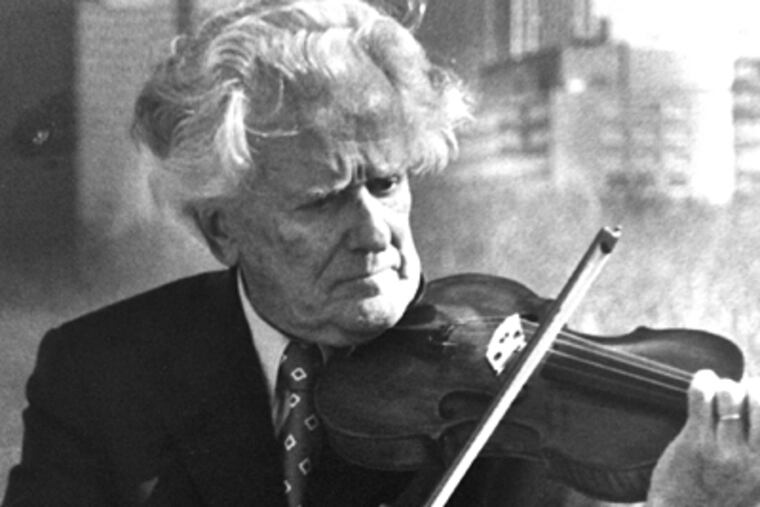
Miguel Ficher was a research chemist at hospitals in St. Louis and Philadelphia, but a 1995 article in The Inquirer profiled him foremost as a musical researcher.
After all, the story reported, he was the son of Jacobo Ficher, "the Russian-Argentine composer and conservatory director of enormous prominence in Argentina."
Because of that heritage, music critic Daniel Webster wrote, Dr. Ficher set out in 1987 "to create a dictionary of Latin American classical composers to complete the pantheon in which his father would be a prominent member."
The result, published by Scarecrow Press in 1996, was Latin American Classical Composers: A Biographical Dictionary. He was one of three editors, with Martha Furman Schleifer and John M. Furman.
On Thursday, Nov. 3, Dr. Ficher, 89, died of chronic leukemia at Thomas Jefferson University Hospital.
When he arrived from Argentina in 1961, Webster wrote, "Ficher's realization that serious Latin American music did not cross the borders into the United States was a source of regret, but not a trumpet call to action."
He needed to focus on his hospital jobs, to support his wife and their three daughters.
But in 1987, when he retired from Thomas Jefferson University Hospital, where he had been doing research in endocrinology as it pertained to male fertility, Webster wrote, Dr. Ficher began to wonder about his father's legacy.
And the legacy of others.
"Who can name Chile's best known composer?" Webster said Dr. Ficher wondered. "Who is writing music in Guyana, Suriname, Colombia and Brazil? And who was writing music in 1791 and 1814 . . .? He began to feel an indebtedness . . . to a world that had attracted his father to leave Russia and which had nurtured his father's music."
The Ficher house in Old City, Webster wrote, became a meeting place for young Latin American composers visiting in this country. They could supply more names, background, leads, and sometimes verifications.
A daughter, Dora, said in a phone interview that the book did not satisfy his love of classical music.
In his retirement, she said, he was a violinist in an amateur chamber music group, a member of the Music Fund Society of Philadelphia, and, from 2005 to 2009, president of the Mary Louise Curtis branch of the Settlement Music School in Queen Village.
Born in Buenos Aires, Dr. Ficher earned a master's degree at the University of Buenos Aires' School of Science in 1946 and a doctorate in chemistry there in 1950.
His dual identity manifested itself in Buenos Aires as a classical-music violinist and an orchestral conductor, his daughter said.
He earned a fellowship in 1961 and moved with his wife and three daughters to what is now the Barnes-Jewish Hospital of Washington University in St. Louis.
After two years, they returned to Argentina, but, he told Webster, "we couldn't adapt again to life in Buenos Aires, so I came back to the United States," to work at what is now Albert Einstein Medical Center.
Webster wrote that "he continued a life of research at Einstein, St. Christopher's Hospital, Eastern Pennsylvania Psychiatric Institute and finally Thomas Jefferson University."
But Dr. Ficher was sanguine about what was found in the years spent on the composers' dictionary.
"The eight years of sleuthing have turned up names of composers of deep significance within their countries," Webster wrote, but also "composers whose output may amount to little more than a few hymns."
All now documented.
Besides his daughter Dora, Mr. Ficher is survived by his wife, Ilda, daughters Claudia Beckerman and Tamar Port, five grandchildren, and two great-grandchildren.
A memorial service was set for 1:30 p.m. Sunday, Nov. 13, at Congregation Rodeph Shalom, 615 N. Broad St., Philadelphia.